|
Cybertelecom Federal Internet Law & Policy An Educational Project |

|
Net
Neutrality FCC Policy Statements |
|
|
|
"How do you think they’re going to get customers? Through a broadband pipe. Cable companies have them. We have them. Now what they would like to do is use my pipes for free, but I ain’t going to let them do that because we have spent this capital and we have to have a return on it. So there’s going to have to be some mechanism for these people who use these pipes to pay for the portion they’re using. Why should they be allowed to use my pipes? The Internet can’t be free in that sense, because we and the cable companies have made an investment and [for] a Google or Yahoo! or Vonage or anybody to expect to use these pipes for free is nuts!” - SBC (aka AT&T) CEO Edward Whitacre Interview of Ed Whitacre, BusinessWeek November 7, 2005
"Infrastructures, for purposes such as transportation and communication, have long been vital to national welfare. They knit together a country's economy by facilitating the movement of people, products, services, and ideas, and play important roles in national security." - NSFNet Final Report
p. 4.
Short History of Network Neutrality
The commercial Internet is launched in the 1990s, momentously with the privitization of the NSFNET in 1995. This was the dial-up era where residential end users could reach multiple ISPs over a common carrier network. According to Prof. Shane Greenstein, by the late 1990s the average end user had a choice of ten local ISPs that it could reach over the telephone network. Switching costs were low; different ISPs could be accessed over the same telephone network using the same modems. The provision of inferior or discriminatory service was disciplined by a competitive market in which end-users could easily switch ISPs. Even AOL which started the decade with a walled-garden proprietary network service had to conceded to market demands and revise its business plan to become an Internet service provider. The dial-up era was guided by the policy of the Computer Inquiries which sought to ensure an open network platform and prevent discimination by the carrier.
The economics changed with the introduction of the broadband era. No longer was the end user provided with two services: a common carrier service and an internet service. Now the network service provider bundled communications network and Internet access into one service known as Broadband Internet Access Service. The market consolidated and end-users had a choice of one, maybe two wireline broadband Intertnet access services. ISPs captured larger market share; Comcast eventurally reached 24 percent of the end-user market. This represented a sizable portion of any edge-providers business plan; if the edge-provider wanted access to that end-user market share, the endge provider would have to negotiate with the BIAS provider. Switching costs (to the extent that a customer could switch) rose as different ISPs involved different physical networks with different installations and different customer equipment. Bundling of ISP service with telephone and cable service also make the service more sticky. In this environment, discriminatory behavior on behalf of BIAS providers could no longer be disciplined by a competitive market of ISPs and end-users switching providers. By now, use of the Internet had matured and been integrated into every part of life and become critical infrastructure; disruption or impairment of service could be costly.
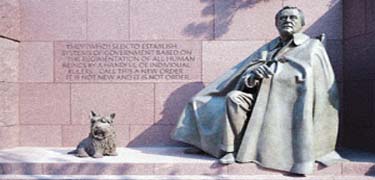
See FDR Four Freedoms | Audio | Text | Four Freedoms Poster | FDR MemorialFCC Chair Powell advocated during his tenure for facilities based broadband competition. When it was clear to him that there was a risk this was not going to happen, he released his Four Freedoms Network Neutrality principles.
Under Chair Kevin Martin, these principles were revised and released in an order as a part of the FCC's DSL proceeding declaring Internet over DSL an information service. The FCC sought to enforce these statements against Comcast, however the enforcement action was overturned by the D.C. Circuit court.
In 2010, Chair Genachowski released Open Internet rules which sought to rely on Sec. 706 authority, imposing common carriage obligations forbidding discrimination without declaring that BIAS providers are common carriers; the appellate court overturned the rules concluding that the FCC cannot declare that BIAS providers are not common carriers on the one hand and treat them like common carriers on the other. According to the Communications Act, the FCC faced a binary decision; if it wanted to impose non-discrimination obligations consistent with common carriage, it had to declare that BIAS providers are common carriers (it had to place them under Title II of the Communications Act). If it did not place BIAS providers under title II, it could not impose the non-discrimination obligations at the heart of network neutrality. In both the Open Internet context and the VoIP context, the FCC has long sought to avoid imposing title II obligation on the Internet. Over the years, new legal authority tailored to the Internet has been repeatedly introduced in Congress but never passed, leaving the FCC with the conundrum of using poorly fitting title II as the only authority available to achieve network neutrality.
In 2015, Chair Wheeler released revised Open Internet rules, pursuant to the appellate court remand, concluding that BIAS providers are common carriers and imposing non discrimination obligations, placing BIAS providers under title II of the Communications Act. The FCC used forbearance authority to impose only those title II obligations consistent with network neutrality policy objectives; outdated or poorly fitting obligations were generally not applied to BIAS providers. These Open Internet rules were affirmed by the Appellate Court for the first time.
In 2017, Chair Pai announced his plan to repeal and replace the Open Internet rules, declaring that it was a mistake to use title II authority to achieve network neutrality.
Policy Ch. Pai 2017 Open Internet NPRM Open Internet Rules 2015 Framework for Broadband Internet NOI (Third Way) National Broadband Plan Sec. 4.4 Network Neutrality Order 2010 (remanded by D.C. Cir) Joint Petition for a Declaratory Ruling that Text Messages are a Title II Service and fall under anti discrimination provisions. Comments Due Feb. 13, 2008. Replies Due Mar. 14. Broadband Connectivity Competition Policy , FTC Staff Report, (June 2007) Broadband Market Practices SKYPE petition with the FCC arguing that Part 68 CFR, also known as the Carterfone Decision, should apply to wireless telecommunications networks Service Rules for the 698-746, 747-762 and 777-792 MHz Bands et al. , Second Report and Order, 22 FCC Rcd 15289, 15364 paras. 203-204 (2007); 47 C.F.R. § 27.16 Internet over DSL 2005 which included the Policy Statement on Broadband Internet Access and the Consumer Protection in the Broadband Era NPRM Enforcement "a 2008 Order against Comcast for interfering with peer-to-peer file sharing, which the Commission found “contravene[d] . . . federal policy” by “significantly imped[ing] consumers’ ability to access the content and use the applications of their choice.”" Formal Complaint of Free Press and Public Knowledge Against Comcast Corporation for Secretly Degrading Peer-to-Peer Applications; Broadband Industry Practices; Petition of Free Press et al. for Declaratory Ruling that Degrading an Internet Application Violates the FCC's Internet Policy Statement and Does Not Meet an Exception for “Reasonable Network Management,” File No. EB-08-IH-1518, WC Docket No. 07-52, Memorandum Opinion and Order, 23 FCC Rcd 13028, 13054, 13057, paras. 44, 49 (2008) Madison River Alleged to have Blocked Vonage Calls (resolved through settlement) Madison River Communications, File No. EB-05-IH-0110, Order, 20 FCC Rcd 4295 (Enforcement Bur. 2005) (Ch. Powell calls for protection of "open Internet" through consumer protection norms and enforcement) Funding BTOP Funding Conditions 2010 Mergers Comcast / NBC Merger: agreed to abide by Open Internet 2010 obligations until 2018. Applications of Comcast Corporation, General Electric Company and NBC Universal, Inc. for Consent to Assign Licenses and Transfer Control of Licenses, MB Docket No. 10-56, Memorandum Opinion and Order, 26 FCC Rcd 4239, 4275, para. 94 & n.213 (2011) AT&T agreed to be bound by the Network Neutrality principles as a part of AT&T / Bell South Merger Conditions. AT&T Inc. and BellSouth Corp. Application for Transfer of Control , Memorandum Opinion and Order, 22 FCC Rcd 5662, 5663, para. 2, 5727-28, para. 119 (2007)
The Network Neutrality provisions were integrated into the merger conditions of (these merger conditions expired October 2007):
- SBC Commc'ns, Inc. and AT&T Corp. Applications for Approval of Transfer of Control , Memorandum Opinion and Order, 20 FCC Rcd 18290, 18392, para. 211& Appx F. (2005);
- Verizon Commc'ns Inc. and MCI, Inc. Applications for Approval of Transfer of Control , Memorandum Opinion and Order, 20 FCC Rcd 18433, 18537, para. 221 (2005)
Time Warner and Comcast acquisition of Adelphia (2005) (shout out to Harold Feld for point this out) para 223: "The Commission held out the possibility of codifying the Policy Statement's principles where circumstances warrant in order to foster the creation, adoption, and use of Internet broadband content, applications, services, and attachments, and to ensure consumers benefit from the innovation that comes from competition. Accordingly, the Commission chose not to adopt rules in the Policy Statement. This statement contains principles against which the conduct of Comcast, Time Warner, and other broadband service providers can be measured. [emphasis added] Nothing in the record of this proceeding, however, demonstrates that these principles are being violated by Comcast or Time Warner or that the transactions before us create economic incentives that are likely to lead to violations. Additionally, the vigorous growth of competition in the high-speed Internet access market further reduces the chances that the transactions are likely to lead to violations of the principles." Applications for Consent to the Assignment and/or Transfer of Control of Licenses, Adelphia Communications Corporation, (and Subsidiaries, Debtors-In-Possession), Assignors, to Time Warner Cable Inc. (Subsidiaries), Assignees, Adelphia Communications Corporation, (and Subsidiaries, Debtors-In-Possession), Assignors and Transferors, to Comcast Corporation (Subsidiaries), Assignees and Transferees, Comcast Corporation, Transferor, to Time Warner Inc., Transferee, Time Warner Inc., Transferor, to Comcast Corporation, Transferee, MB Docket No. 05-192, Memorandum Opinion and Order, 21 FCC Rcd 8203, 8299, para. 223 (2006)
A precursor to the NN debate is the Open Access debate - this argument was put forth largely by independent ISPs who had plentiful access to consumers over the dial up networks, but knew that they would have difficulty getting access to consumers over closed broadband networks. Independent ISPs argued for access to the broadband networks so that they could over their Internet services to consumers on the same terms and conditions as the network infrastructure providers. The argument was premised largely on Computer II, which ruled that incumbent phone companies could offer Internet services, but if they did, they had to offer their transmission services to all other ISPs on the same terms and conditions. The incumbent could not bundle there telecommunications service with their email service forcing them to pay for the incumbents email service, even when they wanted the independent's email service. Largely the FCC ruled that Internet over broadband services such as DSL and Cable are Information services and therefore incumbents do not have to unbundle their networks, providing just the transmission service to people who wanted to build new service. However, in the AOL/TW merger, the FCC rules that AOL/TW had to give access to its network to 12 ISPs.
Net over Cable NPRM Para 87 (cable open access) Having concluded that Internet over Cable was an Information Service, the FCC released a Further Notice of Proposed Rulemaking in which it inquired, among other things, Is the threat that subscriber access to Internet content or services could be blocked or impaired, as compared to content or services provided by the cable operator or its affiliate, sufficient to justify regulatory intervention at this time?
AOL / TW merger FCC ruled AOLTW must provide access to its Internet over cable network to 12 independent ISPs including Earthlink. 12 ISPs did sign up for the offering. Some of the ISPs said that they knew that they were getting a bad deal, but "I had to get on the bus - it was the only bus in town." The only way these ISPs would get broadband access to their customers over cable was through this deal. Either they went out of business because they did not offer broadband, or they take a risk on the AOLTW deal even though they were pretty sure they would still go out of business. Computer Inquiries (including attaching devices (aka CPE) to the network) Common Carriage (US Post Office) (Telegraph) (Telephone) Policy Statements:
|
FCC
Chairman Powell's "Four Freedoms"
|
FCC Order 2005
|
|||
For the purpose of... mak[ing] available, so far as possible, to all the people of the United States, without discrimination on the basis of race, color, religion, national origin, or sex, a rapid, efficient, Nationwide, and world-wide wire and radio communication service with adequate facilities at reasonable charges…. |
As we continue to promote competition among high-speed platforms, we must preserve the freedom of use broadband consumers have come to expect. Thus, I challenge the broadband network industry to preserve the following “Internet Freedoms:” |
The Commission has a duty to preserve and promote the vibrant and open character of the Internet as the telecommunications marketplace enters the broadband age. To foster creation, adoption and use of Internet broadband content, applications, services and attachments, and to ensure consumers benefit from the innovation that comes from competition, the Commission will incorporate the above principles into its ongoing policymaking activities |
to preserve the Internet as an open platform for innovation, investment, job creation, economic growth, competition, and free expression. To provide greater clarity and certainty regarding the continued freedom and openness of the Internet | The Internet "must remain open: open for commerce, innovation, and speech; open for consumers and for the innovation created by applications developers and content companies; and open for expansion and investment by America’s broadband providers. For over a decade, the Commission has been committed to protecting and promoting an open Internet." |
| Communicate and receive any content to and from any destination or end user | Freedom to Access Content: Consumers should have access to their choice of legal content; | consumers are entitled to access the lawful Internet content of their choice. | No blocking. Fixed broadband providers may not block lawful content, applications, services, or non-harmful devices; mobile broadband providers may not block lawful websites, or block applications that compete with their voice or video telephony services | No Blocking: broadband providers may not block access to legal content, applications, services, or non-harmful devices |
| Network optomized for a single application (US mail; telegraph; telephony) although you could use network for any complaint purpose (telegraph network was used for telephony; telephone network was used for Internet; telecom lines were used for private networks like ATM and travel reservations SABRE) | Freedom to Use Applications: Consumers should be able to run applications of their choice; | consumers are entitled to run applications and use services of their choice, subject to the needs of law enforcement. | No Blocking | |
| Attach any compliant device |
Freedom to Attach Personal Devices: Consumers should be permitted to attach any devices they choose to the connection in their homes; and |
consumers are entitled to connect their choice of legal devices that do not harm the network. | No blocking | No Blocking |
consumers are entitled to competition among network providers, application and service providers, and content providers.
|
would not be allowed to deprive any of its users of the user's entitlement to competition among network providers, application providers, service providers, and content providers; | |||
| "activity necessary incident to rendition of service, and to protection of property and service" | fn 15: The principles we adopt are subject to reasonable network management. | A network management practice is reasonable if it is appropriate and tailored to achieving a legitimate network management purpose, taking into account the particular network architecture and technology of the broadband Internet access service. para 82. | reasonable network management | |
No unreasonable discrimination. Fixed broadband providers may not unreasonably discriminate in transmitting lawful network traffic. |
No Throttling: broadband providers may not impair or degrade lawful Internet traffic on the basis of content, applications, services, or non-harmful devices. No Paid Prioritization: broadband providers may not favor some lawful Internet traffic over other lawful traffic in exchange for consideration of any kind—in other words, no “fast lanes.” This rule also bans ISPs from prioritizing content and services of their affiliates. |
|||
| Network Information Disclosure; Comparatively Efficient Interconnection; Open Network Architecture; Tariffs | Freedom to Obtain Service Plan Information: Consumers should receive meaningful information regarding their service plans. (this principal does not carry forward to the 2005 versions) | Transparency. Fixed and mobile broadband providers must disclose the network management practices, performance characteristics, and terms and conditions of their broadband services | Transparency | |
| Title II | Sec. 706 | Title II; Sec. 706 |
Compare this to the Open Data Network principles articulated by the NAS Computer Science and Telecommunications Board:
An Open Data Network includes the following characteristics:
- Open to users: It does not force users into closed groups or deny access to any sectors of society, but permits universal connectivity, as does the telephone system.
- Open to service providers: It provides an open and accessible environment for competing commercial or intellectual interests. For example, it does not preclude competitive access for information providers.
- Open to network providers: It makes it possible for any network provider to meet the necessary requirements to attach and become a part of aggregate of interconnected networks.
- Open to change: It permits the introduction of new applications and services over time. It is not limited to only one application, such as TV distribution. It also permits the introduction of new transmission, switching, and control technologies as these become available in the future.
[CSTB, Realizing the Info Future p. 3 1994] [See also CSTB, Realizing the Info Future p. 14 1994 ("The committee concludes that a national infrastructure capturing the ODN architecture will not be widely deployed if competitive forces alone shape the future; deregulation, along likely lines, will not be sufficient to guide the development and deployment of the ODN architecture. While anecdotal, numerous comments from inside the cable and telephone industries suggest that the perceived costs of adding the features that support openness are discouraging the necessary investment in the current competitive climate. The committee therefore concludes that these features will not be incorporated in the evolving national information infrastructure without policy intervention. Needed now is direct action by government to ensure a planned, coordinated start to deploying the access circuit technology for the NII.")] [CSTB, Realizing the Info Future p. 67 1994 (" To define the minimum services that must be provided everywhere in the NII, it is necessary to establish a baseline of defined mandatory functionality. ")] [CSTB, Realizing the Info Future p. 68 1994 ("The real consequence of this definition of NII compliance is the maximizing of interoperation, the ability of end nodes attached to the ODN to communicate among themselves effectively, assuring users that any parts of the NII that can support a particular service will implement it in a compatible manner.")]
- Chairman Powell Commends Swift Action to Protect Internet Voice Services, FCC 3/4/2005 (Republican FCC Chairman Michael Powell calls for the protection of the open Internet (a.k.a. network neutrality) through consumer protection norms stating “In my view, the surest way to preserve ‘Net Freedom’ is to handle these issues in an enforcement context where hypothetical worriers give way to concrete facts and—as we have shown today—real solutions.” )
- Remarks of Chairman Powell at the VON Fall 2004 Conference and Exposition in Boston, Mass., FCC 10/19/2004
- Remarks of Michael K. Powell Chairman, Federal Communications Commission At the Silicon Flatirons Symposium on “The Digital Broadband Migration: Toward a Regulatory Regime for the Internet Age” University of Colorado School of Law Boulder, Colorado February 8, 2004 (As prepared for delivery) PRESERVING INTERNET FREEDOM: GUIDING PRINCIPLES FOR THE INDUSTRY (aka Four Freedoms Speech)
- Powell Urges Industry to Adopt "Net Freedom" Principles., FCC 2/10/2004