|
Cybertelecom Federal Internet Law & Policy An Educational Project |
Net
Neutrality P2P Comcast Bittorrent
|
Net
Neutrality P2P Comcast Bittorrent |
|
|
|
In one of the initial Network Neutrality skirmishes before the FCC, the FCC found that Comcast had violated the FCC's Broadband Principles by blocking BitTorrent, a P2P application which could deliver video in competition with Comcast's video. The FCC ordered Comcast to cease its discriminatory behavior.
The FCC's jurisdiction over network neutrality was unclear. The FCC had declared that Internet over Broadband was an information service, not a telecommunications service. Yet it believed it had authority to prevent discriminatory behavior over the Internet.
The decision of the FCC was reversed by D.C. Circuit Court.
Table of Contents
Robb Topolski on Comcast TCP Resets Allegations
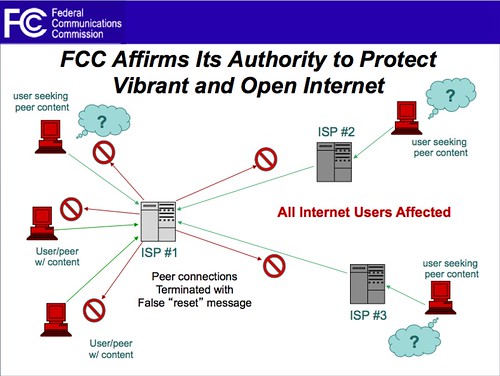
The allegation was that Comcast was interferring with BitTorrent and P2P traffic, specifically that Comcast injected TCP Reset commands in order to disrupt P2P traffic.
The belief was that Comcast had an incentive to do this in order to protect its revenue from its MVPD Cable Video service.
The allegations came to light as a result of Associated Press and EFF reports. Peter Svensson, Comcast Activity Hinders Subscribers’ File-Sharing Traffic, AP Testing Shows, Associated Press, Oct. 19, 2007
Complaint
On November 1, 2007, Free Press and Public Knowledge filed a formal complaint before the FCC, arguing that Comcast's actions violated the FCC Broadband Policy Statement. Free Press also petitioned for a Declaratory Ruling. This would be followed by a petition filed by Vuze for a rulemaking.
- Free Press, Public Knowledge, Media Access Project, Consumer Federation of America, Consumers Union, Information Society Project at Yale Law School, Professor Charles Nesson, Co-Director of the Berkman Center for Internet & Society, Harvard Law School, Professor Barbara van Schewick, Center for Internet & Society, Stanford Law School, Petition for Declaratory Ruling, CC Docket Nos. 02-33, 01-337, 95-20, 98-10, GN Docket No. 00-185, CS Docket No. 02-52, WC Docket No. 07-52 (filed Nov. 1, 2007).
- Petition for Declaratory Ruling of Free Press et al., CC Docket No. 02-33, WC Docket No. 07-52 (filed Nov. 1, 2007) Acrobat
- Vuze Petition for Rulemaking to Establish Rules Governing Network Management Practices By Broadband Network Operators, WC Docket No. 07-52 (filed Nov. 14, 2007) (Petition).
- PK Press Release " Vuze is a startup that provides high-quality video content using peer-to-peer technology that is working hard to attract licensed content partners for viewing while providing an innovative experience for its customers who want to upload their own video. "
Investigation
Requests for Comments
The FCC released multiple requests for comment and held hearings.
The Free Press, Public Knowledge Formal Complaint, as an item before the Enforcement Bureau, would not be a proceeding itself that would be put out for public comment.
- 1/14/08 Comment Sought on Petition for Declaratory Ruling Regarding Internet Management Policies. Public Notice: Word | Acrobat (DA No. 08-91). (Dkt No 07-52).
- 1/14/08 Comment Sought on Petition for Rulemaking to Establish Rules Governing Network Management Practices by Broadband Network Operators. Public Notice: Word | Acrobat (DA No. 08-92). (Dkt No 07-52).
- Network Management Practices Inquiry
Comcast
Comcast (eventually) conceded that it was involved in the action but argued that the action was necessary in order to conduct congestion management. [McCullagh]
Analysis
Authority
The Commission justified its order as an exercise of what courts term its “ancillary jurisdiction,” see id. at 13034–41 ¶¶ 14–22, a power that flows from the broad language of Communications Act section 4(i). See 47 U.S.C. § 154(i) (“The Commission may perform any and all acts, make such rules and regulations, and issue such orders, not inconsistent with this chapter, as may be necessary in the execution of its functions.”); see generally American Library Ass’n v. FCC, 406 F.3d 689, 700–03 (D.C. Cir. 2005).
Broadband Internet is information service.
Source: Martin 10/02/08Findings
The FCC concluded that Comcast violated FCC rules by
- Impairment of the P2P applications; and
- Failing to disclose to end users its network management practices.
- "As a result, the Commission found that many consumers experiencing difficulty using only certain applications would not place blame on Comcast, where it belonged, but rather on the applications themselves, thus further disadvantaging those applications in the competitive marketplace." Press Release 2008 at 2.
The FCC found that Comcast was using deep packet inspection in order to detect P2P traffic; Comcast would then inject a TCP RST command to the end users, causing the TCP session to terminate and reset. This disrupted the performance of the P2P application.
The FCC concluded that Comcast had an incentive to protect its MVPD cable video service against OTT video competition. [MOO para. 5 ("Such video distribution poses a particular competitive threat to Comcast’s video-on-demand (“VOD”) service. “VOD . . . operates much like online video, where Internet users can select and download or stream any available program without a schedule and watch it any time, generally with the ability to fast-forward, rewind, or pause the programming.”11 Comcast has recently placed a significant emphasis on expanding its VOD business, and its VOD revenues have experienced robust growth.12 Moreover, Comcast has “begun incorporating its VOD content online through sites competing directly with BitTorrent protocol sites.")]
The FCC rejected Comcast's argument that this was reasonable network management designed to address congestion.
- Comcast selectively targeted some applications; it did not treat all applications equally
- Comcast engaged in its behavior regardless of
- whether there was congestion or not,
- time of day (peak traffic hours versus off-peak hours),
- geographic location (one point in a network may be congestion but another may not be)
- Amount of bandwidth consumed by application (alot of bandwidth or a smal amount)
Resolution
The FCC ordered Comcast to
- End its discriminatory practices;
- Disclose its network management practices; and
- Implement a compliance plan
CITATION: In re Formal Complaint of Free Press and Public Knowledge Against Comcast Corp. for Secretly Degrading Peer-to-Peer Applications, 23 F.C.C.R. 13028 (2008)
8/20/08 Commission Orders Comcast to End Discriminatory Network Management Practices.
MO&O: Word | Acrobat
News Release (8/1/08): Word | Acrobat ("Comcast has unduly interfered with Internet users’ right to access the lawful Internet content and to use the applications of their choice." " The Commission announced its intention to exercise its authority to oversee federal Internet policy in adjudicating this and other disputes regarding discriminatory network management practices with dispatch, and its commitment in retaining jurisdiction over this matter to ensure compliance with a proscribed plan to bring Comcast’s discriminatory conduct to an end")
Martin Statement: Word | Acrobat
Copps Statement: Word | Acrobat
Adelstein Statement: Word | Acrobat
Tate Statement: Word | Acrobat
McDowell Statement: Word | AcrobatReaction to Decision
- Sidecut Reports ("The big question for many casual FCC observers is why would Martin, a Republic who is no historical friend of net neutrality rules, suddenly embrace the 2005 principles? The answer is, it may be the lesser-of-two evils choice that his telco friends would wholeheartedly support, because it gives them a pain free way to say that new net neutrality laws aren't needed. Indeed, just moments after the FCC's vote was made public, both Verizon and AT&T issued statements supporting Martin's actions.")
- Verizon Statement on FCC Comcast Decision, August 1, 2008 ("Without making a judgment on the substance of today's ruling, it is clear that the Federal Communication Commission is prepared to uphold its broadband principles. Now the entire industry should redouble its efforts to set standards for transparency and ensure that consumers know what they are getting when purchasing access or using applications. And we should get ahead of the curve in developing and adopting sound network-management practices as new services emerge. "With both the FCC and the Federal Trade Commission (FTC) engaged in oversight of Internet usage and practices, new legislation and more regulation, with all their unintended consequences, are not needed.")
- Letter from Professor Jack Balkin, Yale Law School and Professor Barbara van Schewick, Stanford Law School, to Marlene H. Dortch, Secretary of the Federal Communications Commission, Comment on Commission Order Requiring Comcast to End Discriminatory Network Management Practices (August 20, 2008).
Disclose Network Management Plan
IETF RFC 6057, Comcast's Protocol-Agnostic Congestion Management System (Dec. 2010) ("This document describes the congestion management system of Comcast Cable, a large cable broadband Internet Service Provider (ISP) in the U.S. Comcast completed deployment of this congestion management system on December 31, 2008.")
Compliance
- LETTER TO VICE PRESIDENT REGULATORY AFFAIRS, COMCAST CORPORATION. Response to letter detailing Comcast's broadband network management practices, planned deployment of protocol-agnostic network management practices, and other issues. Action by: Chief, Wireline Competition Bureau and General Counsel by LETTER. OCH
TXT
"We seek clarification with respect to an apparent discrepancy between Comcast's filing and its actual or advertised practices. Specifically, in Appendix B of your September 19 submission, Comcast notes that if a consumer uses 70% of his provisioned bandwidth for 15 min or more when his neighborhood Cable Modem Termination System (CMTS) node has been near capacity for a period of 15 minutes or more, that consumer loses priority when routing packets thru congested portions of the network. If such a consumer then places a VoIP call along a route experiencing actual congestion, Comcast states that consumer may find that his "VoIP call sounds choppy." Critically, the Appendix draws no distinction between Comcast's VoIP offerings and those offered by its competitors
"Comcast's website, however, suggests that such a distinction does in fact exist. The website claims that "Comcast Digital Voice is a separate facilities-based IP phone service that is not affected by this (new network management) technique." It goes on to state, by contrast, that customers of other "VoIP providers that rely on delivering calls over the Public Internet may experience a degradation of their call quality at times of network congestion."
"We request that Comcast explain why it omitted from its filings with the Commission the distinct effects that Comcast's new network management technique has on Comcast's VoIP offering versus those of its competitors. We also ask that you provide a detailed justification for Comcast's disparate treatment of its own VoIP service as compared to that offered by other VoIP providers on its network. In particular, please explain how Comcast Digital Voice is facilities-based," how Comcast Digital Voice uses Comcast's broadband facilities, and, in particular, whether (and if so, how) Comcast Digital Voice affects network congestion in a different manner than other VoIP services.
"To the extent that Comcast maintains that its VoIP offering is a telephone service offering transmission facilities for VoIP calls distinct from Comcast's broadband offerings, then it would appear that the fee Comcast assesses its customers for VoIP services pays in part for the privileged transmission of information of the customer's choosing across Comcast's network. As we have stated before, the "heart of telecommunications [under the act] is transmission." And offering "telecommunications for a fee directly to the public" is the statutory definition of a telecom service. Given that Comcast apparently is maintaining that its VoIP service is a "separate facilities-based" telephone service that is distinct from its broadband service and differs from the service offered by "VoIP providers that rely on delivering calls over the public Internet, it would appear that Comcast's VoIP service is a telecom service subject to regulation under Title II of the Communications Act of 1934, as amended.
"We thus request that Comcast explain any reason the Commission should not treat Comcast's VoIP offering as a telecom service under Title II - a service subject, among other things, to the same intercarrier compensation obligations applicable to other facilities-based telecom carriers. We understand that Comcast's VoIP service is not yet complying with such intercarrier compensation obligations.
"Please submit your response by the close of business on Friday, January 30, 2009. "
(Citations omitted)
Litigation: Comcast v FCC
Derived from Verizon v. FCC, No. 11-1355 (D.C. Cir. Jan. 14, 2014).
We have held that the Commission may exercise such ancillary jurisdiction where two conditions are met: “(1) the Commission’s general jurisdictional grant under Title I covers the regulated subject and (2) the regulations are reasonably ancillary to the Commission’s effective performance of its statutorily mandated responsibilities.” American Library Ass’n, 406 F.3d at 691–92.
"In Comcast, we vacated the Commission’s order, holding that the agency failed to demonstrate that it possessed authority to regulate broadband providers’ network management practices. 600 F.3d at 644. Specifically, we held that the Commission had identified no grant of statutory authority to which the Comcast Order was reasonably ancillary. Id. at 661. The Commission had principally invoked statutory provisions that, though setting forth congressional policy, delegated no actual regulatory authority. Id. at 651–58. These provisions, we concluded, were insufficient because permitting the agency to ground its exercise of ancillary jurisdiction in policy statements alone would contravene the “‘axiomatic’ principle that ‘administrative agencies may [act] only pursuant to authority delegated to them by Congress.’” Id. at 654 (alteration in original) (quoting American Library Ass’n, 406 F.3d at 691). We went on to reject the Commission’s invocation of a handful of other statutory provisions that, although they could “arguably be read to delegate regulatory authority,” id. at 658, provided no support for the precise order at issue, id. at 658–61."
Comcast v FCC
- "In this case we must decide whether the Federal Communications Commission has authority to regulate an Internet service provider's network management practices. Acknowledging that it has no express statutory authority over such practices, the Commission relies on section 4(i) of the Communications Act of 1934, which authorizes the Commission to "perform any and all acts, make such rules and regulations, and issue such orders, not inconsistent with this chapter, as may be necessary in the execution of its functions." 47 U.S.C. § 154(i). The Commission may exercise this "ancillary" authority only if it demonstrates that its action-here barring Comcast from interfering with its customers' use of peer-to-peer networking applications-is "reasonably ancillary to the . . . effective performance of its statutorily mandated responsibilities." Am. Library Ass'n v. FCC, 406 F.3d 689, 692 (D.C. Cir. 2005). The Commission has failed to make that showing. It relies principally on several Congressional statements of policy, but under Supreme Court and D.C. Circuit case law statements of policy, by themselves, do not create "statutorily mandated responsibilities." The Commission also relies on various provisions of the Communications Act that do create such responsibilities, but for a variety of substantive and procedural reasons those provisions cannot support its exercise of ancillary authority over Comcast's network management practices. We therefore grant Comcast's petition for review and vacate the challenged order."
- Statement Of Commissioner Michael J. Copps On Chairman Genachowski's Announcement To Reclassify Broadband. STMT. News Media CMMR
TXT
- 4/6/10 FCC Statements on Comcast v. FCC Decision.
Commission Statement: Word | Acrobat
Copps Statement: Word | Acrobat
McDowell Statement: Word | Acrobat
Clyburn Statement: Word | Acrobat
Baker Statement: Word | Acrobat- See also USTA v. FCC Slip 16 DC Cir. 2015 ("In Comcast, we vacated that order because the Commission had failed to identify any grant of statutory authority to which the order was reasonably ancillary")
Aftermath
Chairman Martin Praised FCC Jurisdiction and protection of the Open Internet
Keynote Remarks of Chairman Martin at the "Network Neutrality Conference-Implications For Innovation And Business Online", Copenhagen, Denmark. 10/2/08 Word | Acrobat | Archive Presentation: Powerpoint ("At the FCC, we have been focusing on creating a regulatory environment that promotes investment and competition, setting the rules of the road so that players can complete on a level playing field and removing regulatory obstacles that discouraged infrastructure investment and slowed deployment….. The Commission will remain vigilant in protecting consumers’ access to content, applications and services on the Internet. Subscribers should be able to go where they want, when they want, and generally use the Internet in any legal manner")
Open Internet 2010
"While the Comcast matter was pending, the Commission sought comment on a set of proposed rules that, with some modifications, eventually became the rules at issue here. See In re Preserving the Open Internet, 24 F.C.C.R. 13064 (2009). In support, it relied on the same theory of ancillary jurisdiction it had asserted in the Comcast Order. See id. at 13099 ¶¶ 83–85. But after our decision in Comcast undermined that theory, the Commission sought comment on whether and to what extent it should reclassify broadband Internet services as telecommunications services. See In re Framework for Broadband Internet Service, 25 F.C.C.R. 7866, 7867 ¶ 2 (2010). Ultimately, however, rather than reclassifying broadband, the Commission adopted the Open Internet Order... See 25 F.C.C.R. 17905.
References
Papers
- Kevin Bauer, Dirk Grunwald, and Douglas Sicker, The Arms Race in P2P
- Dischinger, M., Mislove, A., Haeberlen, A., and Gummadi, K. P. Detecting BitTorrent blocking. In IMC '08: Proceedings of the 8th ACM SIGCOMM conference on Internet measurement (October 2008), ACM
- CISCO, TCP Reset Segment Control
- EFF.
- S Floyd, RFC 3360, Inappropriate TCP Resets Considered Harmful (August 2002) "This document is being written because there are a number of firewalls in the Internet that inappropriately reset a TCP connection upon receiving certain TCP SYN packets, in particular, packets with flags set in the Reserved field of the TCP header. In this document we argue that this practice is not conformant with TCP standards, and is an inappropriate overloading of the semantics of the TCP reset. We also consider the longer-term consequences of this and similar actions as obstacles to the evolution of the Internet infrastructure."
- Glasnost: Results from tests for BitTorrent traffic blocking.
- Shane Greenstein, Martin Peitz, and Tommaso Valletti, Net Neutrality: A Fast Lane to Understanding the Trade-offs, 30 J. of Econ. Perspectives, no. 2, Spring 2016, at 127,131 (discussing the case of Bit-Torrent and Comcast).
- Weaver, N., Sommer, R., and Paxson, V. Detecting forged TCP reset packets. In Proceed- ings of NDSS (February 2009).
- One cable company to rule them all Salon 2004 (Comcast ... The company's terms of service also prohibit users from running file-sharing applications (among other things))
- University Gets Tough On P2P InternetWeek Feb 2004 ("Campus residents can no longer use Kazaa, Morpheus or any other P2P (peer-to-peer) file-sharing software to download music, movies or software applications. The free lunch ended abruptly at the beginning of the 2003-04 school year, when network administrators working in the campus housing unit turned on software they developed that not only detects illicit network activity but also dynamically enforces acceptable-use policies without IT intervention.")
News
- Litigation
- Court Drives FCC Towards Nuclear Option to Regulate Broadband, Wired 4/7/2010
- Comcast vs FCC: In Battle For Net Neutrality, Did the Courts Hand Comcast a Pyrrhic Victory?, Gigaom 4/7/2010
- CTIA Reaction to D.C. Circuit Court of Appeals Decision on Comcast, CTIA 4/7/2010
- NCTA Responds to Circuit Court Decision in Comcast v. FCC, NCTA 4/7/2010
- Broadband has no regulator, BitTorrent CEO says, CW 4/21/2010
- FCC Loses Comcast Case: End of Line for FCC's Creative Claims of Authority?, PFF 4/7/2010
- "Ancillary jurisdiction" has to be ancillary to something, Crawford 4/7/2010
- Court Decision Endangers FCC's Ability to Protect Net Neutrality and Implement National Broadband Plan, Free Press 4/7/2010
- Court Tells FCC It Has No Mandate To Enforce Net Neutrality (And That's A Good Thing), Techdirt 4/7/2010
- Court Rejects FCC Authority Over the Internet, EFF 4/7/2010
- The Nobles Must Follow the Law, PFF 4/7/2010
- Comcast, FCC take net neutrality dispute to court, Globe and Mail 1/8/2010
- Comcast, FCC Head To Court Over Net Neutrality - Comcast still argues FCC had no authority to 'sanction' carrier for throttling.., dslreports 1/8/2010
- Supreme Court Indecency Case Has Implications for Comcast/BitTorrent, PK 4/28/2009
- Comcast Wins Lottery on BitTorrent Appeal., Tales from the Sausage Factory 9/10/2008
- Compliance
- Comcast defends itself against FCC's VoIP probe, Ars Technica 2/5/2009
- Consumer Advocates Embrace FCC's Latest Comcast Inquiry - Comcast tells us they're still digesting the letter..., dslreports 1/21/2009
- FCC Again Wants Details From Comcast On Its Traffic-Shaping Efforts, Techdirt 1/21/2009
- Comcast Testing New Network Management, Internet News 8/27/2008
- My FCC Presentation on the Future of Digital Media, Maverick 7/28/2008
- Comcast Testing New Network Management, Internet News 8/27/2008
- Comcast and Vonage collaborate on network management, CNET 7/10/2008
- Comcast Seeks to Stave Off FCC Oversight With Vonage Deal, Ecommerce Times 7/10/2008
- Comcast Unveils Its New Traffic Management Architecture, EFF 9/25/2008
- Evaluation of the Comcast/BitTorrent Filing - Really Excellent, Except For The Gapping Hole., Tales from the Sausage Factory 9/25/2008
- Comcast Says No One Has Complained About Its New Traffic Slowing Efforts, Techdirt 9/25/2008
- I Am Pleasantly Surprised By Comcast Compliance, But Am Still Nasty And Suspicious By Nature., Tales from the Sausage Factory 9/24/2008
- Comcast Discloses Network Management Practices, CircleID 9/22/2008
- Comcast discloses, then hits the comments trail, Muni 9/22/2008
- Tales of the Sausage Factory: What Will Comcast Do Today? First Compliance Check On Comcast/BitTorrent Order., Tales from the Sausage Factory 9/19/2008
- FCC's Order
- Good-Bye, Humpty Dumpty?, PFF 8/27/2009
- FCC enforcing imaginary laws in P2P ruling, says Comcast, Ars Technica 8/18/2009
- Comcast Fighting FCC Throttling Ruling - Still claims agency lacked the authority to act..., dslreports 8/18/2009
- Was The Entire FCC Comcast Investigation A Farce? - Editorial: Is Kevin Martin setting the stage for usage-based billing?, dslreports 7/31/2008
- Legal and Procedural Flaws May Doom FCC's Comcast Ruling, PFF 8/29/2008
- FCC to Comcast: You Stink and You Lie, IP Democracy 8/20/2008
- Order Against Comcast Issued, FCC Credits EFF, EFF 8/20/2008
- Public Knowledge Praises FCC's Order Protecting Internet, Condemning Comcast Discrimination, PK 8/20/2008
- Summary of the FCC's Comcast Network Management Order, Telefrieden 8/20/2008
- The FCC Releases the Comcast Complaint Order Part I - Why This Is A Huge Win., Tales from the Sausage Factory 8/20/2008
- Declan McCullagh, FCC Formally Rules Comcast's Throttling of Bittorrent was Illegal, CNET Aug. 20, 2018[McCullagh]
- Legal and Procedural Flaws May Doom FCC's Comcast Ruling, PFF 8/29/2008
- The FCC vs. Comcast: Who's Got the Most Marbles?, Ecommerce Times 8/27/2008
- The FCC's Comcast/Net Neutrality Order & Commissioner McDowell's Dissent, Tech Liberation Front 8/27/2008
- Former FCC Chairman: Comcast Action Legality "Murky", Tech Liberation Front 8/27/2008
- Comcast Given 30 Days to Disclose Network Management Practices, Says FCC Order, CircleID 8/20/2008
- Internet Luminaries Praise FCC Action, Save the Internet 8/20/2008
- Investigation
- AT&T Says It Will Cut Off P2P Wireless Users; But What About Pandora Users?, Techdirt 7/31/2008
- FCC probably can't police Comcast's BitTorrent throttling, CNET 7/28/2008
- FCC's McDowell: The Internet Will Stop If You Regulate Comcast - Guess we know which way he's going to vote on Friday., dslreports 7/28/2008
- FCC to Hammer Comcast on Throttling Shenanigans, Ecommerce Times 7/28/2008
- MAP filing shows Comcast waived its right to challenge BitTorrent Complaint process two years ago., MAP 7/24/2008
- Comcast Not On Notice? They Were Told Point Blank!, Tales from the Sausage Factory 7/21/2008
- FCC "Enforcement" Against Comcast?, CDT 7/18/2008
- FCC and Comcast: Reasonably Vague, CircleID 7/15/2008
- FCC Crackdown on Comcast Doesn?t Even Include Fine - Is the FCC's proposed punishment going to change anything at all?, dslreports 7/14/2008
- Kevin Martin Tries To Thread The Needle In Sanctioning Comcast, Techdirt 7/14/2008
- FCC Chairman Seeks to End Comcast's Delay of File Sharing, Wash Post 7/14/2008
- Sandvine: 44% of Internet Traffic P2P - Now please buy our hardware to help throttle, dslreports 6/30/2008
- Comcast CTO: P2P Uses Half of Upstream Capacity, IP Democracy 6/26/2008
- ISPs experimenting with new P2P controls, CW 6/24/2008
- Big Telco Calls on FCC to Act in Comcast Case, Save the Internet 6/20/2008
- Vigilantes Against BitTorrent? Revision3 Taken Down by SYN Floods, Peerflow 6/4/2008
- Comcast Unleashes the Lapdogs, Save the Internet 7/31/2008
- Don't Be Too Quick To Cheer On FCC On Its Net Neutrality Response, Techdirt 7/31/2008
- CDT Policy Post on Network Management, cdt 5/22/2008
- Elude Your ISP's BitTorrent Blockade, Slashdot 5/15/2008
- Didn't Take Long: Comcast Ditches P2P Bill Of Rights Idea, Techdirt 5/9/2008
- AT&T To Vuze: We Don't Throttle BitTorrent - Nor do we use false reset messages like Comcast., dslreports 4/29/2008
- Comcast Under Fire From FCC Yet Again, Internet News 4/24/2008
- FCC Chairman Calls Comcast Liar, Critics Pile On, Ecommerce Times 4/24/2008
- Comcast's Network Practices Need Scrutiny, FCC Chief Says, Wash Post 4/24/2008
- Maybe The FCC Can Handle The Truth, PK 4/24/2008
- Comcast, AT&T absent at FCC hearing on Net neutrality, CNET 4/18/2008
- Absent Comcast in hot seat at FCC hearing, CNET 4/18/2008
- Net Neutrality Hearing Hits Silicon Valley, Wash Post 4/18/2008
- A One-Sided Net Neutrality Debate, Internet News 4/18/2008
- Stanford FCC Meeting One-Sided but Useful - Lessig dominated the conversation; ISPs were absent, dslreports 4/18/2008
- FCC Weighs Next Steps at Second Net Neutrality Hearing, Ecommerce Times 4/18/2008
- Lessig Editorial on Net Neutrality, Center for Internet and Society 4/18/2008
- Does Bell Really Have a P2P Bandwidth Problem?, CircleID 4/18/2008
- Openness for the Internet by Rep Anna Eshoo, Save the Internet 4/18/2008
- Comcast Can't Fill Seats With Comcast Supporters; Skips FCC Hearing Entirely, Techdirt 4/18/2008
- Ben Scott Speaks at Stanford, Save the Internet 4/18/2008
- My Testimony From Today, Tales from the Sausage Factory 4/18/2008
- Study Confirms ISPs Meddle With Web Traffic, Slashdot 4/18/2008
- Hands Off Statement on FCC Stanford Hearing, Hands off the Internet 4/18/2008
- VIDEO: FCC hearing on Network Management at Stanford, PK 4/18/2008
- FCC Hearings at Stanford: Towards a Consensus on ISP Transparency?, EFF 4/18/2008
- FCC Net Neutrality Meeting at Stanford Today - Comcast denies invitation to attend, dslreports 4/17/2008
- Comcast Steers for High Ground With P2P Bill of Rights, Ecommerce Times 4/17/2008
- Bits: Comcast's Concession to Net Neutrality, NYT 4/17/2008
- Who's Speaking at Stanford?, Save the Internet 4/17/2008
- Comedy Central Send An Omen: South Park and the Upcomming FCC Hearing (spoiler alert!), Tales from the Sausage Factory 4/17/2008
- Public Knowledge Calls Comcast-Pando Proposal 'Ludicrous', PK 4/15/2008
- Comcast wants 'bill of rights' for file-sharers, ISPs, Globe and Mail 4/15/2008
- Comcast /BitTorrent Update: Important Filings by Topolski, Peha, and Ou (and some analysis by yr ., Tales from the Sausage Factory 4/10/2008
- What Comcast/Bittorrent Actually Means: Bittorrent Selling Hardware, Techdirt 4/8/2008
- Comcast and BitTorrent, or "Honestly Charlie Brown, The Market Dictates I Let You Kick The Footba., Tales from the Sausage Factory 4/3/2008
- BitTorrent Comcast Cooperation
- STATEMENT OF COMMISSIONER MICHAEL J. COPPS IN RESPONSE TO COMCAST/BITTORRENT ANNOUNCEMENT., FCC 3/28/2008
- COMMISSIONER DEBORAH TAYLOR TATE APPLAUDS COMCAST/BITTORRENT AGREEMENT., FCC 3/28/2008
- STATEMENT OF FCC COMMISSIONER ROBERT M. MCDOWELL REGARDING BITTORRENT AND COMCAST RESOLUTION., FCC 3/28/2008
- Comcast Press Release, Comcast and Bittorrent Form Collaboration to Address Network Management, Network Architecture and Content Distribution, (March 27, 2008)
- File sharers get help spotting ISP interference, Globe and Mail 3/28/2008
- Comcast to Stop Hampering File-Sharing, NYT 3/28/2008
- Public Knowledge Sees BitTorrent-Comcast Arrangement As Irrelevant, PK 3/28/2008
- Comcast and BitTorrent agree to 'collaborate', CNET 3/28/2008
- Comcast Realizes Blocking By Protocol Is A Problem; Asks BitTorrent For Some Help, Techdirt 3/28/2008
- FCC Investigation Initiated
- FCC Investigates Net Neutrality Violations, FreePress 1/17/2008
- FCC Starts Triple Investigation of Carrier Internet Practices, PK 1/17/2008
- Comcast welcomes FCC inquiry into traffic management, CW 1/11/2008
- P2P users blast Comcast in FCC proceeding, Ars Technica 1/29/2008
- Petition For Declaratory Ruling Regarding Internet Management Policies, FCC 1/17/2008
- Petition For Rulemaking To Establish Rules Governing Network Management Practices By Broadband Network Operators, FCC 1/17/2008
- F.C.C. Asks Comcast About Internet Filter, NYT 1/17/2008
- FCC wants to know: Is degrading P2P traffic 'reasonable'?, CNET 1/17/2008
- FCC Announces Public En Banc Hearing in Cambridge, Massachusetts on Broadband Network Management Practices, FCC 2/13/2008
- FCC To Investigate Comcast For Blocking Net Traffic, Consumer Affairs 1/10/2008
- F.C.C. to Look at Complaints Comcast Interferes With Net, NYT 1/9/2008
- FCC to Probe P2P Complaint. What Does This Mean?, IP Democracy 1/9/2008
- FCC To Investigate Comcast Filtering; Questions Why Comcast Wasn't Forthcoming, Techdirt 1/9/2008
- Anne Broache, FCC: We'll investigate Comcast-BitTorrent flap, CNET (Jan 8, 2008) (Kevin Martin at CES announcing that FCC will investigate, " "The question is going to arise: Are they reasonable network practices?" AP quoted Martin, a Republican, as saying. "When they have reasonable network practices, they should disclose those and make those public." " )
- Comcast Puts Its Speed Limits in Writing, Internet News 2/13/2008
- Comcast Sorta, But Not Really, Admits To Content Jamming, Techdirt 2/13/2008
- Comcast Reacts To FCC Probe By Changing Fine Print, Tales from the Sausage Factory 2/7/2008
- Comcast: The Blogosphere Will Keep Us Honest, IP Democracy 2/13/2008
- Complaints Filed
- Net Neutrality, Comcast & the FCC: A Closer Look, Future of Music 12/11/2007
- Groups Press FCC on Comcast, Net Neutrality, Wash Post 11/5/2007
- FCC urged to stop Comcast Internet blocking, CNET 11/1/2007
- FCC Pressed to Stop Comcast's Internet Blocking, Free Press 11/1/2007
- Groups Petition FCC to Stop Comcast's P2P Delays, IP Democracy 11/1/2007
- Net Neutrality Advocates Hit Back at Comcast, Save the Internet 11/1/2007
- Allegations of Interference with P2P
- Expert Dismantles EFF?s Analysis of Comcast Throttling - Says EFF doesn't even understand the technology, DSLreports 12/18/2007
- Peter Eckersley, Comcast is also Jamming Gnutella (and Lotus Notes?), Electronic Freedom Foundation Blog, Oct 20, 2007,
- Stephen Wellman, Comcast Is Blocking More Than BitTorrent, Including Lotus Notes, Information Week, Oct. 22, 2007
- David Isenberg, How the AP tested Comcast's Network, Isen.Blog (Oct. 20, 2007)
- Seth Schoen, EFF tests agree with AP: Comcast is forging packets to interfere with user traffic, Electronic Freedom Foundation
Blog, Oct. 19, 2007- Peter Svensson (AP), How the AP tested Comcast's Network, Santa Barabara News Press (Oct. 19, 2007)
- An AP reporter attempted to download, using file-sharing program BitTorrent, a copy of the King James Bible from two computers in the Philadelphia and San Francisco areas, both of which were connected to the Internet through Comcast cable modems. We picked the Bible for the test because it's not protected by copyright and the file is a convenient size. In two out of three tries, the transfer was blocked. In the third, the transfer started only after a 10-minute delay. When we tried to upload files that were in demand by a wider number of BitTorrent users, those connections were also blocked. Not all Comcast-connected computers appear to be affected, however. In a test with a third Comcast-connected computer in the Boston area, we were unable to test with the Bible, apparently due to an unrelated error. When we attempted to upload a more widely disseminated file, there was no evidence of blocking. The Bible test was conducted with three other Internet connections. One was provided by Time Warner Inc.'s Time Warner Cable, and the other came from Cablevision Systems Corp. The third was the business-class connection to the AP's headquarters, provided by AT&T Inc. and Cogent Communications Group Inc. No signs of interference with file-sharing were detected in those tests. Further analysis of the transfer attempt from the Comcast-connected computer in the San Francisco area revealed that the failure was due to ''reset'' packets that the two computers received, carrying the return address of the other computer. Those packets tell the receiving computer to stop communicating with the sender. However, the traffic analyzer software running on each computer showed that neither computer actually sent the packets. That means they originated somewhere in between, with faked return addresses.
- Declan McCullagh, Comcast really does block BitTorrent traffic after all, CNET (Oct 19, 2007) (reporting on AP tests of copying public domain King James bible, at 4.24 MB, using Bit Torrent, a peer-to-peer application)
- Peter Svensson (AP), Comcast Blocks Some Internet Traffic, SFGATE (Oct. 19, 2007) ("Comcast Corp. actively interferes with attempts by some of its high-speed Internet subscribers to share files online, a move that runs counter to the tradition of treating all types of Net traffic equally. The interference, which The Associated Press confirmed through nationwide tests, is the most drastic example yet of data discrimination by a U.S. Internet service provider. It involves company computers masquerading as those of its users. If widely applied by other ISPs, the technology Comcast is using would be a crippling blow to the BitTorrent, eDonkey and Gnutella file-sharing networks. While these are mainly known as sources of copyright music, software and movies, BitTorrent in particular is emerging as a legitimate tool for quickly disseminating legal content.")
- Ernesto, Comcast Throttles BitTorrent Traffic, Seeding Impossible, TorrentFreak (Apr 17, 2007) (Comcast users report that Bittorrent transfers are cut off; Comcast preventing customers from seeding).
- Leaked Comcast Memo on Traffic Shaping - Customer service rep was just doing her job, DSLreports 10/30/2007
- Harold Feld, Look! My Solution Found A Problem! Comcast Degrades BitTorrent Traffic Without Telling Users, WetMachine, Oct. 27, 2007,
- Comcast and Net Neutrality, Freedom to Tinker 10/26/2007
- EFF replicates Comcast discrimination via TCP spoofing, Isen.blog 10/23/2007
- Associated Press Confirms That Comcast Blocks Some BitTorrent Traffic; Despite Comcast Denials, Techdirt 10/23/2007
- Memo to Comcast: Non-Answers Foster Paranoia, IP Democracy 10/23/2007
- Empirical Evidence of Net Bias-Now What?, TeleFrieden 10/23/2007
- Peter Svensson, Comcast Admits Delaying Some Traffic, Associated Press, Oct 23, 2007.
- Congressman to Comcast: Stop interfering with BitTorrent, CNET 10/26/2007
- Here's the Low-Down on Comcast's P2P Policies, IP Democracy 10/26/2007
- Anti-Neuts agree Comcast out of line, Isen.blog 10/26/2007
- Comcast Caught Blocking File Sharing, CircleID 10/23/2007
- Comcast Traffic Jamming Heats Net Neutrality Debate, Ecommerce Times 10/23/2007
- Quote of Note: Comcast Terms of Service, Isen.blog 10/23/2007
- Brad Stone, Comcast: We’re Delaying, Not Blocking, BitTorrent Traffic, New York Times Blog: Bits, Oct. 22, 2007
- Seth Schoen, Comcast and BitTorrent, Electronic Frontier Foundation Blog, September 13, 2007,
- Marguerite Reardon, Comcast denies monkeying with BitTorrent traffic, CNET (Aug 21, 2007) ("when I spoke to Comcast spokesman Charlie Douglas earlier today, he flat-out denied that the company was filtering or "shaping" any traffic on its network.")
- Is Comcast Lying About BitTorrent Throttling? - Allegations denied but user experiences say otherwise, DSLreports 8/29/2007
- How to Thwart Comcast's BitTorrent Shenanigans - Dissecting the cable giant's traffic shaping efforts..., DSLreports 8/29/2007
- Comcast Responds To Traffic Shaping Accusations - But chooses their words carefully...., DSLreports 8/28/2007
- Scott Gilbertson, It’s Comcastic: Is Comcast Blocking Users from Seeding Torrents?, Wired Monkey_Bites, Aug. 20, 2007.
- Other News
- Comcast P2P Settlement Lawyer Thinks You Should Take That $16 - 'The more people sign up the more Comcast has to pay...' he tells us., dslreports 4/21/2010
- Public Knowledge 'Appalled' At RCN Settlement Case - Laments FCC's authority over network management, dslreports 4/21/2010
- RCN Settles Over P2P Throttling - E-mail to customers 'vigorously' denies any wrong doing, dslreports 4/21/2010
- Should You Take That Comcast P2P Settlement Money? - Critic who discovered Comcast's behavior says no..., dslreports 4/16/2010
- Comcast owes users $16 for P2P blocking; should they take it?, Ars Technica 4/16/2010
- Comcast 'P4P' Tests Boost P2P By 80% - Though there's still more questions than answers about Pando's 'new P2P', dslreports 11/5/2008
- AT&T Backbone Sees 20% P2P Drop - Hulu, YouTube and other alternative video 'taking over', dslreports 7/31/2008
- AT&T Says It Will Cut Off P2P Wireless Users; But What About Pandora Users?, Techdirt 7/31/2008
- Vuze calls for FCC probe of Cox Cable traffic management, Ars Technica 2/5/2009
- Internet Congestion: ISPs Don Traffic Cop Uniforms, Ecommerce Times 10/21/2008
- As Expected, BitTorrent Providers Planning To Route Around Comcast Barrier, Techdirt (Feb 18, 2008) (" It's no secret that every time ISPs look to filter or degrade the performance of a certain kind of traffic, it only increases attempts to encrypt the traffic, which actually makes things worse for the ISPs. ")
- Norwegian Public Broadcaster Uses BitTorrent for Content Distribution, Michael Geist 1/29/2008
- BitTorrent Trend Suggests ISPs Need to Improve Networks - The ultimate alternative to BitTorrent throttling, dslreports 2/4/2008
- Comcast: Metered Broadband Isn't the Solution, IP Democracy 2/13/2008
- Comcast and "network management", Susan Crawford 12/4/2007
- The Impact of Comcast's BitTorrent Policy on Network Neutrality, MTTLR 12/4/2007
- Verizon: No 'need' to degrade P2P traffic...yet, CNET 2/13/2008
- The Network Management Excuse, CircleID 1/17/2008
- Telco Sock Puppet Wants Comcast Investigated - AT&T funded group plays policy games., DSLreports 11/13/2007