 |
Cybertelecom Federal Internet Law & Policy An Educational Project |
|
Postal Service | |
|
- Common Carriage - Notes |
© Cybertelecom ::The first public communications network in the United States was the US Postal Service. Prior to the American revolution, European postal service was a communications network enjoyed by the elite. In America, the value of the postal service rose with the importance of newspapers as a means of disseminating revolutionary news to the population. Postmasters were generally also publishers of newspapers. They received mail coming off the ships from Europe and gleaned information from European newspapers.
The postal service as a communications network was at the heart of the American revolution. Before the Colonialists wrote the Declaration of Independence and before they went to war, they first established their own separate postal service, the Constitutional Postal Service. A first step towards independence was to break free of the Crown Post and postal surveillance by the British army. The Constitutional postal service was used disseminated revolutionary fervor. The Stamp Act, imposing a tax on everything printed, is cited as a catalyst for the revolution. When the Colonialists wrote the Constitution, they included a provision for the Postal Service and Postal roads (as well as the First Amendment).
The Congress shall have power... To establish post offices and post roads;... U.S. Constitution, Article I, Section 8
It is the only infrastructure provision in the Constitution. The Postal Service delivering newspapers ubiquitously was a means of binding the nation together, engaging in a democratic discourse. [Binding the Nation, SI ("George Washington envisioned a nation bound together by a system of post roads and post offices. Starting the System documents America's increasing need for a mail system to ensure the free flow of information between citizens and their government.")] [Nat. Geo. 2020 ("the Founding Fathers had wanted a service that would bind together the scattered populous of the new United States. It was, in other words, a tool of nationalism. Over the course of two centuries, the agency would drive the expansion of roads and transit, strengthen the nation’s connections with its rural communities, and brave all conditions to bring packages to citizens’ front doors.")][Nat. Geo. 2020 (1823: 80,000 miles of post roads)]
Post Office advocates argue that the Constitutional provision authorizes the Post Office as a government monopoly; it doesnt say that and it was not until 1845 that Congress began to pass laws establishing the postal office as a government monopoly. Post Office advocates would also argue that the Constitutional provision gives the Post Office authority to own, operate, and control all mediums of "transmission of intelligence." The Post Office will perpetually attempt to gain control over telegraph service, telephone service, and finally email service.
The Post Office as a communications network was heralded with a utopian ferver that would be echoed with the telegraph, telephone, and Internet networks. George Washington declared:
The importance of the post office and post roads on a plan sufficiently liberal and comprehensive, as they respect the expedition, safety, and facility of communication, is increased by their instrumentality in diffusing a knowledge of the laws and proceedings of the Government, which, while it contributes to the security of the people, serves also to guard them against the effects of misrepresentation and misconception.[Washington 1791] The sentiment was repeated in 1906 by Congressman A. F. Lever of South Carolina with the introduction of free rural delivery:
"[Rural delivery] has become a great university in which 36,000,000 of our people receive their daily lessons from the newspapers and magazines of the country. It is the schoolhouse of the American farmer, and is without a doubt one of the most potent educational factors of the time."[USPS Monopoly 2008 8] See Post Roads Act 1866 (extending Post Roads authority to telegraph, granting telegraph the right to build and operate on Post Roads)
As Postmasters were also publishers, they stood as gatekeepers to the communications network, controlling which newspapers would be delivered and which would not. Benjamin Franklin and his partner William Goddard's Pennsylvania Chronicle suffered this discrimination by the former Philadelphia postmaster, who was also the owner of a rival newspaper and sympathetic to the Crown. The postmaster refused to deliver newspapers to Franklin and Goddard, depriving them of a source of information, and then refused to deliver the Pennsylvania Chronicle, driving it out of business. Goddard responded by establishing the Constitutional postal service "founded upon the constitutional principles of open communication, freedom from governmental interference, and the guaranteed free exchange of ideas." [William Goddard and the Constitutional Post, Binding the Nation, SI]
Mr. Goddard's Proposal for Establishing an American Post Office 1774
The present American Post Office was first set up by a private gentleman in one of the Southern Colonies, and the Ministry of Great Britain finding that a revenue might arise from it, procured an Act of Parliament in the ninth year of the reign of Queen Anne, to enable them to take into their own hands, and succeeding Administrations have ever since, taken upon them to regulate it — have committed the management of it to whom they pleased, and avail themselves of its income, now said to be at least £3,000 sterling per annum clear.
By this means a set of officers, Ministerial indeed, in their creation, direction, and dependence, are maintained in the Colonies, into whose hands all the social, commercial, and political intelligence of the Continent is necessarily committed; which at this time, every one must consider as dangerous in the extreme. It is not only our letters that are liable to be stopped and opened by a Ministerial mandate, and their contents construed into treasonable conspiracies, but our newspapers, those necessary and important alarms in time of publick danger, may be rendered of little consequence for want of circulation. Whenever it shall be thought proper to restrain the liberty of the press, or injure an individual, how easily may it be effected? A Postmaster General may dismiss a rider and substitute his hostler in his place, who may tax the newspapers to a prohibition; and when the master is remonstrated to upon the head, he may deny he has any concern in the matter, and tell the Printer he must make his terms with the Post.
As, therefore, the maintenance of this dangerous and unconstitutional precedent of taxation without our consent — as the parting with very considerable sums of our money to support officers of whom it seems to be expected that they should be inimical to our rights — as the great danger of the increase of such interest and its connections, added to the considerations above mentioned, must be alarming to a people thoroughly convinced of the fatal tendency of this Parliamentary establishment, it is therefore proposed [the Constitutional Postal Service]:
[Shawn Powers, Where did the principle of secrecy in correspondence go?, The Guardian Aug 12, 2015] Franklin responded, when he became postmaster, by declaring that the postal service would deliver all newspapers at an affordable rate. [Benjamin Franklin: Postmaster General, USPS ("Remembering his own experiences as a printer and postmaster, Franklin abolished the practice of letting postmasters decide which newspapers could travel through the mail and mandated delivery of all newspapers for a small fee. ")] This policy would later be codified by the Post Office Act of 1792. [1792 Postal Act, Binding the Nation, SI ("Under the act, newspapers would be allowed in the mails at low rates to promote the spread of information across the states.")]
Network Neutrality
The postal service may not examine or read the content it carries. It cannot charge different rates based on the information carried (it can charge different rates for the form of the post - different rates for letters, magazines, or newspapers - but not different rates for the Cleveland Plain Dealer as opposed to the New York Times). It must deliver to the destination requested by the sender. It must serve all parties.
But this was not always so. Paul Starr in his book, The Creation of the Media, recounts the origins of the Postal Service in the United States.
NonMailable Matter
1873 Comstock Act - An Act for the Suppression of Trade in, and Circulation of, Obscene Literature and Articles of Immoral Use. March 3, 1873, ch. 258, § 2, 17 Stat. 599
- US Postal Laws and Regulations 1887: Sec. 380 Obscene Matter - Every obscene, lewd, or lascivious book, pamphlet, picture, paper, writing, print, or other publication of an indecent character, and every article or thing designed or intended for the prevention of conception or procuring of abortion, and every article or thing intended or adapted for any indecent or immoral use, and every written or printed card, circular, book, pamphlet, advertisement, or notice of any kind giving information, directly or indirectly, where or how, or of whom, or by what means, any of the hereinbefore-mentioned matters, articles or things may be obtained or made, and every letter upon the envelop of which, or postal card upon which, indecent, lewd, obscene, or lascivious delineations, epithets, terms, or langauge may be written or priinted, are hereby declared to be non-mailable matter, and shall not be conveyed in the mails nor delivered from any post-office nor by any letter carrier; and any person who shall knowingly deposit, or cause to be deposited, for mailing or delivery, anything declared by this section to be non-mailable matter, and any person who shall knowingly take the same, or cause the same to be taken, from the mails, for the purpose of circulating or disposing of, or of aiding in the circulation or disposition of the same, shall be deemed guilty of a misdemeanor, and shall for each and every offense be fined not less than one hundred dollars nor more than five thousand dollards, or imprisoned at hard labor not less than one year nor more than ten years, or both, at the discretion of the court.
- used to prosecute Margaret Sanger 1916, founder of Planned Parenthood) Margaret Sanger was then jailed for 30 days for breaking the Comstock Law, which forbade the discussion and dissemination of birth control. [Planned Parenthood History] [Anthony Comstock "Chastity" Laws, American Experience] [Brandon R. Burnette, Comstock Act of 1873, The First Amendment Encyclopedia ] [Comstock Law of (1873), jrank ("Comstock was appointed special agent of the U.S. Post Office and given the express power to enforce the statute. Comstock held this position for the next 42 years.")]
- Bolger v. Youngs Drug Products Corp., 463 U.S. 60, 103 S. Ct. 2875, 77 L. Ed. 2d 469 (1983)
(b) Advertising for contraceptives not only implicates "substantial individual and societal interests" in the free flow of commercial information, but also relates to activity that is protected from unwarranted governmental interference. Thus, appellee's proposed commercial speech is clearly protected by the First Amendment. P. 69.
(c) Neither of the interests asserted by appellants -- that § 3001(e)(2) shields recipients of mail from materials that they are likely to find offensive and aids parents' efforts to control the manner in which their children become informed about birth control -- is sufficient to justify the sweeping prohibition on the mailing of unsolicited contraceptive advertisements. The fact that protected speech may be offensive to some persons does not justify its suppression, and, in any event, recipients of objectionable mailings can avoid further offensiveness simply by averting their eyes or disposing of the mailings in a trash can. While the second asserted interest is substantial, § 3001(e)(2), as a means of effectuating this interest, fails to withstand scrutiny. The statute's marginal degree of protection afforded those parents who desire to keep their children from confronting such mailings is improperly achieved by purging all mailboxes of unsolicited material that is entirely suitable for adults. Section 3001(e)(2) is also defective because it denies parents truthful information bearing on their ability to discuss birth control and to make informed decisions in this area.
Protection of Network or Service
US Postal Laws and Regulations 1887
- Sec. 1438 Forgery or Counterfeiting Postage Stamps (crime)
- Sec. 1440 Penalty for Injuring Street Mailing Boxes
- Sec. 1441 Injuring Mail Matter in Street Mailing Box
Interception
US Postal Laws and Regulations 1887
- Sec. 1442 Embesslement of Letters Containing Enclosures
- Sec. 1447 Penalty for Detaining, Opening, or Destroying Letters
- Sec. 1448 Penalty for Intercepting or Secreting Letters
- Sec. 1449 Stealing or Fraudulently Obtaining Mail; Opening Valuable Letters
- Sec. 1451 Stealing, Detaining, or Destroying Newspapers
- Sec. 1452 Robbery of the Mail
Post Office Control of Private Communications Services
The US Constitution states that "Congress shall have the power... to establish Post Offices and Post Roads." Constitution, Sec. 8.7. The U.S. Congress implemented this authority by establishing the US Post Office as a monopoly service for the delivery of mail. Note that the Constitution does not mandate a government operated monopoly postal service. Congress enacted laws in 1845 and 1851 which eliminated private postal competition and established the postal service as a government monopoly. [Universal Service and the Postal Monopoly: A Brief History, USPS]
The US Constitutional authority has been construed as authority over the transmission of intelligence. The Post Office and other advocates have repeatedly argued that the Post Office should have control over the transmission of intelligence in its various forms. [Govt Ownership 1914 at 7 ("It was clearly (the Framers of the Constitution's) intention that the Government should control all means for the transmission of intelligence.")] The Post Office has argued that it should control and operate telegraph service (See Telegraph: Era of Western Union), telephone service, and in the 1970s email.
In the 1800s, Europe established the model, with government owned, post office operated telegraph. The first electric telegraph network in the United States was government owned and Post Office operated. During the Civil War both the North and the South seized control of telegraph; telegraph in the North was controlled by the US Military Telegraph Service while telegraph in the South was controlled by the Post Office. In 1918, the USG nationalized telegraph, telephone, cable, radio and railroad service pursuant to war powers authority.
Much like the early Western Union and AT&T under Theodore Vail, the Post Office viewed and argued that competition was inefficient and wasteful. The Post Office also argued that regulatory policy that attempted to address harms through competition was "futile." [Govt Ownership 1914 at 10 ("The history of this business clearly establishes the futility of competition as a means of regu lating its conduct in the interest of the people.")]
Telephone service saw the evolution of this model from the entangled telegraph-USG relationship to "government sanctioned monopoly." After a brief era of "excessive competition," AT&T employed a successful strategy of knocking its competitors out of the market - too successful as it captures the attention of anti trust authorities in Washington who had just successfully broken up Standard Oil. The solution for AT&T was to become a 'government sanctioned monopoly,' a position initiated by the Kingsbury Accord and cemented by the Communications Act. AT&T would protect this position by advancing the Military-Industrial Complex, becoming a virtual research arm of the USG during World War II and the Cold War. A 1950s anti-trust investigation by the Department of Justice was defused on the grounds of the importance of AT&T to US military strategy.
- World War II 1940: Bell Labs becomes a research lab of the US Military, working on radar, encryption, communications.
- Cold War 1950s: AT&T is 'volunteered' to develop and operate the NIKE missile system. Bell Labs continues USG military research. [Matthews ("Government contracts were not only a source of revenue for the firm, but “they gave the company strong allies within the government that the company would need as the twentieth century reached its midpoint.” These relationships helped fend off various efforts to check AT&T’s dominance of the telephony industry, like a 1949 antitrust suit brought by the Justice Department and settled in 1956, with the AT&T telephone monopoly still intact.")]
- 1969: DOD ARPA initiates ARPANET. 1975: DCA takes over administration of ARPANET, marking move from experimental to operational network. 1980: ARPANET migrates to the Internet Protocol and becomes The Internet.
- 1985: National Science Foundation initiates NSFNET, opening the Internet to civilian government use. 1995: NSF completes privitization of the Internet. Numerous individual networks on the Internet continue to be government or government-funded networks.
- 1996: Telecommunications Act enacted, authorizing universal service funding for Internet service.
- 2001: AT&T cooperates with NSA providing extensive warrantless wiretaps of US domestic communications [Matthews]
Date Postaln Service and Private Communications Companies 1788 Constitution ratified, giving Congress authority to establish a post office and post roads DATE private mail service is declared illegal, establishing the Post Office's monopoly over mail service 1837 Woodbury's Report on a USG (optical) telegraph service anticipates that it would be associated with the Post Office, concludes construction of telegraph would "prove useful for national defense, official government correspondence, and commerce." 1843 Congress funds Morse' experimental telegraph line; operated by the US Post Office until 1847. 1845 Annual Report Postmaster Cave Johnson (who as a Senator had opposed funding Morse's experimental telegraph line): reports to Congress that telegraph cannot be operated profitably, but also recommends ownership of telegraph service be retained by USG; Morse offers to sell telegraph patent to USG for $100K 1846 Appropriations Act: Proceeds from telegraph service treated as postage and placed in Treasure for benefit of Post Office; Authorizes Postmaster to lease or sell telegraph line. 1846 Annual Report Postmaster Cave Johnson again calls for government ownership of telegraph 1861 Civil War: North took control of all telegraph service in the United States, placing them under the control of the War Department. The General Superintendent of Western Union acted simultaneously as the Military Superintendent of all military lines. The North would build 15,000 miles of telegraph line during the war, much of which it gave to Western Union. The South took control of telegraph lines and placed them under control of the Southern Post Master General 1862 USG funds the construction of the transcontinental railroad and telegraph lines. Multiple railroad / telegraph authorizations enacted over next decades. USG / Postal Service gets priority use on railroads and telegraph. 1866 Senate asks Postmaster to report on advisability of government owned and operated telegraph service; recommends against it due to the depleted federal budget. [Field 248] 1866 The Post Roads Act gives telegraph service value in the form of public land and ROW access, contains clause that USG has right to nationalize telegraph service, is administered by the Post Office. Establishes govt rate for telegraph service until 1934 when FCC takes over responsibility. This is the last legislation that gives Postal Service authority over private electronic communications 1867 "Nearly every" Postmaster General from the Civil War till World War I calls for government ownership and control of telegraph and telephone service. [Govt Ownership 1914 at 36] 1868 Hubbard lobbies Congress to establish a postal telegraph company, USG owned telegraph network connecting post offices, critical of Western Union's exorbitant rates (William Orton leads WU's efforts to defeat Hubbard) [Wolff p. 41] 1869 (1) Bill proposed by Sen. C.C. Washburn for "construction by Government of a line of telegraph, with four wires, from Washington to New York, to be operated, as far as practicable, by the employes of the post-office" (2) Bill for creation of US Post Telegraph Company, authorizing G.G. Hubbard to construct lines on post roads between post offices, and for post offices to provide telegraph service to public. (3) Bill authorizing James F. Hall to construct line between Boston and DC which the government shall purchase within three years. These Bills were not reported favorably out of committee. [WU Report 1869 at 42-43] [Beauchamp p. 65] 1869 Pres. Grant endorsed recommendation of Postmaster to place telegraph under government control [Govt Ownership 1914 at 20] 1882 Postmaster General Howe: "The business of the telegraph is inherently the same as that of the mail. It is to transmit messages from one person to another. That is the very purpose for which post offices and post roads are established. The power to establish is not limited to any particular modes of trans mission. The telegraph was not known when the Constitution was adopted. Neither was the railway. I can not doubt that the power to employ one is as clear as to employ the other." [Govt Ownership 1914 at 7] 1883 Gardiner G. Hubbard, Government Control of the Telegraph, The North American Review, Vol. 137, No. 325 (Dec., 1883), pp. 521-535 1884 Report of the Senate Committee of Post Offices and Post Roads on Postal Telegraph, May 27 (with testimony from Hubbard, Green) 1913 Postmaster Albert Burleson issues Order 7187, June 7, 1913, ordering a special committee of the Post Office to report on the desirability and practicability of extending the Government Ownership and control of communications to electronic means of communications. [Govt Ownership 1914 at 7] This creates pressure that helps lead to the Kingbury Commitment. 1914 Report of Postmaster General Burleson: Government Ownership of Electronic Means of Communications 1914 1915 The Postalization of the Telephone: Hearing on H.R. 20471 Before the House Committee on the Post Office and Post Roads, 63d Cong., 3d Sess. (1915) 1918 WWI Telegraph and telephone are briefly nationalized and placed under authority of Post Office 1934 FCC established; jurisdiction over telegraph transfered from ICC and Post Office to FCC 1970 Western Union in partnership with USPS launches Mailgram; message sent as telegraph to destination where it is printed and delivered by USPS (like the early days of telegraph service) 1979 USPS historically opposed the entrance of private express mail service into the market; In 1979, Congress ends prohibition on private express mail service allowing the entrance of companies like FedEx. 1982 USPS initiates ECOM email service; attempts to make private commercial email service illegal 2011 USPS launches media campaign attempting to persuade Americans that online commerce is unsafe
New Postal Service Ad Campaign Tells E-Mailing Businesses Paper Can't Be HackedIn 2011, amidst the national budget crisis, drastically decreased use of mail, and significant shortfalls in the USPS budget, the USPS launched a series of scare ads aimed at convincing the public that email was not safe to use for communications. [Angela Greiling Keane, Postal Service Tells E-Mailing Businesses Paper Cant Be Hacked, Businessweek, Nov. 5, 2011] Legacy communication medium declaring that the innovative communications medium is "unsafe" has been done before. [See Telegraph Company hiring magician to show that radio telegraph is unsafe.]
Privacy / Interception of US Mail
Compare Fourth Amendment :: Electronic Communications Privacy Act which applies to telephone and Internet services. See also Federal Privacy.
Statute
- 39 USC s 404(c): "The Postal Service shall maintain one or more classes of mail for the transmission of letters sealed against inspection. The rate for each such class shall be uniform throughout the United States, its territories, and possessions. One such class shall provide for the most expeditious handling and transportation afforded mail matter by the Postal Service. No letter of such a class of domestic origin shall be opened except under authority of a search warrant authorized by law, or by an officer or employee of the Postal Service for the sole purpose of determining an address at which the letter can be delivered, or pursuant to the authorization of the addressee"
- 39 U.S.C. § 412 Nondisclosure of lists of names and addresses
- 39 U.S.C. § 233.11 Mail reasonably suspected of being dangerous to persons or property
- Privacy Act
- 39 CFR 266 and 268
- USPS Guide to Privacy, FOIA, and Records Management 2016
- (2-2) Information from the contents or cover of any customer’s mail may not be recorded or otherwise collected or disclosed within or outside the Postal Service, except for Postal Service operations and law enforcement purposes as specified in Title 39 of the Code of Federal Regulations (CFR) 233.3 and chapter 2 of the Administrative Support Manual.
- Post Office Act of 1792 ("Under the act, newspapers would be allowed in the mails at low rates to promote the spread of information across the states. To ensure the sanctity and privacy of the mails, postal officials were forbidden to open any letters in their charge unless they were undeliverable." [Binding the Nation: Starting the System: 1792 Postal Act, SI)]
- Sec. 16. And be it further enacted, That if any person, employed in any of the departments of the general post-office, shall unlawfully detain, delay, or open, any letter, packet, bag or mail of letters, with which he shall be entrusted, or which shall have come to his possession, and which are intended to be conveyed by post: Or if any such person shall secrete, embezzle or destroy any letter or packet, entrusted to him, as aforesaid, and which shall not contain any security for, or assurance relating to money, as herein after described, every such offender, being thereof duly convicted, shall, for every such offence, be fined not exceeding three hundred dollars, or imprisoned not exceeding six months, or both, according to the circumstances and aggravations of the offence. And if any person employed as aforesaid, shall secrete, embezzle or destroy, any letter, packet, bag, or mail. of letters, with which he shall be entrusted, or which shall have come to his possession, and are intended to be conveyed by post, containing any bank note, or bank post bill, bill of exchange, warrant of the treasury of the United States, note of assignment of stock in the funds, letters of attorney for receiving annuities or dividends, or for selling stock in the funds, or for receiving the interest thereof, or any letter of credit, or note for, or relating to the payment of money, or other bond or warrant, draft, bill, or promissory note whatsoever, for the payment of money; or if any such person, employed as aforesaid, shall steal or take any of the same out of any letter, packet, bag or mail of letters, that shall come to his possession, he shall, on conviction for any such offence, suffer death. And if any person, who shall have taken charge of the mail of the United States, shall quit or desert the same, before his arrival at the next post-office, every such person, so offending, shall forfeit and pay a sum, not exceeding five hundred dollars, for every such offence. And if any person, concerned in carrying the mail of the United States, shall collect, receive or carry any letter or packet, or shall cause or procure the same to be done, contrary to this act, every such offender shall forfeit and pay, for every such offence, a sum not exceeding fifty dollars.
Caselaw
- Ex parte Jackson, 96 U.S. 727 (1877) (“the right of the people to be secure in their papers against unreasonable searches and seizures [4th Amendment] extends to their papers, thus closed against inspection, wherever they may be. Whilst in the mail, they can only be opened and examined under like warrant, issued upon similar oath or affirmation, particularly describing the thing to be seized, as is required when papers are subjected to search in one's own household”)
Discussion
Derived From: Letter from Richard A. Hertling, Principal Deputy Assistant Attorney General, to The Honorable John Conyers Jr. (May 7, 2007) (obtained by Government Attic per FOIA)
"Generally speaking, there are three exceptions that permit the warrantless opening of such mail, in addition, of course, to the consent of the sender or addressee. Cf United States v. Licata, 761F.2d537, 544-45 (9th Cir. 1985) (involving consent search of package).
Compare ECPA Exigent Circumstances. Compare Open Internet Reasonable Network Management and ECPA Protection of Network "First, it has long been recognized that the Fourth Amendment permits the warrantless opening of mail under "exigent circumstances." The Supreme Court has stated that "[t]he need to protect or preserve life or avoid serious injury is justification" for a warrantless search. Mincey v. Arizona, 437 U.S. 385, 392 (1978) (internal quotation omitted). In addition, during the Clinton Administration, the United States Postal Service promulgated a regulation providing for warrantless searches of mail under "exigent circumstances." See 39 C.F.R. § 233. l l(b); 61 Fed. Reg. 28,059 (June 4, 1996). Under that regulation, exigent circumstances exist when "[m]ail, sealed or unsealed, [is] reasonably suspected of posing an immediate danger to life or limb or an immediate and substantial danger to property." 39 C.F.R. § 233. J l(b). That standard continues to represent the Executive Branch's understanding of the meaning of "exigent circumstances" justifying the warrantless opening of mail."
"The United States Postal Service, rather than the Department of Justice, is the principal agency that opens suspicious mail and parcels pursuant to that regulation. The Postal Service informs us that "exigent circumstance" searches typically are initiated when a postal inspector observes a suspicious package. Packages may be suspicious, for example, because they are vibrating, making noises, or leaking suspicious substances. The Postal Service indicates that, when it is possible, the postal inspector ordinarily first makes efforts to contact either the sender or the addressee in order to obtain consent to open the package without a warrant. The Postal Service indicates that it makes efforts to keep its warrantless mail searches to a minimum and limits such searches to only the most urgent circumstances. For example, the Postal Service has advised that, since October 2003, the U.S. Postal Service has handled approximately 700 billion pieces of mail. During that time, postal inspectors have opened mail without a warrant due to exigent circumstances approximately 15 0 times. Therefore, only a miniscule portion of the number of packages and mail transported through the postal system is subject to a warrantless search on the basis of exigent circumstances. "
Second, the Fourth Amendment permits the warrantless searching of mail entering or leaving the United States. See, e.g., United States v. Ramsey, 431U.S.606, 616 (1977). Congress specifically has authorized the warrantless search of mail at the border, although some of those provisions place restrictions on the reading of correspondence. See, e.g., 19 U.S.C. § 1583(a)(l) (permitting warrantless search of"mail of domestic origin transmitted for export ... and foreign mail transiting the United States"), ( c )( 1 )-(2) (permitting search of first~class mail weighing more than 16 ounces if there is reasonable cause to believe that the mail contains specified contraband, merchandise, national defense or related information, or a weapon of mass destruction, but requiring a judicial warrant or consent to read any correspondence such mail contains); see also 19 U.S.C. § 482 (authorizing "[a]ny of the officers or persons authorized to board or search vessels" to "search any ... envelope, wherever found, in which he may have a reasonable cause to suspect there is merchandise which was imported contrary to law"); 31 U.S.C. § 53 l 7(b) (authorizing search at border of, among other items, "envelopes" for evidence of currency violations). Regulations promulgated during the Carter Administration, see 43 Fed. Reg. 14,451(Apr.6, 1978), also authorize the warrantless opening of mail under certain circumstances, but prohibit the reading of correspondence it contains absent a search warrant or consent. 19 C.F.R § 145.3(a) (authorizing opening of mail that appears to contain matter besides correspondence "provided that [Customs officers or employees] have reasonable cause to suspect the presence of merchandise or contraband"), ( c) ("No Customs officer or employee shall read, or authorize or allow another person to read, any correspondence contained in letter class mail" absent a search warrant or consent); 19 C.F.R. pt. 145 app. (authorizing Customs Service to examine, with certain exceptions for diplomatic and government mail, "all mail arriving from outside the Customs territory of the United States which is to be delivered within the (Customs territory of the United States]"). United States Customs and Border Protection is the entity principally responsible for implementing those statutes and regulations.
"Third, provisions in the Foreign Intelligence Surveillance Act of 1978 ("FISA"), as amended, 50 U.S.C. § 1801 et seq., specifically authorize the Attorney General to conduct physical searches of mail without prior judicial authorization in certain circumstances. Section 304(e) of FISA, 50 U.S.C. § 1824(e), provides that the Attorney General, under certain circumstances, may approve the execution of an emergency physical search of property, including property that "is in transit to or from an agent of a foreign power or a foreign power," id. § 1824(a)(3)(B), so long as the Attorney General subsequently obtains an order from the Foreign Intelligence Surveillance Court authorizing the search. Section 302 of FISA, 50 U.S.C. § 1822, permits the Attorney General to "authorize physical searches without a court order ... to acquire foreign intelligence information" if directed against information, material, or property "used exclusively by, or under the open and exclusive control of, a foreign power or powers." Information regarding the use of these statutory authorities is exceptionally sensitive and highly classified, and it would not be appropriate in this setting to discuss whether any searches of mail have been conducted pursuant to these provisions. The National Security Division of the Department of Justice would be involved in implementing any searches conducted pursuant to those provisions. While the President has the constitutional authority to order warrantless searches for foreign intelligence purposes, see, e.g., In re Sealed Case, 310 F.3d 717, 742 (Foreign Intel. Surv. Ct. of Rev. 2002) (noting that "all the other courts to have decided the issue [have] held that the President did have inherent authority to conduct warrantless searches to obtain foreign intelligence information"), as the Attorney General confirmed in his testimony before the Senate Judiciary Committee on January 18, 2007, we are not aware that warrantless searches of mail have been conducted pursuant to that authority during this Administration. See also Answer to Question 158, Senate Judiciary Committee Questions for the Record for the Attorney General (Jan. 18, 2007)."
Colonies
Post offices during colonial times could be taverns, inns, and coffee houses where third parties had opportunities to read third party mail.
Benjamin Franklin and William Hunter instructions to Post Offices 1753. “Post Office Instructions and Directions, 1753,” Founders Online, National Archives, last modified March 30, 2017, http://founders.archives.gov/documents/Franklin/01-05-02-0048.
6. Item, You are not to open or suffer to be opened any Mail or Bag of Letters, except such Bags as shall be sent unto you with Letters to be delivered at your Stage, unless there be an urgent Necessity; and in that Case you must always seal up the Bag again, with the Seal of your Office, and send a Note therein, specifying the Reason why the said Bag was broke open.
Papers
- Anuj C. Desai, Wiretapping Before the Wires: The Post Office and the Birth of Communications Privacy, 60 STAN. L. REV. 553, 577-78 (2007).
News
- Kevin Kosar, Yes, the Government can open your mail without a warrant, R Street Nov. 19, 2014
Critical Infrastructure
National Infrastructure Protection Plan Postal and Shipping Sector ("The Postal and Shipping Sector is an integral component of the U.S. economy, employing more than 1.5 million people and earning revenues of more than $148 billion per year. The Postal and Shipping Sector moves hundreds of millions of messages, products, and financial transactions each day. ")
Timeline
- 1982: USPS initiates E-COM electronic mail service
- 1979: USPS suspends prohibition on private delivery of express mail [USPS Monopoly 2008 16]
- 1971: The Postal Reoganization Act of 1970 enacted by Congress abolished the Post Office Department as a cabinet level agency of the executive branch. Postal functions were transferred to an independent Government agency known as the United States Postal Service, which commenced operations on July 1, 1971.
- 1934: Communications Act transfers USPS oversight of telegraph rates to the FCC
- 1923: Mail slots or receptacles required for the delivery of mail to the home. [USPS Monopoly 2008 6]
- 1918: August 12: Post Office took over airmail service from U.S. Army Air Service. Affordability and speed results in Airmail service taking market share back from telegraph service. [US Centennial of Flight Commission] [USPS Monopoly 2008 10 ("In 1926 the Department began contracting out its airmail service; by the end of 1927 all of its airmail was carried under contract")] [Nat Geo 2020]
- In a reversal, Air Mail service disrupts telegraph service [Bolter 77]
- 1916 July 11: Rural Post Roads Act a measure “to provide that the United States shall aid the States in the construction of rural post roads” [Funding the Expansion of Rural Post Roads, House History, Art & Archives ("Harkening back to the debates over internal improvements during Andrew Jackson’s administration—the question of whether to use federal money to pay for what would otherwise appear to be state and local concerns—improved roads would generate more trade which, ultimately, would benefit the entire country.")]
- 1913 Parcel Post introduced (packages up to 11 lbs). People try to ship their children. [USPS Monopoly 2008 9] [Nat Geo 2020]
- 1912: Congress terminates Sunday mail service. MEGAN GARBER, The Unlikely Alliance That Ended Sunday Mail Delivery ... in 1912, The Atlantic NOV 12, 2013 ("By the early 20th century, new technologies—the telegraph, the telephone, the train—had reduced people's urgent reliance on the Postal Service. They could then, better than they could have before, do without Sunday deliveries."); SUSAN JACOBY, Original Intent, Mother Jones Dec. 2005 ("The 1844 invention of the telegraph would eventually put an end to the commercial need for daily mail, but in the 1820s and ’30s, business still depended on the government to keep the mails moving seven days a week.")
- 1890 Rural Free Service
"In 1890, nearly 41 million people — 65 percent of the American population — lived in rural areas. Although many city dwellers had enjoyed free home delivery since 1863, rural citizens had to pick up their mail at the Post Office, leading one farmer to ask: “Why should the cities have fancy mail service and the old colonial system still prevail in the country districts?”
"Postmaster General John Wanamaker, who served from 1889 to 1893, ... thought it made more sense to have one person deliver mail than to have 50 people ride into town to collect their mail. He cited business logic and social philosophy as reasons to give rural dwellers free delivery. Businesses could expand their markets. Rural customers paid the same postage rates as city people. Rural people needed the important information provided by newspapers yet did not always have time to walk or ride to the Post Office. Young people might stay on the farm if correspondence and magazines eased their isolation." [Rural Free Service, USPS]
"Congressional authority for rural free delivery (RFD) was granted in March 1893, the month Wanamaker left office. Experimental rural free delivery service began in 1896 out of three Post Offices in West Virginia; within a year 44 routes were underway in 29 states. The service proved enormously popular and was declared permanent in 1902." [USPS Monopoly 2008 7]
- 1866: Post Roads Act Telegraph companies must file acceptance of terms of Post Roads Act with the Post Master General
- 1863: "distance based letter rates were dropped." Postage was now flat rate regardless of domestic distance. Free delivery of mail introduced in urban settings (previously mail had been delivered to the Post Office only) [USPS Monopoly 2008 5-6]
- 1861: Transcontinental telegraph line completed, disrupting and ending Pony Express service.
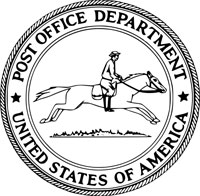
- 1860: Pony Express service initiated
- 1847: "On July 1 , 1847, the United States Post Office issued its first general issue postage stamp , a five-cent stamp honoring Benjamin Franklin , the first postmaster general under the Continental Congress, and a ten-cent stamp honoring George Washington . The first U.S. postal cards were issued in 1873, the first commemorative stamps in 1893, and the first airmail stamps in 1918. " [LOC Today in History July 1]
- 1846: The Mexican American War creates demand for news from the conflict, resulting in the creation of Associated Press. Initially AP funded a Pony Express route. [AP History]. This is soon replaced by a news over telegraph service.
- 1844-46 USPS Operates Telegraph Service: US Post Office opens and operates first telegraph line. It, of course, goes poorly. 1846 USPS Annual Report again calls for telegraph to be placed under its control, foreseeing that telegraph would disrupt mail service. [Annual Report of the Postmaster General, 1846, 689 (USPS will be ""superseded in much of its most important business in a few years, if the telegraph be permitted to remain under the control of individuals."")] USPS will make the same argument about email.
- Post Office Act of 1845 and 1851, eliminates private competition with the post office - establishing post office as a government monopoly, greatly reduces cost of postage, making it affordable for personal use (not just business and news) [USPS Monopoly 2008 4 ("the utility of the mail system to the general public was greatly increased by an act of Congress that simplified and slashed postage rates for letters, reducing the five distance-based categories down to two, and the cost of sending a letter, in some cases, by more than two-thirds. ... For example, in 1845, the cost of sending a letter from Baltimore to New York City was lowered to 5 cents, from 18.75 cents.")] [Nat. Geo. 2020]
- 1844 American Letter Mail Company established (a private postal company established in response to high USPS postal rates)
- Post Office Act of 1792 ("Under the act, newspapers would be allowed in the mails at low rates to promote the spread of information across the states. To ensure the sanctity and privacy of the mails, postal officials were forbidden to open any letters in their charge unless they were undeliverable." [Binding the Nation: Starting the System: 1792 Postal Act, SI)] [USPS Monopoly 2008 4 (low postal rates and free exchange of papers between newspapers led to numerous newspapers and high circulations; it also led to high literacy rate)]
- Sec. 22. And be it further enacted, That all newspapers, conveyed in the mail, shall be under a cover open at one end, carried in separate bags from the letters, and charged with the payment of one cent, for any distance not more than one hundred miles, and one cent and a half for any greater distance:
- 1791: Bill of Rights Ratified
- Paul Starr contrasts the new rights to those enjoyed in Britain: "Most provisions in the Bill of Rights restated rights that the English had enjoyed under the common law, but one element that grew specifically out of the Revolution era was the Fourth Amendment: "The right of the people to be secure in their persons, houses, papers, and effects, against unreasonable searches and seizures, shall not be violated, and no Warrants shall issue but upon probable cause, supported by Oath or affirmation, and particularly describing the placed to be searched, and the persons or things to be seized." The reference to "papers" underlines the historical connection of the Fourth Amendment to freedom of expression." [Starr 95]
- 1788: Ninth state ratifies Constitution giving Congress the power to establish the Postal Service.
- 1781: Congress ratifies Articles of Confederation 1777.
Article IX: "The United States in Congress assembled shall also have the sole and exclusive right and power of . . . establishing or regulating post offices from one State to another, throughout all the United States, and exacting such postage on the papers passing through the same as may be requisite to defray the expenses of the said office ."
Journals of the Continental Congress, 1774-1789, Volume XXIII, 1782 (Washington, DC: Government Printing Office, 1914), 672-673. “An Ordinance for Regulating the Post Office of the United States of America.“
- 1775: July 26 Continental Congress establishes a Post Office. Benjamin Franklin was the first Post Master. The Continental Congress was concerned to establish a postal service that was secure and free from search and seizure by British authorities - and anyone else for that matter. Postal riders "had to swear to secure his mail under lock and key" [USPS History] [PBS] [Journals of the Continental Congress, Vol. 2. p. 208, July 26, 1775 "Agreeable to the order of yesterday, the Congress resumed the consideration of the report of the Committee of the post office; which being debated by paragraphs, was agreed to as follows"] [Editorial Note of the Foundiiing of the Post Office, 26 July 1775, Founders Online, Achrives.gov "The crucial report from Frankln's committee has disappeared... the Post Office was one of the solid achievements of the period, and the one about which least is known."] [USPS Monopoly 2008 2 ("Franklin and his fellow patriots saw a robust mail system as critical to the nation’s welfare. A healthy postal network facilitated communication among army commanders and the first elected representatives, and representatives and their constituents; newspapers sent through the mail enabled Americans to participate in political life. ")]
- 1774:
- Britain dismissed Franklin as Post Master [USPS Pub. 100 Colonial Times] [PBS]
- William Goddard establishes the Continental Post, independent from the British postal service. Goddard warned about the British service:
- "Letters are liable to be stopped & opened by ministerial mandates, & their Contents construed into treasonable Conspiracies; and News Papers, those necessary and important vehicles, especially in Times of public Danger, may be rendered of little avail for want of Circulation ... " [USPS Pub. 100 Colonial Times]
- 1765: Britain imposes Stamp Tax on the colonies. A tax imposed on every piece of paper, from newspapers and documents to playing cards. Britain imposed the tax for the purpose of raising funds for the defense of the "frontier" near the Appalachian Mountains. [Williamsburg]
- 1753: Benjamin Franklin appointed Deputy Post Master of North America. [Starr 66] [PBS] [USPS Pub. 100]
- 1737: Benjamin Franklin appointed Post Master of Philadelphia. [USPS Pub. 100 Colonial Times] [Starr 60] [PBS]
- 1710: UK passes Post Office Act (aka Queen Anne Act) creating postal system in the American colonies, with a Post Master established in New York. [Queen Anne's Act, Binding the Nation SI] One purpose of the Post Office Act was to raise revenue to pay for the War of Spanish Succession "Thus the charge on a letter from New York to Philadelphia was raised from four and one-half pence to nine pence; that on a letter from Boston to Philadelphia from fifteen pence to twenty-one pence." [William Smith, The Colonial Post-Office, p 268 1916 ] [USPS Monopoly 2008 12 ("the British Crown Post hoped to profit by its mail monopoly and return its profit to Great Britain")]
- 1700s: Post Offices were frequently local taverns where mail would be delivered to be picked up be local residents, or dropped off to be picked up by a carrier. The mail sat easy exposed to the prying eyes of any gentleman who might be enjoying a beverage in the tavern. [PBS ("Letters were carried by friends, by slaves, by sea captains, and by other travelers. "Post offices" were taverns, inns, and coffee houses where these letter carriers dropped off correspondence for recipients in the locale. ")] [Colonial Post Bibliography, SI] [Colonies and the Mail, Binding the Nation, SI]
- 1692: UK Parliament grants patent to Thomas Neale to operate a post office in the American colonies.
- 1639: First notice of mail service in the colonies [USPS Pub. 100 Colonial Times]
- Nov. 5, 1639: Massachusetts establishes first colonial post office, Richard Fairbank's tavern.
- 550 BC: postal service invented Persia
- 2400 BC: courier networks found in Egypt
Laws
Books
- Paul Starr, Creation of the Media: Political Origins of Modern Communications (2004 Basic Books)
Papers
- Richard B. Kielbowicz, News in the Mail: The Press, Post Office, and Public Information, 1700-1860s (Westport, CT: Greenwood Press, 1989), 141-155.
- CARL H. SCHEELE, NEITHER SNOW NOR RAIN . . . : THE STORY OF THE UNITED STATES MAILS (1970)
- George Washington, Third Annual Message to Congress, October 25, 1791. From University of California, American Presidency Project.
- Boyce Upholt, The Tumultuous History of the US Postal Service - and its constant fight for survival, National Geo May 18, 2020 [Nat Geo 2020]
Links
- National Postal Museum
- US Postal Service,
- Benjamin Franklin, World of Influence, Man of Letters, PBS
- Colonial Williamsburg: A Summary of the Stamp Act of 1765
- Benjamin Franklin: World of Letters, PBS (2002)