 |
Cybertelecom
Federal Internet Law & Policy An Educational Project |
|
Fourth Amendment | |
|
|
The right of the people to be secure in their persons, houses, papers, and effects, against unreasonable searches and seizures, shall not be violated, and no Warrants shall issue, but upon probable cause, supported by Oath or affirmation, and particularly describing the place to be searched, and the persons or things to be seized.
"Subtler and more far reaching means of invading privacy"
Derived From: 1985 ECPA Report Chapter 2 Note that this was written in 1985, but highly reflects the tensions of the current day
Electronic surveillance is the epitome of the two-edged sword of technology for many Americans. Public opinion polls evidence considerable concern about possible excessive and abusive use of electronic surveillance by the Government (and others), and show support for strong safeguards and protections to tightly control the use of such technology. But, at the same time, the public is concerned about crime—especially violent crime—and supports the appropriate use of technology to combat and prevent crime and bring offenders to justice. ’
The capabilities for surveillance-the observation and monitoring of individual or group behavior including communication- are greatly expanded and enhanced with the use of technological devices. For example, technology makes it more efficient and less conspicuous to track movements, to hear conversations, to know the details of financial and other personal transactions, and to combine information from diverse sources into a composite file.
New surveillance tools are technically more difficult to detect, of higher reliability and sensitivity, speedier in processing time, less costly, more flexible and adaptable, and easier to conceal because of miniaturization and remote control. Current R&D will produce devices with increased surveillance capabilities, e.g., computer speech recognition and speaker identification, fiber optics, and expert systems.
From a law enforcement and investigative standpoint, the potential benefits offered through new electronic technologies may be substantial- e.g., the development of more accurate and complete information on suspects, the possible reduction in time and manpower required for case investigation, and the expansion of the options for preventing and deterring crimes. From a societal perspective, the possible benefits are also important–including the potential to increase one’s sense of physical security in the home and on the streets, improve the capability to know when someone is in need of assistance, strengthen efforts to prevent the sale of illegal substances, and enhance the protection of citizens and Government officials from terrorist actions.
However, while providing increased security, the use of sophisticated technologies for surveillance purposes also presents possible dangers to society.’ Over time, the cumulative effect of widespread surveillance for law enforcement, intelligence, or other investigatory purposes could change the climate and fabric of society in fundamental ways. For example, how will hotlines that encourage people to anonymously report potentially damaging information and one-party consent to the monitoring of conversations affect the level of trust in our society? Will private space and anonymity be preserved when individuals increasingly must make private information widely available, e.g., to banks, medical clinics, and credit agencies, in order to carry on everyday activities? How will informality and spontaneity in communications and behavior be affected as more personal activities are ‘‘on the record’ or “in view?”
But most importantly for the purposes of this study, the use of electronic surveillance devices may infringe on the protections afforded in the first amendment (freedom of speech and press, and the right to peaceably assemble and to petition the Government for a redress of grievances), fourth amendment (unreasonable searches and seizures), and fifth amendment (protection against self-incrimination). The use of such devices may also conflict with procedural and substantive protections in specific statutes, e.g., Title III of the 1968 Omnibus Crime Control and Safe Streets Act, the Privacy Act of 1974, the Foreign Intelligence Surveillance Act of 1978, the Electronic Funds Transfer Act of 1978, and the Cable Communications Policy Act of 1984.
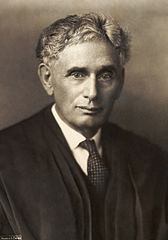
Justice Louis BrandeisMany innovations in electronic surveillance technology have outstripped constitutional and statutory protections, leaving areas in which there is currently no legal protection against, or controls on the use of, new surveillance devices. In 1928, Justice Louis Brandeis, in his dissenting opinion in Olmstead v. United States, warned that:
Subtler and more far reaching means of invading privacy have become available to the Government . . . the progress of science in furnishing the Government with means of espionage is not likely to stop with wiretapping. Ways may some day be developed by which the Government. without removing papers from secret drawers, can reproduce them in court, and by which it will be enabled to expose to a jury the most intimate occurrences of the home.Although use of some surveillance techniques requires a court order, many do not require any authorized approval and some are not even covered by judicial interpretation of the fourth amendment prohibition on unreasonable searches and seizures. Additionally, the privacy and procedural rights of those subject to surveillance may also be violated, since their activities may be monitored even though no criminal suspicion has attached to them. Finally, given the unobtrusive nature of surveillance activities, it may be difficult to detect when one’s rights have been violated.
The use of electronic surveillance devices may result in more efficient law enforcement. Their use may be required in part by the use of more evasive and sophisticated devices by those suspected of engaging in criminal activities. Yet, the cumulative impact of the increased use of surveillance, with or without a court order, is an important consideration for any society that prides itself on limited government and individual freedom.
The key policy issue is to determine the appropriate balance between the civil liberty interests and the intelligence, law enforcement, or other governmental interests involved. In some circumstances, the law enforcement interest will be great enough to outweigh the civil liberty interest. In other circumstances, the reverse will be the case. Policy, be it judicial, legislative, or administrative, seeks to define the parameters for this balancing process.
James Madison addressed this basic dilemma of democratic governments in Federalist #51:
If men were angels, no government would be necessary. If angels were to govern men, neither external nor internal controls on government would be necessary. In framing a government which is to be administered by men over men, the great difficulty lies in this: You must first enable the Government to control the governed; and in the next place, oblige it to control itself.Search and Seizure
Derived From: 1985 ECPA Report Chapter 2
The critical triggering phrase of the fourth amendment is “searches and seizures. ” If there is no search or seizure, then official behavior is not covered by the fourth amendment, and it need not be reasonable, based on probable cause, or carried out pursuant to a warrant. Although there may be statutory protections that require certain conduct, an individual does not have fourth amendment protections unless there is a search and seizure. The secondary triggering phrase of the fourth amendment is “unreasonable.” Even if official conduct is regarded as a search or seizure, there is no invasion of fourth amendment protections if the conduct is reasonable. Determination of reasonableness depends on the judicial balancing of the individual interest, generally regarded as a privacy interest, against the governmental interest, including law and order, national security, internal security, and the proper administration of the laws. Reasonableness generally entails a predicate of probable cause and, with many exceptions, the issuance of a warrant.
The meaning and scope of the fourth amendment have involved judicial construction of these key phrases. Definition of “searches” has come to be a crazy patchwork quilt, depending partly on whether the search involves a person’s body or home, partly on how public the activity is, partly on the degree of invasion or intrusiveness involved in conducting the search, partly on the facts of the case under consideration, and partly on who is on the Court.
Derived From: Searching and Seizing Computers and Obtaining Electronic Evidence in Criminal Investigations
Computer Crime and Intellectual Property Section, Criminal Division, DOJ (2009) (NB: This is a rendition of the state of the law from law enforcement and reflects their views)
According to the Supreme Court, a "'seizure' of property occurs when there is some meaningful interference with an individual's possessory interests in that property," United States v. Jacobsen, 466 U.S. 109, 113 (1984), and the Court has also characterized the interception of intangible communications as a seizure. See Berger v. New York, 388 U.S. 41, 59-60 (1967). Furthermore, the Court has held that a "'search' occurs when an expectation of privacy that society is prepared to consider reasonable is infringed." Jacobsen, 466 U.S. at 113. If the government's conduct does not violate a person's "reasonable expectation of privacy," then formally it does not constitute a Fourth Amendment "search" and no warrant is required. See Illinois v. Andreas, 463 U.S. 765, 771 (1983). In addition, a warrantless search that violates a person's reasonable expectation of privacy will nonetheless be constitutional if it falls within an established exception to the warrant requirement. See Illinois v. Rodriguez, 497 U.S. 177, 185-86 (1990). Accordingly, investigators must consider two issues when asking whether a government search of a computer requires a warrant. First, does the search violate a reasonable expectation of privacy? And if so, is the search nonetheless permissible because it falls within an exception to the warrant requirement?
See Expectation of Privacy
|
From the movie Brazil: Sam Lowry: My name's Lowry. Sam Lowry. I've been told to report to Mr. Warren.Porter - Information Retrieval: Thirtieth floor, sir. You're expected. Sam Lowry: Um... don't you want to search me? Porter - Information Retrieval: No sir. Sam Lowry: Do you want to see my ID? Porter - Information Retrieval: No need, sir. Sam Lowry: But I could be anybody. Porter - Information Retrieval: No you couldn't sir. This is Information Retrieval. |
Private Searches
The Fourth Amendment "is wholly inapplicable to a search or seizure, even an unreasonable one, effected by a private individual not acting as an agent of the Government or with the participation or knowledge of any governmental official." United States v. Jacobsen, 466 U.S. 109, 113 (1984) (internal quotation marks omitted). As a result, no violation of the Fourth Amendment occurs when a private individual acting on his own accord conducts a search and makes the results available to law enforcement. See id. According to Jacobsen, agents who learn of evidence via a private search can reenact the original private search without violating any reasonable expectation of privacy. What the agents cannot do without a warrant is "exceed[] the scope of the private search." Id. at 115. See also United States v. Miller, 152 F.3d 813, 815-16 (8th Cir. 1998); United States v. Donnes, 947 F.2d 1430, 1434 (10th Cir. 1991). But see United States v. Allen, 106 F.3d 695, 699 (6th Cir. 1997) (stating in dicta that Jacobsen does not permit law enforcement to reenact a private search of a private home or residence). This standard requires agents to limit their investigation to the scope of the private search when searching without a warrant after a private search has occurred. Where agents exceed the scope of the private warrantless search, any evidence uncovered may be vulnerable to a motion to suppress. Private individuals often find contraband or other incriminating evidence on computers and bring that information to law enforcement, and the private search doctrine applies in these cases. In one common scenario, an individual leaves his computer with a repair technician. The technician discovers images of child pornography on the computer, contacts law enforcement, and shows those images to law enforcement. Courts have agreed that such searches by repairmen prior to their contact with law enforcement are private searches and do not implicate the Fourth Amendment. See United States v. Grimes, 244 F.3d 375, 383 (5th Cir. 2001); United States v. Hall, 142 F.3d 988, 993 (7th Cir. 1998); United States v. Anderson, 2007 WL 1121319 at *5-6 (N.D. Ind. Apr. 16, 2007); United States v. Grant, 434 F. Supp. 2d 735, 744-45 (D. Neb. 2006); United States v. Caron, 2004 WL 438685, at *4-5 (D. Me. Mar. 9, 2004); see also United States v. Kennedy, 81 F. Supp. 2d 1103, 1112 (D. Kan. 2000) (concluding that searches of defendant's computer over the Internet by an anonymous caller and employees of a private ISP did not violate Fourth Amendment because there was no evidence that the government was involved in the search).One private search question that arises in computer cases is whether law enforcement agents must limit themselves to only files examined by the repair technician or whether all data on a particular storage device is within the scope of the initial private search. The Fifth Circuit has taken an expansive approach to this question. See United States v. Runyan, 275 F.3d 449, 464-65 (5th Cir. 2001) (police did not exceed the scope of a private search when they examined more files on privately searched disks than had the private searchers). Under this approach, a third-party search of a single file on a computer allows a warrantless search by law enforcement of the computer's entire contents. See id. Other courts, however, may not follow the Fifth Circuit's approach and instead rule that government searchers can view only those files whose contents were revealed in the private search. See United States v. Barth, 26 F. Supp. 2d 929, 937 (W.D. Tex. 1998) (holding, in a pre-Runyan case, that agents who viewed more files than private searcher exceeded the scope of the private search). Even if courts follow the more restrictive approach, the information gleaned from the private search will often provide the probable cause needed to obtain a warrant for a further search. Importantly, the fact that the person conducting a search is not a government employee does not always mean that the search is "private" for Fourth Amendment purposes. A search by a private party will be considered a Fourth Amendment government search "if the private party act[s] as an instrument or agent of the Government." Skinner v. Railway Labor Executives' Ass'n, 489 U.S. 602, 614 (1989). The Supreme Court has offered little guidance on when private conduct can be attributed to the government; the Court has merely stated that this question "necessarily turns on the degree of the Government's participation in the private party's activities, . . . a question that can only be resolved 'in light of all the circumstances.'" Id. at 614-15 (quoting Coolidge v. New Hampshire, 403 U.S. 443, 487 (1971)).In the absence of a more definitive standard, the various federal Courts of Appeals have adopted a range of approaches for distinguishing between private and government searches. About half of the circuits apply a "totality of the circumstances" approach that examines three factors: whether the government knows of or acquiesces in the intrusive conduct; whether the party performing the search intends to assist law enforcement efforts at the time of the search; and whether the government affirmatively encourages, initiates, or instigates the private action. See, e.g., United States v. Pervaz, 118 F.3d 1, 6 (1st Cir. 1997); United States v. Smythe, 84 F.3d 1240, 1242-43 (10th Cir. 1996); United States v. McAllister, 18 F.3d 1412, 1417-18 (7th Cir. 1994); United States v. Malbrough, 922 F.2d 458, 462 (8th Cir. 1990). This test draws a line between situations where the government is a mere knowing witness to the search and those where the government is an active participant or driving force. However, this line can be difficult to discern. For example, in United States v. Smith, 383 F.3d 700 (8th Cir. 2004), police detectives participating in "parcel interdiction" at Federal Express removed a suspicious package from a conveyer belt, submitted it to a canine sniff, and delivered the package to the Federal Express manager, telling the manager that "if she wanted to open it that would be fine." However, because the police did not actually ask or order the manager to open the package, and because there was no evidence that the manager felt obligated to open the package, the Court found that the manager was not a "government agent" for Fourth Amendment purposes. Id. at 705. See also United States v. Momoh, 427 F.3d 137, 141-42 (1st Cir. 2005) (DHL employee's desire to comply with FAA regulations did not make her a government agent absent "affirmative encouragement"). By contrast, in United States v. Souza, 223 F.3d 1197 (10th Cir. 2000), the Court found that a UPS employee was a government agent. In Souza, the police identified and removed the package from the conveyer belt, submitted it to a canine sniff, and told the UPS employee that they suspected it contained drugs. The police then told the employee that they could not tell her to open the package, but they pointed to it and said "but there it is on the floor." Id. at 1200. The employee began to open the package, but when she had difficulty, the police assisted her. While the officers' actual aid in opening the package made this an easy case, the Court's analysis suggests that the officers' other actions-identifying the package and encouraging the employee to open it-might have made the employee a government agent, particularly without evidence that the employee had an independent motivation to open it. See id. at 1202.Other circuits have adopted more rule-like tests that focus on only the first two factors. See, e.g., United States v. Miller, 688 F.2d 652, 657 (9th Cir. 1982) (holding that private action counts as government conduct if, at the time of the search, the government knew of or acquiesced in the intrusive conduct, and the party performing the search intended to assist law enforcement efforts); United States v. Paige, 136 F.3d 1012, 1017 (5th Cir. 1998) (same); United States v. Lambert, 771 F.2d 83, 89 (6th Cir. 1985) (holding that a private individual is a state actor for Fourth Amendment purposes if the police instigated, encouraged, or participated in the search, and the individual engaged in the search with the intent of assisting the police in their investigative efforts).Two noteworthy private search cases involve an individual who hacked into computers of child pornographers for the purpose of collecting and disclosing evidence of their crimes. The hacker, who refused to identify himself or meet directly with law enforcement, emailed the incriminating evidence to law enforcement. In both cases, the evidence was admissible because when it was gathered, the individual was not an agent of law enforcement. In the first case, United States v. Steiger, 318 F.3d 1039 (11th Cir. 2003), the court had little difficulty in determining that the search did not implicate the Fourth Amendment. Because the relevant searches by the hacker took place before the hacker contacted law enforcement, the hacker was not acting as a government agent, and the private search doctrine applied. See id. at 1045. In the Steiger case, a law enforcement agent thanked the anonymous hacker, assured him he would not be prosecuted, and expressed willingness to receive other information from him. Approximately a year later (and seven months after his last previous contact with law enforcement), the hacker provided to law enforcement information he had illegally obtained from another child pornographer, which gave rise to United States v. Jarrett, 338 F.3d 339 (4th Cir. 2003). In Jarrett, the court ruled that although "the Government operated close to the line," the contacts in Steiger between the hacker and law enforcement did not create an agency relationship that carried forward to Jarrett. Id. at 346-47. Moreover, although the government created an agency relationship through further contacts with the hacker during the second investigation, that agency relationship arose after the relevant private search and disclosure. See id. at 346. Thus, the hacker's private search in Jarrett did not violate the Fourth Amendment.