
|
Cybertelecom Federal Internet Law & Policy An Educational Project |

|
Disclosure |
|
|
|
Consumers of network service need information in order to make informed choices and use network services. Disclosure addresses required information publicly provided by network providerss to third parties who interface with the network: customers (individuals, edge providers), people building apps and services over the network, and third parties interconnecting with the network (CPE and network interconnection).
Initial network information disclosure was straight forward: required tariffs included rates, routes, and terms of service. For example, with telegraph service, a company may disclose that a customer could have an unrepeated message for a cheaper price, but with no liability from the carrier; or the customer could have a repeated message for a higher price and liability on the part of the carrier for accurate transmission. As network technology evolved, so did the customer. The customer changed from simply inserting a message into a network and expecting it to come out the other side - to attaching customer premise equipment (CPE, IMPs, routers, modems) to the telephone network, building virtual overlay networks, and expecting data to come out accurately on the other side. The telephone network afforded only the attachment of hardware (CPE); the Internet evolved the network ecosystem to support the use of higher layer applications and services over a data network; in order to use the service, third parties need disclosure of the characteristics of the network service.
- US Postal Service: Tariffs: rates, routes, terms
- Telegraph: ICA Sec. 6: tariffs: rates, routes, terms
- Telephone:
- Tariffs: rates, routes, terms
- Network Information Disclosure
- Computer III: Comparably Efficient Interconnection and Open Network Architecture
- Part 68 Technical Interconnection Disclosures
- Internet:
- Open Internet Disclosure;
- Peering Policy Disclosure
- Measuring Broadband America (performance measurements disclosed by government)
- BTOP Disclosure Requirements
Internet over the Communications Network :: Computer Inquiries
Initially, the Internet was an overlay network, built over the telephone network. The Policy which ensured that computer networks had the resources they needed in order to do cool things was known as the Computer Inquiries. In order for computer companies to build data networks out of telecommunications networks, they needed information. As a result, as part of the Computer Inquiries, the FCC implemented Network Information Disclosure requirements.
Internet is the Communications Network :: Open Internet
The Broadband Policy
The Internet evolved into "Internet Broadband Service" in the 2000s. As the Internet became critical infrastructure in society and the economy, disclosure rules were introduced.
In 2005, Chairman Michael Powell gave have his "Four Freedoms" Speech, including disclosure:
Consumers should receive meaningful information concerning their service plans.Ch. Powell elaborated:
Simply put, such information is necessary to ensure that the market is working. Providers have every right to offer a variety of service tiers with varying bandwidth and feature options. Consumers need to know about these choices as well as whether and how their service plans protect them against spam, spyware and other potential invasions of privacy.When the Four Freedoms were formally published as the Broadband Policy Statement as part of the Internet over Wireline Facilities Order in August of 2005, the disclosure obligation was not included.
In 2008, Free Press and Public Knowledge alleged that Comcast was blocking the Bittorrent application in violation of the Broadband Policy Statement. Concluding its investigation and finding Comcast at fault, the FCC stated
Although we have not adopted (and we decline to adopt today) general disclosure requirements for the network management practices of providers of broadband Internet access services, the anticompetitive harm perpetuated by discriminatory network management practices is clearly compounded by failing to disclose such practices to consumers. Many consumers experiencing difficulty using only certain applications will not place blame on the broadband Internet access service provider, where it belongs, but rather on the applications themselves, thus further disadvantaging those applications in the marketplace. On the other hand, disclosure of network management practices to consumers in a manner that customers of ordinary intelligence would reasonably understand would enhance the “vibrant and competitive free market . . . for the Internet and interactive computer services” by allowing consumers to compare and contrast competing providers’ practices. [Comcast Order 2008 para. 52]Not having adopted nor adopting a disclosure rule, the FCC nonetheless concluded, "To the extent that Comcast wishes to employ capacity limits in the future, it should disclose those to customers in clear terms" [Comcast Order 2008 para. 53]
Open Internet
The 2017 Restoring Internet Freedom Order (Pai) rescinded the 2015 Order [RIF para 225], affirmed the 2010 Order [RIF para 215, 229]... mostly, and transferred jurisdiction of enforcement to the Federal Trade Commission. [RIF 209 ("Properly tailored transparency disclosures provide valuable information to the Commission to enable it to meet its statutory obligation to observe the communications marketplace to monitor the introduction of new services and technologies, and to identify and eliminate potential marketplace barriers for the provision of information services. Such disclosures also provide valuable information to other Internet ecosystem participants; transparency substantially reduces the possibility that ISPs will engage in harmful practices, and it incentivizes quick corrective measures by providers if problematic conduct is identified. Appropriate disclosures help consumers make informed choices about their purchase and use of broadband Internet access services. Moreover, clear disclosures improve consumer confidence in ISPs’ practices while providing entrepreneurs and other small businesses the information they may need to innovate and improve products.")]
Any person providing broadband Internet access service shall publicly disclose accurate information regarding the network management practices, performance, and commercial terms of its broadband Internet access services sufficient to enable consumers to make informed choices regarding the purchase and use of such services and entrepreneurs and other small businesses to develop, market, and maintain Internet offerings. Such disclosure shall be made via a publicly available, easily accessible website or through transmittal to the Commission.[RIF para 215]. Authority: Sec. 257(c). [RIF para 232].
Rescinded: The 2015 Open Internet Order (Wheeler) clarified and enhanced the 2010 OI transparency rules. Authority: Title II [OI 2015 para 161 "all of the pieces of information described in paragraphs 56 and 98 of the Open Internet Order have been required as part of the current transparency rule, and we will continue to require the information as part of our enhanced rule"] [EB Advisory 2016]
Affirmed: The 2010 Open Internet order (Genachowski) included a disclosure obligation:
A person engaged in the provision of broadband Internet access service shall publicly disclose accurate information regarding the network management practices, performance, and commercial terms of its broadband Internet access services sufficient for consumers to make informed choices regarding use of such services and for content, application, service, and device providers to develop, market, and maintain Internet offerings.[OI 2010 para 54] [EB Advisory 2011] [Verizon v. FCC, 740 F.3d at 659, affirming disclosure obligation] Authority: Section 706.
Disclosure Information
"We expect that effective disclosures will likely include some or all of the following types of information, timely and prominently disclosed in plain language accessible to current and prospective end users and edge providers, the Commission, and third parties who wish to monitor network management practices for potential violations of open Internet principles... We emphasize that this list is not necessarily exhaustive, nor is it a safe harbor-there may be additional information, not included above, that should be disclosed for a particular broadband service to comply with the rule in light of relevant circumstances. Broadband providers should examine their network management practices and current disclosures to determine what additional information, if any, should be disclosed to comply with the rule.: [OI R&O 2010 para 56] [Guidance 2011]
Network Management Practices
- Congestion Management: If applicable, descriptions of congestion management practices; types of traffic subject to practices; purposes served by practices; practices' effects on end users' experience; criteria used in practices, such as indicators of congestion that trigger a practice, and the
typical frequency of congestion; usage limits and the consequences of exceeding them; and references to engineering standards, where appropriate. [177]
- OI Rules 2010 para 161 ("The only exception is the requirement to disclose “typical frequency of congestion,” which we no longer require since it is superseded by more precise disclosures already required by the rule, such as actual performance")
- Application-Specific Behavior: If applicable, whether and why the provider blocks or rate-controls specific protocols or protocol ports, modifies protocol fields in ways not prescribed by the protocol standard, or otherwise inhibits or favors certain applications or classes of applications. [178]
- Device Attachment Rules: If applicable, any restrictions on the types of devices and any approval procedures for devices to connect to the network. (For further discussion of required disclosures regarding device and application approval procedures for mobile broadband providers, see paragraph 98 , infra .)
- Security: If applicable, practices used to ensure end-user security or security of the network, including types of triggering conditions that cause a mechanism to be invoked (but excluding information that could reasonably be used to circumvent network security).
"In response to the statement in the Open Internet Order that effective disclosures "will likely include" information concerning "practices used to ensure end-user security or security of the network," several commenters argued that because broadband providers employ a host of security measures and constantly update them, keeping disclosures up to date in this area will be unduly burdensome. We expect broadband providers to use sound judgment in deciding whether it is necessary and appropriate to disclose particular security measures. In making that determination, the touchstone is that providers must disclose information "sufficient for consumers to make informed choices regarding use of such services and for content, application, service, and device providers to develop, market, and maintain Internet offerings." As that standard suggests, the Commission is concerned with security measures likely to affect a consumer's ability to access the content, applications, services, and devices of his or her choice. Thus, for example, we would expect broadband providers to disclose if security measures intended to prevent the spread of viruses, malware, spam, or other threats to consumers also prevented end users from running a mail server or web server using their broadband connection. But we would not expect providers to disclose internal network security measures, such as routing security practices, that do not directly bear on a consumer's choices. "[Guidance]
Para 55. The rule does not require public disclosure of competitively sensitive information or information that would compromise network security or undermine the efficacy of reasonable network management practices. [173] For example, a broadband provider need not publicly disclose information regarding measures it employs to prevent spam practices at a level of detail that would enable a spammer to defeat those measures.
2015 OI Rules para 169: "we further clarify that disclosure of network practices shall include practices that are applied to traffic associated with a particular user or user group, including any application-agnostic degradation of service to a particular end user. We also clarify that disclosures of user-based or application-based practices should include the purpose of the practice , which users or data plans may be affected, the triggers that activate the use of the practice, the types of traffic that are subject to the practice, and the practices likely effects on end users experiences. While some of these disclosures may have been required in certain circumstances under the existing transparency rule, here we clarify that this information should always be disclosed. These disclosures with respect to network practices are necessary: for the public and the Commission to know about the existence of network practices that may be evaluated under the rules, for users to understand when and how practices may affect them, and for edge providers to develop Internet offerings."
See also
- Network Assessment and Measurement
- Network Outage Reporting
- Measuring Broadband America (FCC Sec. 706)
- Open Internet Transparency
- AT&T / DirecTV Merger Conditions (interconnection congestion monitoring)
- NRIC Recommendation re Peering Policy Disclosure
Performance Characteristics
- Service Description: A general description of the service, including the service technology, expected and actual access speed, latency
and packet loss*,and the suitability of the service for real-time applications."The Open Internet Order requires broadband providers to disclose accurate information regarding network performance for each broadband service they offer. [OI 2010 paras 54, 56] As noted in the Order, the Commission has launched a broadband performance measurement project to accurately measure key performance metrics, including baseline connection speed and latency...." [Participation in Measuring Broadband America was considered a Safe Harbor for the performance disclosure requirement per 2011 guidance]
2015 OI Rules para 166 rescinded:
- We expect that disclosures to consumers of actual network performance data should be reasonably related to the performance the consumer would likely experience in the geographic area in which the consumer is purchasing service.
- We also expect that network performance will be measured in terms of average performance over a reasonable period of time and during times of peak usage.
- We clarify that, for mobile broadband providers, the obligation in the existing transparency rule to disclose network performance information for each broadband service refers to separate disclosures for services with each technology (e.g., 3G and 4G). Furthermore, with the exception of small providers, mobile broadband providers today can be expected to have access to reliable actual data on performance of their networks representative of the geographic area in which the consumer is purchasing servicethrough their own or third-party testingthat would be the source of the disclosure. Commission staff also continue to refine the mobile MBA program, which could at the appropriate time be declared a safe harbor for mobile broadband providers.
We decline to otherwise codify specific methodologies for measuring the actual performance required by the existing transparency rule. We find that, as in 2010, there is benefit in permitting measurement methodologies to evolve and improve over time, with further guidance from Bureaus and Officeslike in 2011as to acceptable methodologies. We delegate authority to our Chief Technologist to lead this effort.
"Fixed Broadband. To satisfy their obligations under the transparency rule, the 13 fixed broadband providers that chose to participate in the broadband performance measurement project... may disclose their results from the project as a sufficient representation of the actual performance their customers can expect to experience. For example, for a particular tier of service, a broadband provider could disclose data from the project showing the mean upload and download speeds in megabits per second during the "busy hour" between 7:00 p.m. and 11:00 p.m. on weeknights. Similarly, broadband providers could report mean roundtrip latency during this time period.
"Providers that have not participated in the performance measurement project to date may use the methodology developed through the project--which will be released along with the project's initial results - to measure the actual performance of their broadband offerings. Alternatively, a broadband provider may disclose actual performance based on internal testing; consumer speed test data; or other data regarding network performance, including reliable, relevant data from third-party sources such as the broadband performance measurement project.
"Mobile Broadband. The Commission has recognized that measuring performance can be more challenging for mobile broadband than for fixed, and is in the process of obtaining data regarding mobile broadband performance that will help facilitate mobile broadband providers' disclosure of actual performance, as the broadband performance measurement project data will do for fixed services. Once that data has been reviewed, we anticipate the Commission or the Bureau providing further guidance regarding specific methods of disclosing performance information. Until then, mobile broadband providers that have access to reliable information on network performance may disclose the results of their own or third-party testing; many mobile providers routinely receive such performance data. This disclosure could include mean upload and download speeds in megabits per second and mean roundtrip latency. We recognize that some mobile broadband providers, particularly small providers, may not have or reasonably be able to obtain reliable information on their network performance metrics such as mean upload and download speeds. Such a provider that lacks reasonable access to this network performance information may disclose a Typical Speed Range (TSR) representing the range of speeds and latency that can be expected by most of their customers, for each technology/service tier offered, along with a statement that such information is the best approximation available to the broadband provider of the actual speeds and latency experienced by its subscribers. For example, they could disclose that their 3G offerings typically provide download speeds between X and Y kilobits per second. We encourage fixed and mobile providers to disclose the source of their performance measurements and the underlying methodology used to evaluate performance. We expect fixed and mobile broadband providers to reevaluate their performance disclosures whenever they know or have reason to believe that the actual performance of their services has come to differ materially from the performance reported in their disclosures." [Guidance]
* "Packet loss" added by 2015 OI Rules para 161.
- Nicholas Weaver, Wait: That Scary Network Neutrality Packet-Loss Clause Isnt that Bad, Forbes March 12, 2015 ("The order itself first makes clear that, unlike the press release, loss is simply an additional metric alongside existing latency and bandwidth disclosures. This makes it far less likely that a network will optimize for zero loss, as such optimizations will significantly impact latency, relieving my initial fears. ")
- Steve Bellovin, Packet Loss: How the Internet Enforces Speed Limits, CircleID (2015) ("one particular point has caught the eye of network engineers everywhere: the statement that packet loss should be published as a performance metric, with the consequent implication that ISPs should strive to achieve as low a value as possible. That would be very bad thing to do.")
- Nicholas Weaver, This one clause in the new Net Neutrality Regs Would be a Fiasco for the Internet, ForbesFeb. 27, 2015 ("If ISPs optimize to minimize loss (the only performance metric mentioned in the press release!), this will kill interactive video like Skype, FaceTime, and Google hangouts and also decimate high-interactivity online games, so also say goodbye to League of Legends, CounterStrike, Call of Duty, Defense of the Ancients. Unless the FCC removes this clause, the regulations are likely to seriously damage the Internet.")
- Impact of
Specialized Servicesnon-BIAS data services: If applicable, what specialized services, if any, are offered to end users, and whether and how any specialized services may affect the last-mile capacity available for, and the performance of, broadband Internet access service. 2015 OI Rules para 167.Commercial Terms
- Pricing: For example, monthly prices, usage-based fees, and fees for early termination or additional network services.
- OI Rules 2015 Enhancement para 164: we specify the disclosures of commercial terms for prices, other fees, and data caps and allowances as follows:
- Price the full monthly service charge. Any promotional rates should be clearly noted as such, specify the duration of the promotional period, and note the full monthly service charge the consumer will incur after the expiration of the promotional period.
- Other Fees all additional one time and/or recurring fees and/or surcharges the consumer may incur either to initiate, maintain, or discontinue service, including the name, definition, and cost of each additional fee. These may include modem rental fees, installation fees, service charges, and early termination fees, among others.
- Data Caps and Allowances any data caps or allowances that are a part of the plan the consumer is purchasing, as well as the consequences of exceeding the cap or allowance (e.g., additional charges, loss of service for the remainder of the billing cycle).
- Privacy Policies: For example, whether network management practices entail inspection of network traffic, and whether traffic information is stored, provided to third parties, or used by the carrier for non-network management purposes.
- Redress Options: Practices for resolving end-user and edge provider complaints and questions.
Form of Disclosure
2015 OI Rules para 171
We enhance the rule to require a mechanism for directly notifying end users if their individual use of a network will trigger a network practice, based on their demand prior to a period of congestion, that is likely to have a significant impact on the end user’s use of the service. The purpose of such notification is to provide the affected end users with sufficient information and time to consider adjusting their usage to avoid application of the practice.
57. In the Open Internet NPRM , we proposed that broadband providers publicly disclose their practices on their websites and in promotional materials. [181] Most commenters agree that a provider's website is a natural place for end users and edge providers to find disclosures, [182] and several contend that a broadband provider's only obligation should be to post its practices on its website. [183] Others assert that disclosures should also be displayed prominently at the point-of-sale, in bill inserts, and in the service contract. [184] We agree that broadband providers must, at a minimum, prominently display or provide links to disclosures on a publicly available, easily accessible website that is available to current and prospective end users and edge providers as well as to the Commission, and must disclose relevant information at the point of sale. Current end users must be able to easily identify which disclosures apply to their service offering. Broadband providers' online disclosures shall be considered disclosed to the Commission for purposes of monitoring and enforcement. We may require additional disclosures directly to the Commission. [185]
58. We anticipate that broadband providers may be able to satisfy the transparency rule through a single disclosure, and therefore do not at this time require multiple disclosures targeted at different audiences. [186] We also decline to adopt a specific format for disclosures, and instead require that disclosure be sufficiently clear and accessible to meet the requirements of the rule. [187] We will, however, continue to monitor compliance with this rule, and may require adherence to a particular set of best practices in the future. [188]
"The Open Internet Order requires broadband providers to disclose network management practices, performance characteristics, and commercial terms "at the point of sale." [para 57] ... The Commission [stated] that "broadband providers must, at a minimum, prominently display or provide links to disclosures on a publicly available, easily accessible website that is available to current and prospective end users and edge providers." The Commission further explained in the Order that it anticipated that "broadband providers may be able to satisfy the transparency rule through a single disclosure." Accordingly, we clarify that the Order does not compel the distribution of disclosure materials in hard copy or extensive training of sales employees to provide the disclosures themselves. Broadband providers can comply with the point-of-sale requirement by, for instance, directing prospective customers at the point of sale, orally and/or prominently in writing, to a web address at which the required disclosures are clearly posted and appropriately updated. The address provided should enable consumers easily to find the disclosures, rather than, for example, leading to a broadband provider's general purpose home page from which the disclosures are not clearly and readily accessible. At brick-and-mortar retail outlets (i.e., not telephone or Internet sales centers), broadband providers that rely on a web page for point-of-sale disclosure should make available equipment, such as a computer, tablet, or smartphone, through which customers can access the disclosures." [Guidance]
Small Providers
2015 OI Rules para 172-175 "Out of an abundance of caution, we grant a temporary exemption for these providers, with the potential for that exemption to become permanent.... Accordingly, we hereby adopt a temporary exemption from the enhancements to the transparency rule for those providers of broadband Internet access service (whether fixed or mobile) with 100,000 or fewer broadband subscribers as per their most recent Form 477, aggregated over all the providers’ affiliates... Accordingly, the exemption we adopt is only temporary. We delegate to the Consumer & Governmental Affairs Bureau (CGB) the authority to determine whether to maintain the exemption and, if so, the appropriate threshold for it... To be clear, all providers of broadband Internet access service, including small providers, remain subject to the existing transparency rule adopted in 2010. The temporary exemption adopted today, and any permanent exemption adopted by CGB, applies only to the enhanced disclosures described above. "
- SMALL BUSINESS EXEMPTION FROM OPEN INTERNET ENHANCED TRANSPARENCY REQUIREMENTS. The Commission adopts an Order granting a five-year waiver to broadband Internet access service providers with 250,000 or fewer broadband connections from the enhanced reporting requirements adopted in the 2015 Title II Order. (Dkt No. 14-28 ). Action by: the Commission. Adopted: 02/23/2017 by ORDER. (FCC No. 17-17). CGB https://apps.fcc.gov/edocs_public/attachmatch/FCC-17-17A1.docx
https://apps.fcc.gov/edocs_public/attachmatch/FCC-17-17A2.docx
https://apps.fcc.gov/edocs_public/attachmatch/FCC-17-17A3.docx
https://apps.fcc.gov/edocs_public/attachmatch/FCC-17-17A4.docx
https://apps.fcc.gov/edocs_public/attachmatch/FCC-17-17A1.pdf
https://apps.fcc.gov/edocs_public/attachmatch/FCC-17-17A2.pdf
https://apps.fcc.gov/edocs_public/attachmatch/FCC-17-17A3.pdf
https://apps.fcc.gov/edocs_public/attachmatch/FCC-17-17A4.pdf- FCC VOTES TO PROTECT SMALL BUSINESSES FROM NEEDLESS REGULATION. Service Providers with 250,000 Broadband Connections Are Relieved from Excessive Reporting Obligations. News Release. (Dkt No 14-28 ). Adopted: 02/23/2017.CGB https://apps.fcc.gov/edocs_public/attachmatch/DOC-343609A1.docx https://apps.fcc.gov/edocs_public/attachmatch/DOC-343609A2.docx https://apps.fcc.gov/edocs_public/attachmatch/DOC-343609A3.docx https://apps.fcc.gov/edocs_public/attachmatch/DOC-343609A4.docx https://apps.fcc.gov/edocs_public/attachmatch/DOC-343609A1.pdf https://apps.fcc.gov/edocs_public/attachmatch/DOC-343609A2.pdf https://apps.fcc.gov/edocs_public/attachmatch/DOC-343609A3.pdf https://apps.fcc.gov/edocs_public/attachmatch/DOC-343609A4.pdf
- U.S. House of Representatives Passes Small ISP Transparency Exemption, Shirley's Blog Jan. 10, 2017 ("I was delighted and relieved to hear this afternoon when the House passed, by a voice vote nonetheless, the Small Business Broadband Deployment Act (H.R. 288), legislation which would exempt small broadband internet service providers from the FCC’s 2015 enhanced transparency requirements for five years from the date upon which it is enacted, with small ISPs defined as those with not more than 250,00 subscribers on their books.")
- Chmn. Pai on Vote to Protect Small Businesses from Needless Regulation Jan. 27, 2017 ("Today, I am pleased to announce that I have circulated to my colleagues an order that would waive for five years the enhanced transparency reporting requirements for small businesses with no more than 250,000 subscribers. This order mirrors the bipartisan compromise reflected in the Small Business Broadband Deployment Act of 2017legislation introduced by Chairman Greg Walden of the House Energy and Commerce Committee and Representative Dave Loebsack (and which has received a unanimous vote in the House of Representatives), as well as Senators Steve Daines and Joe Manchin.")
- COMMISSIONER CLYBURN STATEMENT ON SMALL BUSINESS EXEMPTION. STMT. News Media OCMC https://apps.fcc.gov/edocs_public/attachmatch/DOC-343074A1.docx
https://apps.fcc.gov/edocs_public/attachmatch/DOC-343074A1.pdf- December 19, 2016 - Letter Commissioners Pai and O'Rielly Letter re: Small Business Exemption
- OPEN INTERNET SMALL BUSINESS EXEMPTION EXTENSION ORDER. Consumer and Governmental Affairs Bureau Order extending the temporary exemption for smaller providers from enhanced transparency requirements. Action by: Acting Chief, Consumer and Governmental Affairs Bureau. Adopted: 12/15/2015 by R&O. (DA No. 15-1425). CGB

Enforcement
- AT&T Mobility, LLC, Notice of Apparently Liability File No. EB-IHD-14-00017504 (June 17, 2015) (fining AT&T Mobility for failure to disclose throttling of "unlimited" data plans)
- See Neutral Not :: Throttling
- FCC PLANS TO FINE AT&T $100 MILLION FOR MISLEADING CONSUMERS ABOUT UNLIMITED DATA PLANS, VIOLATING TRANSPARENCY OBLIGATIONS. News Release. News Media EB DOC | PDF
Government Activity
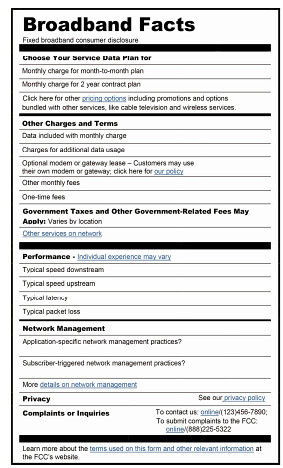
- Guidance on Open Internet Transparency Rule Requirements, GN Docket No. 14-28, Public Notice, 31 FCC Rcd 5330 (2016) (rescinded by RIF 2018, para 225) [EB Advisory 2016]
- FCC Enforcement Advisory, Open Internet Transparency Rule: Broadband Providers Must Disclose Accurate Information to Protect Consumers, Public Notice, 29 FCC Rcd 8606, 8607 (2014) [EB Advisory 2014]
- Enforcement Bureau and Office of General Counsel Issue Advisory Guidance for Compliance with Open Internet Transparency Rule, Public Notice, WC Docket No. 09-191, 26 FCC Rcd 9411 (2011) [EB Advisory 2011]
- Protecting and Promoting the Open Internet, Fed Reg, Final rule; announcement of applicability date., 12/21/2017 In this document, the Commission announces that the Office of Management and Budget (OMB) has approved, for a period of three years for fixed broadband Internet access service (3060-1158) and for a period of two years for mobile broadband Internet access service (3060-1220), the information collections associated with the transparency rule enhancements adopted by the Commission in Protecting and Promoting the Open Internet, Report and Order on Remand, Declaratory Ruling, and Order (Open Internet Order).
- Guidance on Open Internet Transparency Rule
- Released: 04/04/2016. CONSUMER AND GOVERNMENTAL AFFAIRS, WIRELINE COMPETITION, AND WIRELESS TELECOMMUNICATIONS BUREAUS APPROVE OPEN INTERNET BROADBAND CONSUMER LABELS. (DA No. 16-357). (Dkt No 14-28 ). WTB CGB WCB .

- FCC UNVEILS CONSUMER BROADBAND LABELS TO PROVIDE GREATER TRANSPARENCY TO CONSUMERS. Labels Will Help Consumers Make Informed Broadband Purchasing Decisions and Serve as a Safe Harbor Format for Meeting Transparency Rule Requirements. News Release. News Media CGB
- CHAIRMAN WHEELER'S PROPOSAL TO GIVE BROADBAND CONSUMERS INCREASED CHOICE, TRANSPARENCY & SECURITY WITH RESPECT TO THEIR DATA. FACT SHEET. OCHTW https://apps.fcc.gov/edocs_public/attachmatch/DOC-338159A1.docx
https://apps.fcc.gov/edocs_public/attachmatch/DOC-338159A1.pdf
- Released: 07/07/2015. CONSUMER AND GOVERNMENTAL AFFAIRS BUREAU ANNOUNCES COMMENT DATES FOR SMALL BUSINESS EXEMPTION FROM OPEN INTERNET ENHANCED TRANSPARENCY REQUIREMENTS. (DA No. 15-791). (Dkt No 14-28 ). Comments Due: 08/05/2015. Reply Comments Due: 09/04/2015. CGB .https://apps.fcc.gov/edocs_public/attachmatch/DA-15-791A1.docx
https://apps.fcc.gov/edocs_public/attachmatch/DA-15-791A1.pdf- FCC Enforcement Advisory, Open Internet Transparency Rule: Broadband Providers Must Disclose Accurate Information to Protect Consumers, Public Notice, 29 FCC Rcd 8606, 8607 (2014)
- Released: 07/23/2014. FCC ENFORCEMENT ADVISORY: OPEN INTERNET TRANSPARENCY RULE; BROADBAND PROVIDERS MUST DISCLOSE ACCURATE INFORMATION TO PROTECT CONSUMERS. (DA No. 14-1039). EB . https://apps.fcc.gov/edocs_public/attachmatch/DA-14-1039A1.docx
https://apps.fcc.gov/edocs_public/attachmatch/DA-14-1039A2.docx
https://apps.fcc.gov/edocs_public/attachmatch/DA-14-1039A1.pdf
https://apps.fcc.gov/edocs_public/attachmatch/DA-14-1039A2.pdf
https://apps.fcc.gov/edocs_public/attachmatch/DA-14-1039A1.txt
https://apps.fcc.gov/edocs_public/attachmatch/DA-14-1039A2.txt- FCC Enforcement Bureau and Office of General Counsel Issue Advisory Guidance for Compliance with Open Internet Transparence Rule FCC Enforcement Bureau and Office of General Counsel Issue Advisory Guidance for Compliance with Open Internet Transparency Rule, GN Docket No. 09-191, WC Docket No. 07-52, Public Notice, 26 FCC Rcd 9411 (2011)
- "Need For Speed" Information For Consumers Of Broadband Services CG Docket 09-158. 26 FCC Rcd 5847 (2011)
- Consumers rely on Internet-based applications and services that place a wide range of demands on broadband networks. Some applications, like e-mail, are generally not sensitive to network performance. Other applications, such as videoconferencing and gaming, may be affected significantly by a broadband service's speed, latency, and jitter. Consumers seeking to make informed choices between competing broadband Internet access services require information about the speed and performance required for the range of Internet applications they intend to use. We note that the Open Internet Order requires broadband providers to disclose information regarding network management practices, performance, and commercial terms of broadband services. This Public Notice seeks input on the particular types of "need for speed" information that are most useful to consumers assessing which broadband service to purchase. This Notice is a further step in the Commission's ongoing effort to ensure that consumers have access to the information they need about the communications services they purchase and use. News Release: Word | Acrobat
Public Notice: Word | Acrobat- See BTOP Funding Disclosure Requirements 2010
- National Broadband Plan,
- Recommendation 4.5: The FCC should initiate a rule-making proceeding by issuing a Notice of Proposed Rule- making (NPRM) to determine performance disclosure requirements for broadband. ("For broadband today, speed, price and overall perfor- mance are important factors in consumer decision-making. Consumers need to understand what broadband speed they actually need for the applications they want to use; how the speeds advertised by a broadband service provider compare to the actual speed a consumer will experience; and what broad- band service provider and plan will give them the best value overall. The decision is especially complex because the actual performance of broadband service can vary significantly across geographic areas.")
- Open Internet Transparency Workshop (Jan. 19, 2010).
- Consumer Information and Disclosure, CG Docket No. 09158, CC Docket No. 98-170, WC Docket No. 04-36, Notice of Inquiry, 24 FCC Rcd 11380 (2009) ("we have initiated this Inquiry to examine whether there are opportunities to protect and empower consumers by ensuring sufficient access to relevant information about communications services. As discussed below, we seek comment on how to provide consumers with better access to clear, easily understandable information they need to choose a provider, to choose a service plan, manage use of the service plan, and decide whether and when to switch an existing provider or plan. Better access to clear information is particularly important in light of the substantially increased number of delivery platforms and service options that have become available since we last examined consumer information disclosures. " Para 16)
This solution was endorsed by the FCC's NRIC and the IETF. It was also a part of FCC Ch. Powell's Four Freedoms, but was subsequently dropped in FCC Ch. Martin's Broadband Principles. BITAG also recommended disclosures, specifically of "differential treatment." [BITAG (Network operators should disclose information on differential treatment of traffic. p. iv)]
In additional, it has been recommended that a useful endeavor would be to create a baseline of network discriminatory behavior (both good and bad) which exists for such things as network management, security, and network operations.
[FTC Staff Report 2007 p 58: A related concern expressed by some network neutrality proponents is that last mile ISPs might not disclose to end users the ISPs' differential treatment of certain data and that they will be able to get away with such non-disclosure due to a lack of viable competitive alternatives in the marketplace or the difficulty of tracing problems to ISPs' practices. Proponents also suggest that, to the extent that such disclosures are made by ISPs, many end users will not be able to readily understand them, making such disclosures ineffective in checking potential ISP misconduct.262 Some network neutrality proponents also argue that the use of data packet inspection and other traffic analysis technologies by network operators may give rise to privacy concerns that end users might not readily recognize.
Both NSFNET and ARPANet had AUP's which indicated what was and was not appropriate activity over the Net. Standards and protocols are disclosed through RFCs of the Internet Engineering Task Force. See Ports for a list of existing Port-Blocking policies.
FCC NRIC VI Focus Group 4 (Broadband) Recommendations Service Transparency White Paper, December 5,2003 Broadband - Papers (doc) Published 05-Dec-03
Service Transparency: Broadband Service Providers Should:
- Establish controls to administer network policy associated with blocking and filtering.
- Make meaningful information available to customers about blocking and filtering policies. This information should disclose both static and dynamic traffic filtering policies.
- Static Policies are policies that seldom change. Services and applications may depend on a consistent set of policies.
- Dynamic Policies are policies that are adjusted as part of a dynamic need to maintain the “best” operations of the network. Typically these policies are implemented as a response to an outside stimulus (virus, attack, etc).
- Make meaningful information available about expected performance with respect to upstream and downstream data rates and any limitations of the service (i.e., throughput caps, etc.)
- Best effort, “up to”, or unspecified bit rate services should be identified as such in a clear manner.
- Services having specified committed bit rates or other criteria should be handled by a SLA between the parties.
Disclosures
- Cogent Network Neutrality
- COX Ports blocked or restricted by Cox High Speed Internet
- Indiana University Department of Computer Science
- Penn State Ports Blocked to Improve Security of Penn State Network
Papers
- BITAG
- Differentiated Treatment of Internet Traffic BITAG Oct. 2015
- Report on Real-Time Network Management of Internet Congestion (January 2014) ("ISPs and ASPs should disclose information about there user- or application- based congestion management practices...")
- Miller, James and Jordan, Scott, Examining Mobile Broadband Transparency (July 26, 2019). TPRC Conferences, TPRC 47: The 47th Research Conference on Communication, Information and Internet Policy 2019. Available at SSRN: https://ssrn.com/abstract=3428777
- USC Annenberg Center for Network Neutrality #4
- CSTB, Realizing the Info Future p. 52 1994 ("If the ODN is indeed to provide an open and accessible environment for higher-level service providers, then there must be some detailed understanding of the characteristics of this underlying bearer service, so that higher-level service providers can build on that foundation. ")
- Shane Greenstein, Martin Peitz, and Tommaso Valletti, Net Neutrality: A Fast Lane to Understanding the Trade-offs, 30 J. of Econ. Perspectives, no. 2, Spring 2016, at 127, 143. (initiative by a regulatory authority to monitor traffic quality can help avoid the fast lane/dirt road problems by enforcing a minimally required floor. On a related note, if regulation of traffic quality is too complex or costly for the regulatory)
News
- Does Disclosure Trump Net Blocking?, PFF 9/16/2008
- Harold Feld, Look! My Solution Found A Problem! Comcast Degrades BitTorrent Traffic Without Telling Users, WetMachine, Oct. 27, 2007