 |
Cybertelecom Federal Internet Law & Policy An Educational Project |
Email History
|
Email History |
|
|
- Notes History - Timeline - Internet History - - ARPANET 1960s - - ARPANET 1970s - - - TCP/IP - - 1980s - - - NSFNET - - 1990s - - - CIX - - DNS - - World Wide Web - - VoIP - - Backbone - - Internet2 - - Reference - AT&T - Telephone - Telegraph - Common Carrier - Mergers - FCC - - Communications Act - - Telecom Act - - Hush a Phone - - Computer Inquiries - - Universal Service |
Single Computer Email had existed from the earlier 1960s. One account references the Compatible Time-Sharing System, started in 1961, that permitted multiple users at MIT to share computer resources. The habit was established by the users of leaving messages for one another by drafting a message and saving it in a common directory with a file name such as "TO TOM." When Tom logged on, he would access the message. [Vleck] This was followed up in 1965 when Noel Morris and Tom Van Vleck at MIT created the MAIL command which attached a message to an existing user's MAIL BOX file. [Morris] [Vleck] [Programming Staff Note 39
, Proposed Minimum System Documentation, circa 1965]
Licklider was talking to people about inter-computer mail as far back as 1968. Larry Roberts wrote a macro in 1969 that sent mail across the early ARPANet. [Vleck]The first RFC related to email was released in 1971 entitled the "Mail Box Protocol." It is not clear that this protocol was implemented. [Tomlinson]
Email was one of the first applications on the Internet and at the beginning accounted for most of its traffic. [Denning 4] In 1971, Ray Tomlinson of BBN modified the existing SNDMSG program to function over a network and send messages to remote computers, and decided to use the now ubiquitous"@" sign. [Tomlinson] [Nerds p 104] Tomlinson's innovation was incorporated into BBN's TENEX operating system, so that hosts on the ARPANET running TENEX would now have this new network email program built in. [Abbate p 106] [Vanity Fair (quoting Vint Cerf "Ray Tomlinson... figured out a way to cause a file to be transferred from one machine through the Net to another machine and left in a particular location for someone to pick up... He looked around for what symbols on the keyboard were not already in use, and found the “@” sign. It was a tremendous invention.")]
"A 1973 ARPA report showed that three-quarters of all use was email." [Nerds p 109] [Vanity Fair] Larry Roberts is said to have been a big fan of email, which enabled him to work and communicate at any time of day, and to communicate directly with members of the ARPANET community without going through individual project supervisors. [Abbate p 108]
In 1973, at the Network Mail Meeting held at SRI-ARC, the group agreed to the use of the "@" sign in the email "TO" field. [RFC 469] This consensus overcame an interoperability issue, in that in some systems such as Multics, the "@" sign was a kill command. [Padlinksy] The group would also decide to use FTP to transfer the email files between hosts.[Abbate p 106]
"For example, in Multics, an operating system used by some in the 1970s, the "@" symbol indicated a kill line symbol. This meant that any set of characters followed by the '@' sign were ignored by the Operating System. Tomlinson however used the Tenex operating system built at BBN where the '@' sign wasn't used for anything and thus had decided to use it in the email address name to concatenate the user with the host server. " [Akkad]
The First Killer App of the ARPANet / Internet was not foreseen by the designers of the ARPANet / Internet.
Kleinrock: "They soon began to realize that there was a benefit [to joining the ARPANet. You see the biggest surprise about the ARPA network use was e-mail. It was an ad hoc add-on by BBN, and it just blossomed. And that sucked a lot of people in. It still is the biggest use of networks today." [Babbage 24]
Roberts 1967: " Message Service: In addition to computational network activities, a network can be used to handle interpersonal message transmissions. This type of service can also be used for educational services and conference activities. However, it is not an important motivation for a network of scientific computers." (emphasis added) ... " Once it is practical to utilize programs at remote locations, programmers will consider investigating what exists elsewhere. The savings possible from non-duplication of effort are enormous. A network would foster the "community" use of computers. Cooperative programming would be stimulated, and in particular fields or disciplines it will be possible to achieve a "critical mass" of talent by allowing geographically separated people to work effectively in interaction with a system." [Roberts 1967]
"In that sense, when the mail was being developed, nobody thought at the beginning it was going to be the smash hit that it was. People liked it, they thought it was nice, but nobody imagined that it was going to be the explosion of excitement and interest that it became. So that was a surprise to everybody, that it was as big a hit. And it became a major network use; it became perhaps the single largest network use, finally." [Frank Heart 1990]
"The popularity of email was not foreseen by the ARPANET's planners. Roberts had not included electronic mail in the original blueprint for the network... In creating the network's host software, the Network Working Group had focused on protocols for remote login and file transfer, not electronic mail... A draft of the Competition Report referred to email as 'unplanned, unanticipated, and mostly unsupported.' ... The rationale for building the network had focused on providing access to computers rather than to people. In justifying the need for a network, Roberts had compared the cost of using the network against the cost of sending computer data by other media, but he had not compared the cost of email against the costs of other means of communication. The paradigm of resource sharing may have blinded the ARPANET community to other potential uses of the network." [Abbate p 108]
See NPR Interview with Ray Tomlinson The Man Who Made You Put Away Your Pen, Nov 15, 2009
CSTB, Realizing the Info Future p. 61 1994 ("The driving application that first defined the Internet was electronic mail. While the Internet also supported file transfer and remote login, e- mail was the service that most people used and valued. It is supported by various directory services such as WHOIS and NetFind.")
CSTB Toward a National Research Network 1988 ("Researchers face a growing need for communication with professional associates, a need that electronic mail (e-mail) has begun to serve already. As discussed below, researchers have called for expanding the capability of e-mail service to include integration of text, graphics, animation, color, and speech.")
USPS E-COM
The time was 1977. The country is in a tailspin. Saturday Night Live is singing carols about killing Gary Gilmore for Christmas. President Carter takes the Oval Office and pardons Vietnam War draft evaders. The Clash releases their debut album. And the USPS is scared.
The USPS has learned about this thing called electronic mail and electronic transactions. It occurs to the USPS that if everyone were to use these electronic thingies, First Class mail would get wiped out and so would all that revenue.
While there is disagreement on how fast EMS and EFT may develop, it seems clear that two-thirds or more of current mainstream could be handled electronically, and that the volume of USPS - delivered mail is likely to peak in the next 10 years. Any decline in the volume of mail has significant implications for future postal rates, USPS service levels, and labor requirements.
A key policy issue requiring congressional attention is how USPS will participate in the provision of EMS services, both in the near term and in the longer term. If USPS does not attract and keep a sizable share of the so-called Generation II EMS market (electronic input and transmission with hardcopy output) and conventional (especially first-class) mail volume declines, USPS revenues will probably go down, with the likelihood of an unfavorable impact on rates and/or service levels. If USPS does develop a major role in the Generation II EMS market, and if Generation II EMS costs are low enough, the effect on USPS rates and/or service could be favorable. [USPS, p. ix, 1982]
After some careful strategic planning, the USPS launched an attack on email with a classic pincer movement: on the left flank, the USPS initiated its own email service known as E-COM on January 4, 1982; [USPS, p. 3 1982] [USPS 2008] on the right flank, the USPS considered banning all private email service.
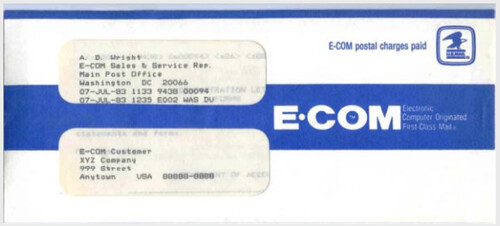
E-COM was a simple concept. The USPS would set up a network where a message would originate electronically. It would then be sent to one of a handful of participating postal offices that had terminals, where it would be printed out.
After arriving at the serving Post Office, the messages were processed and sorted by ZIP Code, then printed on letter-size bond paper, folded, and sealed in envelopes printed with a blue E-COM logo. [USPS 2008]
The hard copy of the message would then be delivered to its destination - essentially in the same manner and with the same speed as first class mail. [ECPA 1985 Report p 45] [USPS, p. 3 1982 (stating that the service was initiated January 1982)]
Before E-COM could get off the ground, it was mired in controversy. [CATO] [USPS, p. 3 1982] The US Postal Commission, the Department of Justice, the Department of Commerce, private companies, and even the FCC, objected. The first objection was that it was against government policy for a government agency to compete with the private sector. [USPS p. 17 1982] Private commercial email services were nascent and promising, and did not think much of a government monopoly using its government bank role to pay for a competing email service. The FCC said, "we have jurisdiction over all wireline and wireless services. That jurisdiction has been interpreted broadly. And there is no dispute that the transmission of a message over a communications network is communications, under the Communications Act, and under our jurisdiction." "Not only that," the FCC was heard to say, "but its common carriage." The FCC stated:
With respect to the relevant judicial decisions defining the nature of common carriage, we note that none of the parties to this proceeding appears to dispute that ECOM service would constitute a common carrier offering if it were to be provided by an entity other than the Postal Service. We also conclude independently that ECOM is a quasi-public offering of a for-profit service which affords the public an opportunity to transmit messages of its own design and choosing. Based on those judicially defined criteria, we find that, in offering ECOM, the Postal Service is engaging in a common carrier activity.
[In re Request for declaratory ruling and investigation by Graphnet Systems, Inc., concerning the proposed E-COM service, FCC Docket No. 79-6 (Sept 4, 1979)] In other words, before E-COM could get launched, the FCC said, "if you are going to do this, then you are under our jurisdiction, and you are going to have to file a tariff for the offering of your common carriage service." The FCC said that email, whether from the USPS or privately offered, is a form of common carriage - they don't say that anymore.
The USPS would not accept "no" for an answer, tinkered with its network in order to weasel out of FCC jurisdiction, and launched E-COM in 1982. A message was priced at 26¢ - and for each email message, the USPS was said to lose around $5 [CATO]. They had apparently estimated that the service would be a raging success; it was not and, with the low message volume, the cost per message was rather high. If you used the service, you had to send at minimum 200 messages. [USPS 2008] The service was one directional; if you got an error message, you would receive it in the mail two days later. When the E-COM messages were printed out, it would take two days more to be delivered. And it cost the same as First Class mail.
For some reason, E-COM was a failure (one Senator called it a turkey). On September 3, 1985, three years after service was initiated, USPS terminated the service and tried to sell it off. [Aide p 8] [ECPA Report 1985 p 46] [USPS 2008]In fiscal year 1984, 23 million E-COM messages were sent. E-COM service had 1,046 certified customers, 528 of whom were communication carriers. That year, the Postal Rate Commission responded to the Postal Service's 1983 request for a 31-cent rate for the first page by recommending a rate of 52 cents for the first page and 15 cents for the second page of E-COM messages. The Governors of the Postal Service, who decide rates and postal policies but can overrule a Postal Rate Commission decision only by a unanimous vote, rejected the Commission's recommended decision and asked for reconsideration. The Commission responded in June with a recommendation of a 49-cent rate for the first page and 14 cents for the second page. The Governors rejected these rates as well, essentially because they priced E-COM out the market, and recommended that the Postal Service dispose of the E-COM system by sale or lease to a private firm or firms. [USPS 2008]
ECOM Notes
- In Brief: "The history of USPS' involvement in e-commerce related products and services began with a brief foray in 1982 when it introduced its Electronic Computer-Originated Mail (E-COM) service.6 However, E-COM generated much controversy and scrutiny from PRC, the Federal Communications Commission (FCC), and Congress. In a report by the House Committee on Government Operations, the oversight committee concluded that the rates charged did not cover the cost for this initiative.7 USPS discontinued ECOM service in September 1985." [GAO-00-188 p 7]
- USPS Business Plan
- Messages would originate electronically, terminate at one of only a few post offices that could receive the messages, be printed out, and then delivered.
- USPS believed that email was going to devastate First Class mail volume by the year 2000. "The OTA analysis indicates that, regardless of what role USPS plays in Generation II electronic mail, reductions in USPS - delivered mail volume due to diversion to Generation III EMS and EFT could reach significant levels by 2000." - [Implications of Email p 8]
- USPS wanted to use email to make up for this loss of First Class revenue. "Regardless of the underlying mainstream growth, the effect of Generation II EMS volume is to "cushion" or offset some of the decline in conventional mail, assuming USPS delivers the Generation II hardcopy output. Put differently, if Generation II volume reached significant levels, USPS-delivered mail volume (conventional plus Generation II) might be maintained at or above a given level for an additional 5 years or so." - [Implications of Email p 5]
- Different reports indicate that E-COM was heavily subsidized, and that this was a violation of USPS's rules. Reports indicate that the price of an E-COM message was 26 cents, and that USPS lost $5.25 on each E-COM letter. Delivery times remained as slow as first class mail. [Aide p 8]
- Description
- "The USPS put in a system with a mainframe computer and "high-speed" printers in major regional post offices. Mailers could submit mail jobs as IBM remote job entry jobs over dedicated SNA links. The interface was so one-way that error messages came back as paper mail a day or two later. E-COM was for first class mail, sent in bulk. You had to send at least 200 letters to a single regional post office in a day [Fed Reg 50 FR 28144-01], so it was useless for general business mail. It cost as much as first class mail, so it was useless for advertising. Mailers couldn't have a return envelope included, so it was useless for bills." Animats Comment on Snail Mail as Email, Slashdot
- Controversy:
- "USPS believes its participation in EMS is authorized by the Postal Reorganization Act mandate to use new facilities and equipment to improve the convenience, efficiency, and cost effectiveness of mail service. Various mailer organizations, consumer groups, and postal labor unions see a USPS role in EMS as essential to USPS long-term viability and to maintaining, or at least minimizing any reductions in, mail services that are vital to a large part of the U.S. population. They point to the critical role of USPS in providing a universal, low cost, nondiscriminatory nationwide communication service. Various private telecommunication and computer firms view USPS involvement in EMS as the entry of a Federal agency into competition with private industry (possibly subject to the Communications Act as well as the Postal Act), raising difficult questions of rate setting and potential cross subsidy." - [Implications of Email p 3]
- "Over the last 3 years, the role of USPS in EMS has been in dispute before various regulatory agencies, the courts, and Congress. USPS initiated E-COM service in January 1982 after the USPS Board of Governors approved the Postal Rate Commission's (PRC) 1980 recommended decision, with the exception of PRC's "experimental" designation (of E-COM as an experimental rather than a permanent service) which was successfully appealed by the Governors to the courts. However, several private firms and the current administration believe that E-COM as presently implemented differs significantly in other ways from the concept originally recommended by PRC. A 1981 inquiry opened by PRC to review what form of E-COM USPS should be offering was suspended after its legality was challenged by USPS. Comments filed before PRC jointly by the Departments of Commerce and Justice and a court challenge to E-COM filed by Justice indicate that the current administration is not supportive of E-COM as presently operating, or possibly of any USPS role in EMS that involves telecommunication, data processing, or printing. This in part reflects continuing concern that E-COM places an independent Government agency (USPS) in competition-perhaps unfairly and/or illegally-with private firms. Some of these firms believe that the demand for EMS can be met by private offerings, and that the USPS role should be restricted to the delivery of hardcopy output from electronic message systems. Others are concerned that in the future USPS may expand its EMS role from printing, enveloping, and physical delivery-as in E-COM-to include telecommunication and perhaps electronic delivery as well." - [Implications of Email p 17]
- Competition: "Furthermore, regulatory decisions by the Federal Communications Commission over the last few years, coupled with congressional actions to rewrite the Communications Act of 1934, are clearing the way for increased competition in the electronic message market." - [Implications of Email p 16]
- "In its original Opinion and Recommended Decision, PRC supported the use of EMS technology by USPS although it differed with USPS in the application of that technology. More specifically, the PRC recommended that USPS provide only the printing, enveloping, and hardcopy delivery functions and not the telecommunication function. The PRC Recommended Decision was based substantially on its finding that "the general obligation imposed on regulatory agencies to consider and promote competitive policies applies to this Commission."12 The PRC decision was also based on the clearly procompetitive policy of FCC and the fact that the FCC asserted jurisdiction over the original USPS E-COM proposal, primarily on the grounds that it included telecommunication transmission functions to be provided by a telecommunication firm (Western Union), which was subject to FCC jurisdiction under the Communications Act of 1934.13 PRC concluded that competition would be best served if USPS did not provide telecommunications. This also permitted PRC to avoid both a possible regulatory impasse with FCC and any direct concession of FCC jurisdiction over postal services per se. USPS subsequently appealed the FCC ruling which asserted jurisdiction over E-COM. However, the appeal was dismissed and the FCC ruling vacated as moot by the court in view of the PRC Recommended Decision and USPS cancellation of the Western Union contract.* Thus, the court did not rule on the merits, and the legal jurisdiction of FCC over USPS involvement in EMS remains unclear. However, regulatory developments since the FCC ruling on E-COM suggest that so-called "enhanced services" such as electronic mail may not be subject to active FCC regulation under title II of the Communications Act. In other words, as long as USPS does not own and operate its own telecommunication transmission system and uses telecommunication services of firms who are regulated as providers of so-called "basic services, " the USPS EMS offerings would not necessarily be regulated by FCC. The applicable FCC decision, known as Computer II, is still under regulatory reconsideration and judicial challenge . . . " - [Implications of Email p 76]
- In re Request for declaratory ruling and investigation by Graphnet Systems, Inc., concerning the proposed E-COM service, FCC Docket No. 79-6 (Sept 4, 1979).
- 14. Thus, in the Communications Act of 1934, as amended, Congress has established a scheme of regulation designed to assure the delivery of communication services to the people of the United States under terms and conditions which would allow the people to take full advantage of the existence of those services. In order to assure the reasonableness of those terms and conditions, Congress in Title II of the Act vested in this Commission jurisdiction over common carriers engaged in interstate and foreign communications. It is evident, moreover, that this Commission has broad and flexible regulatory powers regarding interstate and foreign communications services and facilities and the terms and conditions under which such services and facilities are offered to the public. Philadelphia Television Broadcasting Co. v. FCC, 359 F.2d 282 (D.C. Cir. 1966).
- 15. In ascertaining whether ECOM constitutes an interstate communications service under the Communications Act, it is appropriate to begin with the Act's definition of 'communications,' which is the
. . . transmission [by wire or radio] of writing, signs, signals, pictures, and sounds of all kinds . . . including all instrumentalities, facilities, apparatus, and services (among other things, the receipt, forwarding and delivery of communications) incidental to such transmission.6
Moreover, interstate and foreign communications is defined as communications between states, and between states and a foreign point.7 Based on the legislative history of the Act, the Supreme Court has determined that our jurisdiction over communications services has been broadly defined by the 'very general terms' used in the Act, U.S. v. Southwestern Cable Co., 392 U.S. 157, 168 (1968). See also California Water and Telephone Co., 64 FCC 2d 753 (1977).
- 16. It is undisputed that ECOM is designed to offer consumers a service whereby information can be transmitted from a point of origination to one or more points of termination by means of electronic communications facilities. We therefore conclude that ECOM will be a communications service, pursuant to the statutory definition in Sections 3(a) and 3(b) of the Act. We also believe that the 'including all instrumentalities' aspect of the statutory definitions ensures that, once an entity is regulated because it is engaged in transmission, its activities incidental to that transmission will also be subject to our regulatory authority. 8 Thus, we find that both the electronic transmission and physical delivery portions of ECOM incidental thereto constitute a communications service within the terms of Sections 3(a) and 3(b) of the Act.
- 17. Not only is the proposed service 'communications by wire or radio;' it is also a common carrier activity. As has often been noted, the statutory definition of common carrier is not helpful: "common carrier' or 'carrier' means any person engaged as a common carrier for hire . . .' 47 U.S.C. § 153(h). Our Rules shed little additional light on the issue: '. . . any person engaged in rendering communication service for hire to the public.' 47 C.F.R. § 21.1 Like our Rules and the language of the Act, legislative history is also less than illuminating: the term was not intended to include '. . . any person not a common carrier in the ordinary sense of the term.' Thus, whatever guidance we are to receive on the meaning of communications common carriage must come from judicial interpretations and comparisons of ECOM with existing communications common carrier services already regulated under the Act.
- 18. With respect to the relevant judicial decisions defining the nature of common carriage, 9 we note that none of the parties to this proceeding appears to dispute that ECOM service would constitute a common carrier offering if it were to be provided by an entity other than the Postal Service. We also conclude independently that ECOM is a quasi-public offering of a for-profit service which affords the public an opportunity to transmit messages of its own design and choosing. Based on those judicially defined criteria, we find that, in offering ECOM, the Postal Service is engaging in a common carrier activity. 10
- Interconnection: "The final USPS provisions for interconnection between telecommunication providers and E-COM facilities at the 25 serving post offices (SPOs) appear to be substantially responsive to comments received from private firms. 'g USPS is providing four different interconnection arrangements for those firms desiring dedicated access to E-COM facilities, and two different arrangements for dial-up access at each SPO. The interconnection arrangements are summarized in appendix D. The dedicated access interconnection arrangements appear to meet the technical needs of most firms that provided comments to USPS. In addition, USPS has stated that it "will consider providing additional arrangements as necessary and feasible" and "will consider requests to accommodate user-provided interface circuit boards."20 The dial-up access arrangements will permit dial-up access via any public telephone network." - [Implications of Email p 78]
- Statistics
- "in the first half-year of its existence (January through June 1982), about 660,000 E-COM messages were sent. During July 1982, E-COM averaged about 172,000 messages weekly." - [Implications of Email p 4]
Electronic "Mail"
The developers of email were apparently concerned about calling it "mail" and whether the USPS would demand a postage stamp for each message sent. Therefore they contacted the USPS just to be sure. "We cautiously tried to find out who to ask. We didn't want to ask any low-level people who could only say "no." Finally an MIT professor met someone fairly high up in the Postal Service, who said forget it, don't worry. " -- James Bovard, “Zapped by Electronic Mail, ” Across the Board, June 1985, p. 42
Hearings
- House Committee on Government Operations, “Postal Service Electronic Mail: The Price Still Isn’t Right, ” House Rep. No. 98-552, 1983
- House Committee on Government Operations, “ INTELPOST: A Postal Service Failure in International Electronic Mail, ” House Rep. No. 98-675, 1984.
USPS Reference
- USG
- USPS
- History of the United States Postal Service , USPS
- E-COM, Electronic Computer Originated Mail, USPS History, July 2008
- Implications of Electronic Mail and Message Systems for the US Postal Service, August 1982 NTIS Order # PB83-265017
- Administration Policy Statement, The White House, July 19, 1979 ("“the national interest requires a Postal Service which can serve all Americans and interface with the world’s postal services efficiently and economically. The service has progressively achieved productivity improvement by mechanization and automation in processing of conventional mail . . . A postal EMS is the next logical step to achieve further cost reduction and mail processing improvement.”")
- U.S. Postal Rate Commission, Opinion and Recommended lkbion on Electronic Mail Classification Proposal docket No. MC78-3, Dec. 17, 1979, pp. 278 (with regard to E-COM, "PRC recommended that USPS provide only the printing, enveloping, and hardcopy delivery functions and not the telecommunication function")
- Guidelines to telecommunications interconnection requirements for message input to the USPS E-COM system , ITS NTIA, April 1981
- Implications of Electronic Mail and Message Systems for the U.S. Postal Service , Office of Technology Assessment, Congress of the United States, August 1982
- OTA's analysis suggests that advances in technology and increased competition in the communications marketplace will significantly affect USPS finances, service levels, and labor force requirements over the next two decades. It further suggests that modification or clarification of the USPS role in EMS can, in turn, help determine how effectively USPS accommodates to these changes. Given the difficulty of modifying institutions as large and complex as USPS and the laws and regulations that govern USPS actions, it would seem prudent for Congress and USPS to address these issues aggressively. Changes are taking place so fast in the so-called "communications revolution" that by the time USPS actually experienced significant reductions in conventional mail volume, most opportunities for participation in EMS would have passed and it would be much more difficult to adjust.
- In re Request for declaratory ruling and investigation by Graphnet Systems, Inc., concerning the proposed E-COM service, FCC Docket No. 79-6 (Sept 4, 1979).
- James Bovard, The Law Dinosaur: The US Postal Service, CATO Policy Analysis (Feb. 1985)
- The Future of Mail Delivery (Washington: Joint Economic Committee, June 18 , 1982 )
- F. B. Wood, R. W. Anthony, et al., USPS and the Communications Revolution: Impacts, Options, and Issues, Final Report to the Commission on Postal Service, prepared by the Program of Policy Studies in Science and Technology, The George Washington University, Washington, D. C., Mar. 5, 1977.
- Arthur D. Little, The Impact of Electronic Communication Systems on First Class Mail Volume in J9801990, Cambridge, Mass., April 1978
Email as Tariffed FCC Service
There was a time during the 1970s, before Computer II, when companies were filing tariffs with the FCC for their email services. See On the Matter of Monitoring Compliance with Conditions Underlying General Telephone and Electronics Corporation's Acquisition of Telenet. CC Docket No. 80-197 ORDER (Adopted: April 24, 1980; Released: May 30, 1980) at 78 FCC 2d 419
In the past, Telenet transmission has basically been limited to communications between computers and lower-speed terminals (75 to 1200 bits per second). In 1980, Telenet plans to add interface facilities for its major classes of terminals to take advantage of higher speeds of 2400 to 56,000 bits per second. This includes visual display terminals, inquiries and other transaction processing applications and batch terminals. In addition to expanding its network, Telenet is expanding services it offers. Telenet has filed a tariff to offer Telemail, which it describes as an electronic mail service. In an April 2 News Release, Telenet states that this service is designed to overcome many of the limitations that services such as telex, TWX, and facsimile have. Thus, according to the release, represents the first step of Telenet's expansion into the office automation marketplace. The company expects to expand Telemail into a high-speed, multi-media information distribution system, incorporating electronic data bases.
See also SICOM II order (59 FCC 2d 140) Finding Western Union 's "pseudo station service" (a primitive email) was a common carrier communications service. Pseudo Station Service provides for the diversion of messages for temporary storage at the computer center and their subsequent transmission to a station or stations on the customer's network.
Tymnet received authorization in 1976 from the FCC to provide computer networking and messaging services as a common carrier. Tymnshare Annual Report 1976
United Telecom (aka Sprint) ran an X.25 service known as Uninet.
Other early commercial email services: Quik-COmm (General Electric), Telemail (GTE Telenet), On-Tyme (Tymnet), InfoPlex (Plexus), Faxgram (Graphnet), Mailgram (Western Union), and Datapost (southern Pacific).
In 1988, Vint Cerf convinced NSFNET to make an experimental exception to its AUP (which prohibited commercial traffic), permitting interconnection of the MCI commercial email service with NSFNET. Compuserv and Sprint would soon also gain experimental access for commercial email. [Kesan p 100, 112] [Roberts]
SPAM
So where does the term "SPAM" come from? See Brad Templeton's excellent Origin of the Term "SPAM." In 1970, Monty Python aired The SPAM skit, set in a restaurant that serves excessive amounts of SPAM, and featuring Vikings that repeatedly sing the word "SPAM" until they are told to shut up. This transformed the meaning of SPAM from canned meat to someone who repeats their message excessively until they are told to shut up. See Gordon v. Virtumundo, Inc., 575 F.3d 1040, 1045 n.1 (9th Cir. 2008) (stating that email spam “has its roots in a popular 1970 sketch by the British comedy troupe Monty Python's Flying Circus, in which the word 'spam' is repeated to the point of absurdity.").
In 1978, the first reported SPAM (unsolicited commercial advertisement) email is sent by Digital. Reaction to the DEC Spam of 1978 [See Vanity Fair]
Mail-from: DEC-MARLBORO rcvd at 3-May-78 0955-PDT Date: 1 May 1978 1233-EDT From: THUERK at DEC-MARLBORO Subject: ADRIAN@SRI-KL To: DDAY at SRI-KL, DAY at SRI-KL, DEBOER at UCLA-CCN, To: WASHDC at SRI-KL, LOGICON at USC-ISI, SDAC at USC-ISI, To: DELDO at USC-ISI, DELEOT at USC-ISI, DELFINO at USC-ISI, To: DENICOFF at USC-ISI, DESPAIN at USC-ISI, DEUTSCH at SRI-KL, To: DEUTSCH at PARC-MAXC, EMY at CCA-TENEX, DIETER at USC-ISIB, To: DINES at AMES-67, MERADCON at SRI-KL, EPG-SPEC at SRI-KA, To: DIVELY at SRI-KL, DODD at USC-ISI, DONCHIN at USC-ISIC, To: JED at LLL-COMP, DORIN at CCA-TENEX, NYU at SRI-KA, To: DOUGHERTY at USC-ISI, PACOMJ6 at USC-ISI, To: DEBBY at UCLA-SECURITY, BELL at SRI-KL, JHANNON at SRI-KA, To: DUBOIS at USC-ISI, DUDA at SRI-KL, POH at USC-ISI, To: LES at SU-AI, EAST at BBN-TENEX, DEASTMAN at USC-ECL, To: EBISU at I4-TENEX, NAC at USC-ISIE, ECONOMIDIS at I4-TENEX, To: WALSH at SRI-KL, GEDWARDS at SRI-KL, WEDWARDS at USC-ISI, To: NUSC at SRI-KL, RM at SU-AI, ELKIND at PARC-MAXC, To: ELLENBY at PARC-MAXC, ELLIS at PARC-MAXC, ELLIS at USC-ISIB, To: ENGELBART at SRI-KL, ENGELMORE at SUMEX-AIM, To: ENGLISH at PARC-MAXC, ERNST at I4-TENEX, To: ESTRIN at MIT-MULTICS, EYRES at USC-ISIC, To: FAGAN at SUMEX-AIM, FALCONER at SRI-KL, To: DUF at UCLA-SECURITY, FARBER at RAND-UNIX, PMF at SU-AI, To: HALFF at USC-ISI, RJF at MIT-MC, FEIERBACH at I4-TENEX, To: FEIGENBAUM at USC-ISI, FEINLER at SRI-KL, To: FELDMAN at SUMEX-AIM, FELDMAN at SRI-KL, FERNBACH at LLL-COMP, To: FERRARA at RADC-MULTICS, FERRETTI at SRI-KA, To: FIALA at PARC-MAXC, FICKAS at USC-ISIC, AFIELD at I4-TENEX, To: FIKES at PARC-MAXC, REF at SU-AI, FINK at MIT-MULTICS, To: FINKEL at USC-ISIB, FINN at USC-ISIB, AFGWC at BBN-TENEX, To: FLINT at SRI-KL, WALSH at SRI-KL, DRXAN at SRI-KA, To: FOX at SRI-KL, FRANCESCHINI at MIT-MULTICS, To: SAI at USC-ISIC, FREDRICKSON at RAND-RCC, ETAC at BBN-TENEXB, To: FREYLING at BBN-TENEXE, FRIEDLAND at SUMEX-AIM, To: FRIENDSHUH at SUMEX-AIM, FRITSCH at LLL-COMP, ME at SU-AI, To: FURST at BBN-TENEXB, FUSS at LLL-COMP, OP-FYE at USC-ISIB, To: SCHILL at USC-ISIC, GAGLIARDI at USC-ISIC, To: GAINES at RAND-UNIX, GALLENSON at USC-ISIB, To: GAMBLE at BBN-TENEXE, GAMMILL at RAND-UNIX, To: GANAN at USC-ISI, GARCIA at SUMEX-AIM, To: GARDNER at SUMEX-AIM, MCCUTCHEN at SRI-KL, To: GARDNER at MIT-MULTICS, GARLICK at SRI-KL, To: GARVEY at SRI-KL, GAUTHIER at USC-ISIB, To: USGS-LIA at BBN-TENEX, GEMOETS at I4-TENEX, To: GERHART at USC-ISIB, GERLA at USC-ISIE, GERLACH at I4-TENEX, To: GERMAN at HARV-10, GERPHEIDE at SRI-KA, DANG at SRI-KL, To: GESCHKE at PARC-MAXC, GIBBONS at CMU-10A, To: GIFFORD.COMPSYS at MIT-MULTICS, JGILBERT at BBN-TENEXB, To: SGILBERT at BBN-TENEXB, SDAC at USC-ISI, To: GILLOGLY at RAND-UNIX, STEVE at RAND-UNIX, To: GLEASON at SRI-KL, JAG;BIN(1525) at UCLA-CCN, To: GOLD at LL-11, GOLDBERG at USC-ISIB, GOLDGERG at SRI-KL, To: GROBSTEIN at SRI-KL, GOLDSTEIN at BBN-TENEXB, To: DARPM-NW at BBN-TENEXB, GOODENOUGH at USC-ISIB, To: GEOFF at SRI-KL, GOODRICH at I4-TENEX, GOODWIN at USC-ISI, To: GOVINSKY at SRI-KL, DEAN at I4-TENEX, TEG at MIT-MULTICS, To: CCG at SU-AI, EPG-SPEC at SRI-KA, GRISS at USC-ECL, To: BJG at RAND-UNIX, MCCUTCHEN at SRI-KL, GROBSTEIN at SRI-KL, To: MOBAH at I4-TENEX, GUSTAFSON at USC-ISIB, GUTHARY at SRI-KL, To: GUTTAG at USC-ISIB, GUYTON at RAND-RCC, To: ETAC-AD at BBN-TENEXB, HAGMANN at USC-ECL, HALE at I4-TENEX, To: HALFF at USC-ISI, DEHALL at MIT-MULTICS, To: HAMPEL at LLL-COMP, HANNAH at USC-ISI, To: NORSAR-TIP at USC-ISIC, SCRL at USC-ISI, HAPPY at SRI-KL, To: HARDY at SRI-KL, IMPACT at SRI-KL, KLH at SRI-KL, To: J33PAC at USC-ISI, HARRISON at SRI-KL, WALSH at SRI-KL, To: DRCPM-FF at BBN-TENEXB, HART at AMES-67, HART at SRI-KL, To: HATHAWAY at AMES-67, AFWL at I4-TENEX, BHR at RAND-UNIX, To: RICK at RAND-UNIX, DEBE at USC-ISIB, HEARN at USC-ECL, To: HEATH at UCLA-ATS, HEITMEYER at BBN-TENEX, ADTA at SRI-KA, To: HENDRIX at SRI-KL, CH47M at BBN-TENEXB, HILLIER at SRI-KL, To: HISS at I4-TENEX, ASLAB at USC-ISIC, HOLG at USC-ISIB, To: HOLLINGWORTH at USC-ISIB, HOLLOWAY at HARV-10, To: HOLMES at SRI-KL, HOLSWORTH at SRI-KA, HOLT at LLL-COMP, To: HOLTHAM at LL, DHOLZMAN at RAND-UNIX, HOPPER at USC-ISIC, To: HOROWITZ at USC-ISIB, VSC at USC-ISI, HOWARD at LLL-COMP, To: HOWARD at USC-ISI, PURDUE at USC-ISI, HUBER at RAND-RCC, To: HUNER at RADC-MULTICS, HUTSON at AMES-67, IMUS at USC-ISI, To: JACOBS at USC-ISIE, JACOBS at BBN-TENEXB, To: JACQUES at BBN-TENEXB, JARVIS at PARC-MAXC, To: JEFFERS at PARC-MAXC, JENKINS at PARC-MAXC, To: JENSEN at SRI-KA, JIRAK at SUMEX-AIM, NICKIE at SRI-KL, To: JOHNSON at SUMEX-AIM, JONES at SRI-KL, JONES at LLL-COMP, To: JONES at I4-TENEX, RLJ at MIT-MC, JURAK at USC-ECL, To: KAHLER at SUMEX-AIM, MWK at SU-AI, KAINE at USC-ISIB, To: KALTGRAD at UCLA-ATS, MARK at UCLA-SECURITY, RAK at SU-AI, To: KASTNER at USC-ISIB, KATT at USC-ISIB, To: UCLA-MNC at USC-ISI, ALAN at PARC-MAXC, KEENAN at USC-ISI, To: KEHL at UCLA-CCN, KELLEY at SRI-KL, BANANA at I4-TENEX, To: KELLOGG at USC-ISI, DDI at USC-ISI, KEMERY at SRI-KL, To: KEMMERER at UCLA-ATS, PARVIZ at UCLA-ATS, KING at SUMEX-AIM, To: KIRSTEIN at USC-ISI, SDC at UCLA-SECURITY, To: KLEINROCK at USC-ISI, KLEMBA at SRI-KL, CSK at USC-ISI, To: KNIGHT at SRI-KL, KNOX at USC-ISI, KODA at USC-ISIB, To: KODANI at AMES-67, KOOIJ at USC-ISI, KREMERS at SRI-KL, To: BELL at SRI-KL, KUNZELMAN at SRI-KL, PROJX at SRI-KL, To: LAMPSON at PARC-MAXC, SDL at RAND-UNIX, JOJO at SRI-KL, To: SDC at USC-ISI, NELC3030 at USC-ISI, To: LEDERBERG at SUMEX-AIM, LEDUC at SRI-KL, JSLEE at USC-ECL, To: JACOBS at USC-ISIE, WREN at USC-ISIB, LEMONS at USC-ISIB, To: LEUNG at SRI-KL, J33PAC at USC-ISI, LEVIN at USC-ISIB, To: LEVINTHAL at SUMEX-AIM, LICHTENBERGER at I4-TENEX, To: LICHTENSTEIN at USC-ISI, LIDDLE at PARC-MAXC, To: LIEB at USC-ISIB, LIEBERMAN at SRI-KL, STANL at USC-ISIE, To: LIERE at I4-TENEX, DOCB at USC-ISIC, LINDSAY at SRI-KL, To: LINEBARGER at AMES-67, LIPKIS at USC-ECL, SLES at USC-ISI, To: LIS at SRI-KL, LONDON at USC-ISIB, J33PAC at USC-ISI, To: LOPER at SRI-KA, LOUVIGNY at SRI-KL, LOVELACE at USC-ISIB, To: LUCANIC at SRI-KL, LUCAS at USC-ISIB, DCL at SU-AI, To: LUDLAM at UCLA-CCN, YNGVAR at SRI-KA, LYNCH at SRI-KL, To: LYNN at USC-ISIB, MABREY at SRI-KL, MACKAY at AMES-67, To: MADER at USC-ISIB, MAGILL at SRI-KL, KMAHONEY at BBN-TENEX, To: MANN at USC-ISIB, ZM at SU-AI, MANNING at USC-ISI, To: MANTIPLY at I4-TENEX, MARIN at I4-TENEX, SCRL at USC-ISI, To: HARALD at SRI-KA, GLORIA-JEAN at UCLA-CCN, MARTIN at USC-ISIC, To: WMARTIN at USC-ISI, GRM at RAND-UNIX, MASINTER at USC-ISI, To: MASON at USC-ISIB, MATHIS at SRI-KL, MAYNARD at USC-ISIC, To: MCBREARTY at SRI-KL, MCCALL at SRI-KA, MCCARTHY at SU-AI, To: MCCLELLAND at USC-ISI, DORIS at RAND-UNIX, MCCLURG at SRI-KL, To: JOHN at I4-TENEX, MCCREIGHT at PARC-MAXC, MCCRUMB at USC-ISI, To: DRXTE at SRI-KA cc: BPM at SU-AI* MCKINLEY@USC-ISIB MMCM@SRI-KL OT-ITS@SRI-KA BELL@SRI-KL MEADE@SRI-KL MARTIN@USC-ISI MERRILL@BBN-TENEX METCALFE@PARC-MAXC JMETZGER@USC-ISIB MICHAEL@USC-ISIC CMILLER@SUMEX-AIM MILLER@USC-ISI SCI@USC-ISI MILLER@USC-ISIC MITCHELL@PARC-MAXC MITCHELL@USC-ISI MITCHELL@SUMEX-AIM MLM@SU-AI JPDG@TENEXB MOORE@USC-ISIB WMORE@USC-ISIB JAM@SU-AI MORAN@PARC-MAXC ROZ@SU-AI MORGAN@USC-ISIB MORRIS@PARC-MAXC MORRIS@I4-TENEX OT-ITS@SRI-KA LISA@USC-ISIB MOSHER@SRI-KL MULHERN@USC-ISI MUNTZ;BIN(1529)@UCLA-CCN MYERS@USC-ISIC MYERS@RAND-RCC DRCPM-FF-FO@BBN-TENEXB NAGEL@USC-ISIB NAPKE@SRI-KL NARDI@SRI-KL NAYLOR@USC-ISIE LOU@USC-ISIE NESBIT@RAND-RCC NEUMANN@SRI-KA NEVATIA@USC-ECL NEWBY@USC-ISI NEWEKK@SRI-KA NIELSON@SRI-KL NLL@SUMEX-AIM NILSSON@SRI-KL NITZAN@SRI-KL NOEL@USC-ISIC NORMAN@PARC-MAXC NORTON@SRI-KL JOAN@USC-ISIB NOURSE@SUMEX-AIM PDG@SRI-KL OMALLEY@SRI-KA OCKEN@USC-ISIC OESTREICHER@USC-ISIB OGDEN@SRI-KA OKINAKA@USC-ISIE OLSON@I4-TENEX ORNSTEIN@PARC-MAXC PANKO@SRI-KL TED@SU-AI PARK@SRI-KL PBARAN@USC-ISI PARKER@USC-ISIB PEARCE@USC-ISI PEPIN@USC-ECL PERKINS@USC-ISIB PETERS@SRI-KL AMPETERSON@USC-ISI ASLAB@USC-ISIC EPG-SPEC@SRI-KA PEZDIRTZ@LLL-COMP CHARLIE@I4-TENEX UCLA-DOC@USC-ISI WPHILLIPS@USC-ISI PIERCY@MOFFETT-ARC PINE@SRI-KL PIPES@I4-TENEX PIRTLE@SRI-KL POGGIO@USC-ISIC POH@USC-ISI POOL@BBN-TENEX POPEK@USC-ISI POSTEL@USC-ISIB POWER@SRI-KL PRICE@USC-ECL RANDALL@USC-ISIB RANDALL@SRI-KA RAPHAEL@SRI-KL RAPP@RAND-RCC RASMUSSEN@USC-ISIC RATTNER@SRI-KL RAY@ILL-NTX FNWC@I4-TENEX BRL@SRI-KL RETZ@SRI-KL SKIP@USC-ISIB RICHARDSON@USC-ISIB RICHES@USC-ECL GWEN@USC-ECL OP-RIEDEL@USC-ISIB RIES@LLL-COMP RINDFLEISCH@SUMEX-AIM OP-ROBBINS@USC-ISIB ROBINSON@SRI-KL JROBINSON@SRI-KL RODRIQUEZ@SRI-KL MARTIN@USC-ISI ROM@USC-ISIC ROMIEZ@I4-TENEX ROSE@USC-ISI ROSEN@SRI-KL BARBARA@I4-TENEX ROTHENBERG@USC-ISIB RUBIN@SRI-KL JBR@SU-AI RUBINSTEIN@BBN-TENEXD RUDY@USC-ECL RUGGERI@SRI-KA RULIFSON@PARC-MAXC DALE@USC-ISIB SACERDOTI@SRI-KL SAGALOWICZ@SRI-KL ALS@SU-AI SANTONI@USC-ISIC SATTERTHWAITE@PARC-MAXC SAWCHUK@USC-ECL CPF-CC@USC-ISI SCHELONKA@USC-ISI SCHILL@USC-ISIC SCHILLING@USC-ISI SCHULZ@SUMEX-AIM SCOTT@SUMEX-AIM CPF-CC@USC-ISI OP-SEATON@USC-ISIB SENNE@LL NORM@RAND-UNIX AFWL@14-TENEX SHEPPARD@LL-ASG SHERWIN@USC-ISI SHERWOOD@SRI-KL SHORT@SRI-KL SHORTLIFE@SUMEX-AIM SHOSHANI@BBN-TENEX MARTIN@USC-ISI UCLA-NMC@USC-ISIE SDL@USC-ISIC SKOCYPEC@USC-ISI SLES@USC-ISI SLOTTOW@UCLA-CCN NOAA@14-TENEX SMALL@USC-ISI DAVESMITH@PARC-MAXC DSMITH@RAND-UNIX SMITH@SUMEX-AIM SMITH@USC-ECL MARCIE@I4-TENEX USARSGEUR@USC-ISI LOGICON@USC-ISI EPA@SRI-KL SONDEREGGER@USC-ISIB SPEER@LL AMICON-RN@USC-ISI SPROULL@PARC-MAXC PROJX@SRI-KL STEF@SRI-KA STEFIK@SUMEX-AIM STEPHENS@SRI-KA CFD@I4-TENEX STOCKHAM@SRI-KA STOTZ@USC-ISIB ALLEN@UCLA-SECURITY STOUTE@MIT-ML STRADLING@SRI-KL STROLLO@PARC-MAXC UCLA-0638@UCLA-CCN CRT@SRI-KA SUNSHINE@RAND-UNIX SUTHERLAND@SRI-KL SUTHERLAND@RAND-UNIX SUTHERLAND@PARC-MAXC SUTTON@USC-ISIC SWEER@SUMEX-AIM TAFT@PARC-MAXC TAYLOR@USC-ISIB TAYLOR@PARC-MAXC TAYNAI@SUMEX-AIM TEITELMAN@PARC-MAXC TENENBAUM@SRI-KL GREEP@RAND-UNIX TERRY@SUMEX-AIM TESLER@PARC-MAXC THACKER@PARC-MAXC PWT@RAND-UNIX TIPPIT@USC-ISIE TOBAGI@USC-ISIE TOGNETTI@SUMEX-AIM TORRES@SRI-KL TOWNLEY@HARV-10 ELINA@UCLA-ATS TUCKER@SUMEX-AIM TUGENDER@USC-ISIB LLLSRG@MIT-MC UNCAPHER@USC-ISIB NOSC@SRI-KL UNTULIS@SRI-KL MIKE@UCLA-SECURITY AARDVARK@UCLA-ATS UZGALIS;BIN(0836)@UCLA-CCN VANGOETHEM@UCLA-CCN VANMIEROP@USC-ISIB VANNOUHUYS@SRI-KL VEIZADES@SUMEX-AIM VESECKY@USC-ISI AV@MIT-DMS VICTOR@USC-ISIC VIDAL@UCLA-SECURITY OP-VILAIN@USC-ISIB RV@RAND-UNIX SDL@USC-ISIC VOLPE@SRI-KL VONNEGUT@I4-TENEX VU@SRI-KL WACTLAR@CMU-10A WAGNER@USC-ISI WAHRMAN@RAND-UNIX WALDINGER@SRI-KL WALKER@UCLA-SECURITY WALKER@SRI-KL WALLACE@PARC-MAXC EVE@UCLA-SECURITY LOGICON@USC-ISI DON@RAND-UNIX WATSON@USC-ISIC WEIDEL@USC-ECL WEINBERG@SRI-KL JLW@MIT-AI LAUREN@UCLA-SECURITY WEISSMAN@I4-TENEX WELLS@USC-ISIC GERSH@USC-ISI WETHEREL@LLL-COMP RWW@SU-AI SCRL@USC-ISI TWHELLER@SRI-KA MABREY@SRI-KL WHITE@PARC-MAXC WHITE@SUMEX-AIM WIEDERHOLD@SUMEX-AIM WILBER@SRI-KL EPG-SPEC@SRI-KA WILCOX@SUMEX-AIM WILCZYNSKI@USC-ISIB WILE@USC-ISIB OP-WILLIAMS@USC-ISIB WILSON@USC-ISIB TW@SU-AI SCI@USC-ISI WISNIEWSKI@RAND-UNIX WOLF@SRI-KL PAT@SU-AI NELC3030@USC-ISI WYATT@HARV-10 LEO@USC-ISIB YEH@LLL-COMP YONKE@USC-ISIB YOUNGBERG@SRI-KA ZEGERS@SRI-KL ZOLOTOW@SRI-KL ZOSEL@LLL-COMP DIGITAL WILL BE GIVING A PRODUCT PRESENTATION OF THE NEWEST MEMBERS OF THE DECSYSTEM-20 FAMILY; THE DECSYSTEM-2020, 2020T, 2060, AND 2060T. THE DECSYSTEM-20 FAMILY OF COMPUTERS HAS EVOLVED FROM THE TENEX OPERATING SYSTEM AND THE DECSYSTEM-10COMPUTER ARCHITECTURE. BOTH THE DECSYSTEM-2060T AND 2020T OFFER FULL ARPANET SUPPORT UNDER THE TOPS-20 OPERATING SYSTEM. THE DECSYSTEM-2060 IS AN UPWARD EXTENSION OF THE CURRENT DECSYSTEM 2040 AND 2050 FAMILY. THE DECSYSTEM-2020 IS A NEW LOW END MEMBER OF THE DECSYSTEM-20 FAMILY AND FULLY SOFTWARE COMPATIBLE WITH ALL OF THE OTHER DECSYSTEM-20 MODELS. WE INVITE YOU TO COME SEE THE 2020 AND HEAR ABOUT THE DECSYSTEM-20 FAMILY AT THE TWO PRODUCT PRESENTATIONS WE WILL BE GIVING IN CALIFORNIA THIS MONTH. THE LOCATIONS WILL BE: TUESDAY, MAY 9, 1978 - 2 PM HYATT HOUSE (NEAR THE L.A. AIRPORT) LOS ANGELES, CA THURSDAY, MAY 11, 1978 - 2 PM DUNFEY'S ROYAL COACH SAN MATEO, CA (4 MILES SOUTH OF S.F. AIRPORT AT BAYSHORE, RT 101 AND RT 92) A 2020 WILL BE THERE FOR YOU TO VIEW. ALSO TERMINALS ON-LINE TO OTHER DECSYSTEM-20 SYSTEMS THROUGH THE ARPANET. IF YOU ARE UNABLE TO ATTEND, PLEASE FEEL FREE TO CONTACT THE NEAREST DEC OFFICE FOR MORE INFORMATION ABOUT THE EXCITING DECSYSTEM-20 FAMILY. * NOTE: At this point, the addresses supplied overflows the "to" field.
© Cybertelecom ::Timeline
- 2016
- State OIG releases Office of the Secretary - Evaluation of Email Records Management and Cybersecurity Requirements May 26 (report reviewing then Sec. of State Hilary Clinton's use of a private email server)
- 2012: Petreaus Email Incident
- 2007
- FTC Spam Summit
- Google makes GMail publicly available
- 2006 - Reputation Services
- 2004
- FTC Spam Summit
- April 1, Google launches Gmail beta [Google Gets the Message, News from Google April 1, 2004]
- 2003 - Can Spam Act
- 2002
- Sender accreditation (whitelist)
- Sender pays for improved delivery. Bonded sender.
- 2001: RFC 2821, Simple Mail Transfer Protocol (April 2001) (This document is a self-contained specification of the basic protocol for the Internet electronic mail transport.)
- 1999 - negative reputation services (blocklists) MAPS/Trend, Spamhaus, Senderbase, Symantic, TrustedSource
- 1997
- Supreme Court of Tennessee, Internet Advertising and Tennessee Disbarment, In Re: Laurence A. Canter, 1997.
- Yahoo! Web Based email service launched (Yahoo! acquired web based email service Rocketmail [Yahoo! buys Four11 for free email, CNET Oct. 8, 1997].
- Lycos begins offering free web based email [Yahoo! buys Four11 for free email, CNET Oct. 8, 1997]
- Hotmail acquired by Microsoft [A Short History of Hotmail, Inside Windows Live Jan. 6, 2010]
- Four11 founded, offering Rocketmail, a free web based email services [History of Rocketmail, eHow Tech]
- 1996: July 4, Hotmail established, offering free web based email service [A Short History of Hotmail, Inside Windows Live Jan. 6, 2010]
- 1994
- April Canter and Siegel Green Card Spam.
- Brad Templeton, Origin of the Term "Spam"
- Press Release- PSI And Canter & Siegel Negotiate Agreement On Future. 1994
- 1993: AOL and Delphi interconnect their proprietary email systems to the Internet.
- 1989: Compuserv email connects to NSFNET
- 1988:
- Vint Cerf arranges for a connection of MCI Mail to NSFNET on an experimental basis.
- Dan Webb introduces email messages as evidence in prosecution of Reagan White House's John Poindexter. [Vanity Fair]
- May 23 "Help Me" SPAM to comp.lang.apl (described as charity spam or charity scam) [Origins of First "Spam"]
- Hi. I just finished my junior year in college, and now I'm faced with a major problem. I can't afford to pay for my senior year. I've tried everything. I can't get any more student loans, I don't qualify for any more scholarships, and my parents are as broke as am I. So as you can see, I've got a major problem. But as far as I can see, there is only one solution, to go forward. I've come along way, and there is no chance in hell that I'm going to drop out now! I'm not a quitter, and I'm not going to give up.
- 1986: Oliver North reportedly deletes shreds Iran Contra Emails [The Nation] [History]
- 1985:
- After 3 years, USPS terminates E-COM service. [USPS]
- White House uses DIALCOM in order to email federal agencies. [ECPA Report 1985 p 47]
- 1984: Federal Express introduces Zapmail, a form of email with 2 hour delivery [ECPA Report 1985 p 47]
- 1982:
- RFC 821, Simple Mail Transfer Protocol (Aug. 1982)
- USPS Introduces E-COM (messages that originate as email, are printed out, and then delivered in hard copy form). [USPS] FCC asserts jurisdiction over E-COM as a telecommunications service.
- David Crocker, RFC 822, Standard for the Format of ARPA Internet Text Messages (Aug. 13, 1982)
By 1977, the ARPANet employed several informal standards for the text messages (mail) sent among its host computers. It was felt necessary to codify these practices and provide for those features that seemed imminent. The result of that effort was Request for Comments (RFC) #733, "Standard for the Format of ARPA Network Text Message", by Crocker, Vittal, Pogran, and Henderson. The specification attempted to avoid major changes in existing software, while permitting several new features. This document revises the specifications in RFC #733 , in order to serve the needs of the larger and more complex ARPA Internet. Some of RFC #733 's features failed to gain adequate acceptance. In order to simplify the standard and the software that follows it, these features have been removed. A different addressing scheme is used, to handle the case of inter-network mail; and the concept of re-transmission has been introduced.
- 1979:
- USPS attempts to ban private email service, but is thwarted by the FCC and the US Postal Commission. [Bovard]
- Meeting at BBN to discuss differences and incompatibilities between different ARPA email services. A record of the meeting is recounted in Jon Postel, RFC 808, Summary of Computer Mail Services Meeting Held at BBN on 10 January 1979 (March 1, 1982) A list of all of the differing email services was compiled by Prof David Farber and presented in Appendix A.
- Former ARPA Chief and email advocate SJ Lukasik becomes FCC Chief Scientist
- "President Carter was supporting a USPS proposal to offer limited electronic message service where the messages would be transferred from one post office to another electronically, and then would be brought to the consumer's address by the mailman. This threat brought the research community together and they along with the US Justice Department and the FCC opposed any plans of government intervention in e-mail. They all successfully lobbied for E-mail to be left up to the free market." [Akkad]
- 1978- Reaction to the DEC Spam of 1978, which has the reputation as the first SPAM message [See Vanity Fair]
- 1977:
- DARPA initiative to transform various differing email formats into a single, standard specification. David Crocker, John Vittal, Kenneth Pogran, Austin Henderson, RFC 733, Standard for the Format of ARPA Network Text Message (Nov. 21, 1977) ("This standard specifies a syntax for text messages which are passed between computer users within the framework of "electronic mail"." RFC notes that this work was funded by DARPA.)
- USPS initiates exploration of email
- 1973:
- Stephen Lukasik becomes Chief of ARPA. He was a major proponent of network research of of electronic mail. Would become FCC Chief Scientist in 1979.
- 75% of traffic on ARPANet is email. [Akkad] Study was conducted pursuant to request from ARPA Chief SJ Lukasik
- 1972: RFC 354, Comments on the File Transfer Protocol , ¶ 21 (Aug 18, 1972) (adding Mail File "MLFL" and the MAIL command to FTP)
- 1971
- Email is sent on MIT's CTSS to all recipients with the anti war message "There is no way to Peace. Peace is the way!" [Vleck]
- Ray Tomlinson develops an email application for over the ARPANet, permitting individuals to send messages over the network and alert the recipient that a message had been received. Tomlinson chose the "@" sign for email addresses.
- 1970 - Monty Python Spam Skit airs
- 1965 Noel Morris and Tom Van Vleck invent email
- 1960s Email developed for time share computers (individuals could message each other on the same mainframe computer; but not over a network)
- 1890s: USPS declared it illegal to deliver paper messages through pneumatic tubes under city streets [Bovard]
Papers
- Jay Akkad, The History of Email
- Tom Van Vleck, The History of Electronic Mail (Feb. 2001)
- Errol Morris, Did My Brother Invent Email with Tom Van Vleck?. The New York Times (Jun. 19, 2011) (recounting how Noel Morris and Tom Van Vleck invented email in 1965)
- Email History, How Email was Invented , Living Internet
- Email Servers - SMTP , Living Internet
- Hardy, Ian R; The Evolution of ARPANET Email; 1996-05-13; History Thesis; University of California at Berkeley
- Spam
- Hormel, SPAM Corporate Info, SPAM and the Internet
- IBM A Brief History of SPAM
- Origin of the term "spam" to mean net abuse
- History: Chatting With Martha Siegel of the Internet's Infamous Canter & Siegel, EFF 5/13/03
- History: EFF "Canter & Siegel Green Card Lottery Net Spam Case" Archive, EFF 5/13/03
- The father of modern spam speaks, CNET 5/13/03
- Tom Van Vleck, The History of Electronic Mail (Feb. 2001)
- rec.games.mud (1990) discussing the origin of the term SPAM
- Keith Lynch's timeline of spam related terms and concepts
Books