|
Cybertelecom Federal Internet Law & Policy An Educational Project |

|
Interstate Commerce Commission | |
|
- Telephone - - AT&T History - - - Antitrust - - - Industry : AT&T - - CPE Carterfone - - ILECs - - BOCs - Universal Service - Timeline - Telegraph - Internet - - Computer Inquiries - - Info Services - Common Carrier - Telecom - VoIP - Comm Act 34 - Telecom Act 96 - ICC - FCC - - Communications Act - - Telecom Act - - Hush a Phone - - Computer Inquiries - - Digital Tornado 1997 - - Steven Report 1998 - - Broadband - - Universal Service - - VoIP - - Mergers - - Network Neutrality - FCC Chairs & Commissioners |
© Cybertelecom ::Interstate Commerce Act of 1887
Derived From: Interstate Commerce Act (1887), OurDocuments.Gov
In 1887 Congress passed the Interstate Commerce Act, making the railroads the first industry subject to Federal regulation. Congress passed the law largely in response to public demand that railroad operations be regulated. The act also established a five-member enforcement board known as the Interstate Commerce Commission. In the years following the Civil War, railroads were privately owned and entirely unregulated. The railroad companies held a natural monopoly in the areas that only they serviced.
Monopolies are generally viewed as harmful because they obstruct the free competition that determines the price and quality of products and services offered to the public. The railroad monopolies had the power to set prices, exclude competitors, and control the market in several geographic areas. Although there was competition among railroads for long-haul routes, there was none for short-haul runs. Railroads discriminated in the prices they charged to passengers and shippers in different localities by providing rebates to large shippers or buyers. These practices were especially harmful to American farmers, who lacked the shipment volume necessary to obtain more favorable rates.
Early political action against these railroad monopolies came in the 1870s from “Granger” controlled state legislatures in the West and South. The Granger Movement had started in the 1860s providing various benefits to isolated rural communities. State controls of railroad monopolies were upheld by the Supreme Court inMunn v. Illinois(1877). State regulations and commissions, however, proved to be ineffective, incompetent, and even corrupt. In the 1886Wabashcase, the Supreme Court struck down an Illinois law outlawing long-and-short haul discrimination. Nevertheless, an important result ofWabashwas that the Court clearly established the exclusive power of Congress to regulate interstate commerce. (See Gibbons v. Ogden.)
The Interstate Commerce Act addressed the problem of railroad monopolies by setting guidelines for how the railroads could do business. The act became law with the support of both major political parties and pressure groups from all regions of the country. Applying only to railroads, the law required "just and reasonable" rate changes; prohibited special rates or rebates for individual shippers; prohibited "preference" in rates for any particular localities, shippers, or products; forbade long-haul/short-haul discrimination; prohibited pooling of traffic or markets; and most important, established a five-member Interstate Commerce Commission (ICC).
Years later the ICC would become the model for many other regulatory agencies, but in 1887 it was unique. The Interstate Commerce Act challenged the philosophy of laissez-faire economics by clearly providing the right of Congress to regulate private corporations engaged in interstate commerce. The act, with its provision for the ICC, remains one of America’s most important documents serving as a model for future government regulation of private business.
Interstate Commerce Act, ch. 104, 24 Stat. 379 (1887) (codified as amended throughout 49 U.S.C. (1982)) (Act of February 4, 1887 (Interstate Commerce Act), Public Law 49-41, February 4, 1887; Enrolled Acts and Resolutions of Congress, 1789-; General Records of the United States Government, 1778 - 1992; Record Group 11; National Archives.)
[Red text reflects Mann-Elkins amendments]
"Section 1. That the provisions of this Act shall apply to any corporation or any person or persons engaged in the transportation of oil or other commodity, except water and except natural or artificial gas, by means of pipe lines, or partly by pipe lines and partly by railroad, or partly by pipe lines and partly by water, and to telegraph, telephone and cable companies (whether wire or wireless) engaged in sending messages from one State, Territory, or District of the United States, to any other State, Territory or District of the United States, or to any foreign country, who shall be considered to held to be common carriers within the meaning and purpose of this Act, and to any common carrier or carriers engaged in the transportation of passengers or property wholly by railroad (or partly by railroad and partly by water when both are used under a common control, management, or arrangement for a continuous carriage or shipment), from one State or Territory of the United States or District of Columbia, to any other State or Territory of the United States or the District of Columbia, or from one place in a Territory to another place in same Territory, or from any place in the United States to an adjacent foreign country, or from any place in the United States through a foreign country to another place in the United States, and also to the transportation in like manner of property shipped from any place in the United States to a foreign country and carried from such place to a port of transshipment, or shipped from a foreign country to any place in the United States carried to such place from a port of entry either in the United States or an adjacent country: Provided, however, That the provisions of this Act shall not apply to the transportation of passengers or property, or to the receiving, delivery, storage, or handling of property wholly within one State and not shipped to or from a foreign country from or to any State or Territory as aforesaid, nor shall apply to the transmission of messages by telephone, telegraph or cable wholly within one State and not transmitted to or from a foreign country from or to any State or territory as aforesaid.
"All charges made for any service rendered or to be rendered in the transportation of passengers or property for the transmission of messages by telephone, telegraph cable as aforesaid, or any connection therewith, shall be just and reasonable and every unjust and unreasonable charge for such service or any part thereof is prohibited and declared to be unlawful; Provided, that messages by telegraph, telephone or cable, subject to the provisions of this Act, may be classified into day, night, repeated, unrepeated, letters and commercial, press, government and such other classes as are just and reasonable and different rates may be charged for the different classes of messages. And provided further, that nothing in this Act shall be construed to prevent telegraph, telephone and cable companies from entering into contracts with common carriers for the change of services
Sec. 3 "That it shall be unlawful for any common carrier subject to the provisions of this Act, to make, or give any undue unreasonable preference or advantage to any particular person, company, firm, corporation or locality, or any particular description of traffic in any respect whatsoever, or to subject any particular person, company, firm, corporation or locality, or any particular description of traffic to any undue or unreasonable prejudice or disadvantage in any respect whatsoever,
Section 6: "That every common carrier, subject to the provisions of this Act, shall file with the commission created by this Act, and to print and to keep open to public inspection, schedules showing all the rates, fares and charges for transportation between different points on. its own route and between points on its own route and points on the route of any othr carrier by railroad, by pipe line or by water when a through route and joint rate have been established [#disclosure] [This obligation becomes 47 USC 203][Harris at 113 (25th Annual Report of the ICC, 1911, concluded that, because of the word transportation, Sec. 6 did not apply to telegraph and telephone carriers, recommending to Congress that the Act be amended so that Sec. 6 did apply)]
[Harris at 112 ("A hearing had December 7, 1910, and as a result the Commission that telegraph and telephone companies doing an interstate ness were subject tO the provisions of Sections 1, 3, 15 and 20 Act. It -will be remembered that s 1 provides that charges be just and reasonable; s 3 forbids discrimination; s 15 provides machinery for the enforcement of ss 1 and 3, and relates to the method of keeping accounts and making It had previously been decided 41 that paragraph 5 of s 15, giving a shipper the right to route his shipments by the carrier, not apply to telegraph companies" citing Conf. Rul. No. 305 of March 13, 1911)]
Pacific Railway Act Amendment of 1888
Gives ICC oversight of compliance with the Pacific Railway Act by telegraph (and railroad) service. This applied only to telegraph companies given land grants to build telegraph lines (that's essentially all of them); includes interconnection and non discrimination obligations.1906 Hepburn Act :: Limitation Liability
Gave ICC the power to set maximum railroad rates, institute "just and reasonable" maximum rates and abolished rebates and free rides to "loyal shippers." [Mann-Elkins Act, Laws] [Harris at 105 ("It has been repeatedly held that this part of the Commerce Act manifests the intention of Congress to assume legislative charge of the carrier's liability under its interstate shipments and, consequently, invalidates all legislation on that subject.")Mann-Elkins Act of 1910
"In the Mann-Elkins Act of 1910 [enacted June 18, signed by Pres. William Taft], Congress classified interstate telephone and telegraph operations as common carrier activities and empowered the ICC to regulate their rates [i.e., receive complaints and determine whether rates were "unjust" and "unreasonable."]. [See Esteve Brother, 256 U.S. at 571 (The Act "broadened the scope of the Act to Regulate Commerce to include 'telegraph, telephone and cable companies (whether wire or wireless)'")]
The basis for the legislation, reflected in the legislation history, was Congressional concern about the monopoly characteristics of these telecommunications industries. The advocates of the legislation states:
"Now the telegraph line and the telephone line are becoming rapidly as much a part of the instruments of commerce and as much a necessity of commercial life as the railroad. One of the greatest monopolies in this country today is a system of telephone and telegraph lines; and if it is right and proper to regulate the great railroad systems of this country in the interest of commerce, it is equally right to limit the telegraph and telephone companies.
Why should not these necessary instrumentalities which the citizens have to use, which are monopolies in their particular lines of business, be required to make reasonable charges; and if they are [Jones A-78] unreasonable, why should not the citizen be permitted to appeal to the Interstate Commerce Commission to have it determined whether the charges are or are not reasonable?"
William Jones, The Common Carrier Concept as Applied to Telecommunications. See also [Cherry p 18] [Iardella p 11] [Kende p. 10] [Iardella 9]
The impact of the Manns Elkins Act was to transform common law obligations into statutory obligations (which meant carriers could not engage in individualized contractual negotiations), and established uniform rates. [Esteve Brother, 256 U.S. at 572 ("Before the Act [of 1910], the companies had a common law liability... Thereafter, for all messages sent in interstate and foreign commerce, the outstanding consideration became that of uniformity and equity of rates [tariffs]... The rate became not, as before, a matter of contract by which a legal liability could be modified, but a matter of law by which a uniform liability was imposed. Assent to the terms of the rate was rendered immaterial because, when the rate is used, dissent is without effect.")] [FCC Report 1959 at 11 ("Government regulation of the accounting practices of wire communication carriers began with the Mann-Elkins Act of 1910. That act authorized the ICC to establish uniform systems of accounts for telegraph and telephone carriers, to make valuation studies of certain wire telegraph companies, and to be informed of extensions and improvements in order to keep these valuation studies up to date.")]
References
- Mann-Elkins Act, Pub. L. No. 218, ch. 309, § 7, 36 Stat. 544-45 (1910) (provisions relating to telegraph, telephone and cable companies repealed 1934)
- Commerce Court (Mann-Elkins) Act, Pub. L. No. 218, ch. 309, § 7, 36 Stat. 544 (1910) (amending Interstate Commerce Act of 1887, ch. 104, § 1, 24 Stat. 379 (1887)) (provisions relating to telegraph, telephone and cable companies repealed 1934).
- 24th Annual Report of the Interstate Commerce Commission (reviewing the Mann-Elkins Act, "the Commission expresses doubt whether Congress intended to place the numerous telephone companies, with provisions for interstate communication, under the regulation of the Commission ") (See Ch. Ajit Pai, FCC, 2017, arguing that he does not believe that Congress intended to place Internet service providers under the regulation of the Commission)
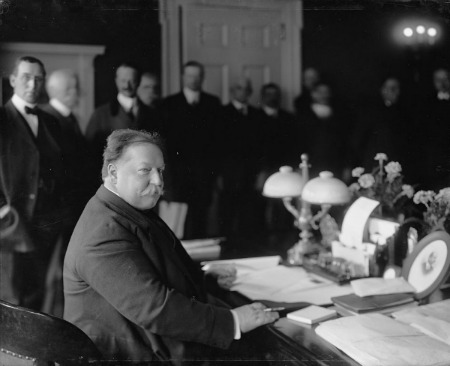
Pres. Taft signing law. Source: SenateTelephone Companies Consolidation Act of 1921
"The Telephone Companies Consolidation Act of 1921 permitted the merger of telephone companies following ICC approval. The statute was premised on the conviction that the telephone industry was a 'natural monopoly.'" [Jones A-78]
Communications Act of 1934
In 1934 the ICC's jurisdiction over communications carriers was transferred to the newly created Federal Communications Commission. - the recommendation to transfer jurisdiction from the ICC to the FCC was based in part on the ICC's preoccupation with regulating railroads, the need for a specialized agency to deal with communications, and the growing power and skill of AT&T to influence governments.
References
- Interstate Commerce Act Civics-Online.org
- PBS | American Experience | ICC
- Sharfman, Isaiah L. (1915).Railway Regulation: An Analysis of the Underlying Problems in Railway Economics from the Standpoint of Government Regulation. Chicago: La Salle Extension University
- Interstate Commerce Commission Annual Report 1910
Caselaw
- Leloup, 127 U.S. at 645 ("communication by telegraph is commerce ... and if carried on between different States, it is commerce among the several States, and directly within the power of regulation conferred upon Congress, and free from the control of state regulations, except such as are strictly of a police character.")
- Ratterman, 127 U.S. at 425 (citing Pensacola);
- Pendleton, 122 U.S. at 356 ("intercourse by the telegraph between the states is interstate commerce"). [Harris at 103 ("Pendleton's case is perhaps the leading authority on this subject, for there it was decided for the first time that the authority of Congress over the subject of commerce by telegraph with foreign countries or between the States, is supreme whenever that body chooses to exert its power; and it is also held that the States can impose no impediments to the freedom of that commerce.")]
- Telegraph Co. v. Texas, 105 U.S. at 464. ("[T]elegraph was an instrument of commerce, and that telegraph companies were subject to the regulating power of Congress in respect, their foreign and interstate business. A telegraph company occupies the same relation to commerce as a carrier of messages, that a railroad company does as a carrier of goods. Both companies are instruments of commerce, and their business is commerce itself. They do their transportation in different ways, and their liabilities are in some respects different, but they are both indispensable to those engaged to any considerable extent in commercial pursuits.")
- Pensacola Telegraph Co. v. Western Union, 96 U.S. at 8 (1877) ("[C]ommercial intercourse is an element of commerce which comes within the regulating power of Congress.")
- Gibbons v. Ogden, 22 U.S. 1, 21 (1824) ("Commerce, undoubtedly, is traffic, but it is something more: it is intercourse. It describes the commercial intercourse between nations, and parts of nations, in all its branches, and is regulated by prescribing rules for carrying on that intercourse.).
Papers
- Wm. Overton Harris, Applicability of the United States Commerce Act to Interstate Telegraph Companies Virginia Law Review, Vol. 2, No. 2 (Nov., 1914), pp. 98-122 [Harris at ]
- The Mann-Elkins Act, Amending the Act to Regulate Commerce, The Quarterly Journal of Economics (August 1910) ("Interstate telegraph, telephone, and cable companies, whether wire or wireless, are declared to be common carriers within the purpose of the Act, and are placed under the regulating authority of the Commission. These companies are allowed to classify their messages into day, night, press, government, and other forms of service, and to prescribe different rates for the different classes, and are authorized to enter into contracts with other common carriers for the exchange of services.")
- Dewitt Clinton Moore, The Law of Interstate Commerce and Federal Regulation Thereof: Including the Mann-Elkins Amendments of 1910 and the Sherman Anti-trust Act of 1890 (1910) ("It has been repeatedly held that intercourse by telegraph and telephone messages and communications between points in different States is interstate commerce. But prior to the Amendment of June 18, 1910, companies engaged in such business were not subject to the Act to Regulate Commerce.")
- G. Hamilton Loeb, The Communications Act Policy Toward Competition: A Failure to Communicate, 1978 Duke L.J. 1, 8 ("Neither the House Report nor the Senate Report that accompanied the respective versions of the bill to the floor to each chamber contained any reference at all to telephone or telegraph, and no proposal to consider telecommunications technology had been made during committee hearings. The first mention in the record of regulation of telecommunications services did not occur until mid-way through the House debate on the railroad bill, when an amendment was offered to include 'telegraph and telephone companies' within the definition of the common carriers to be regulated by the Instates Commerce Act. Its sponsor argued only that 'there is no reason why these great instrumentalities of commerce should not… be put within the provisions of the interstate commerce act' and that 'these necessary instrumentalities which the citizens have to use, which are monopolies in their particular lines of business [should] be required to make reasonable charges'")