|
Cybertelecom Federal Internet Law & Policy An Educational Project |
Erate

|
Erate |
|
|
- Erate - - CIPA - - Erate Guide - - Erate References - - Statistics - Broadband - Universal Service - - Proceedings - - VoIP - - Steven's Report - Digital Divide - Municipal Broadband - Funding - - State - - Private - - Americorp - - CIA - - D Commerce - - - NIST - - - NTIA - - - Stimulus - - DARPA - - D Education - - FCC - - - Erate - - - - CIPA - - - - Erate Guide - - - - Erate References - - - Telemedicine - - HHS - - HUD - - IM Library S - - D Labor - - NSF - - SBA - - USAID - - USDA - - - Rural Utility S |
 "Fairfax County students use PATHWAYS database and STAR SCHOOLS distance learning materials." circa 1994 OSTP Report 1994 (public domain) |
The Telecommunications Act of 1996 significantly expanded the Universal Service program to include support for Internet access to schools and libraries, and rural health care programs. In implementing the program, the FCC created a $2.25 billion fund. All K-12 schools are eligible for subsidies from the program and the subsidies can be used for a wide variety of purposes including Internet access service, installation and maintenance, and certain hardware. Different schools receive different levels of subsidies depending up whether they are urban or rural and depending upon what percentage of their students are eligible under the federal school lunch program - schools with the highest levels of eligibility take from the Fund first. The Fund is collected from telecommunications providers.
Schools and libraries that take advantage of ERate much comply with the Internet Filtering obligations of the Children's Internet Protection Act.
What is Covered by the School and Library Fund? A Guide to the Universal Service $2.25 Billion Fund For Schools and Libraries. 1998 Statistics indicating how close Nation is to achieving goal of wiring all schools by year 2000 ERate FCC Proceedings
The Telecommunications Act of 1996 sets forth the nation's goals for providing affordable telecommunications services to consumers nationwide, particularly to populations such as individuals living in rural, isolated, or high-cost areas, or those with low incomes; schools and libraries; and rural health care facilities. The act instructed FCC to establish a universal service support mechanism to ensure that eligible schools and libraries have affordable access to and use of certain telecommunications services for educational purposes.5 In addition, Congress authorized FCC to "establish competitively neutral rules to enhance, to the extent technically feasible and economically reasonable, access to advanced telecommunications and information services for all public and nonprofit elementary and secondary school classrooms . . . and libraries. . . ."6 Based on this direction, and following the recommendations of the Federal-State Joint Board on Universal Service,7 FCC established the Schools and Libraries Universal Service Support Mechanism, commonly referred to as the E-rate program. FCC designated USAC to carry out the day-to-day activities of the program,8 which is funded from statutorily mandated payments to the Universal Service Fund. FCC oversees USAC and the program through rule-making proceedings, enforcement actions, audits of participants, and reviews of funding decision appeals from participants. FCC also reviews USAC's procedures, including its process for reviewing applications for funding; meets frequently with USAC staff; and provides guidance letters to USAC. A memorandum of understanding between FCC and USAC, first executed in June 2007 and updated in September 2008, as well as FCC orders and rules, set forth the roles and responsibilities of the two parties in the management, oversight, and administration of the program.
The E-rate program provides schools, school districts, libraries, and consortia10 with discounts on telecommunications services, Internet access, and data transmission wiring and components used for educational purposes-that is, activities that are integral, immediate, or proximate to the education of students or to the provision of services to library patrons, such as activities that occur on library or school property.11 Based on indicators of need, eligible schools and libraries qualify for a discount of 20 percent to 90 percent on the cost of services and must show that they can pay for the undiscounted portion of services. Indicators of need include the percentage of students eligible for free or reduced-price lunches through the National School Lunch Program12 and whether the entity is located in a rural area.13 Table 1 shows the discount percentages entities are eligible for based on these indicators. Eligible entities may apply annually for program support.
Table 1: Discount Percentage That E-rate Applicants Are Eligible for Based on the Proportion of Students Eligible for the National School Lunch Program
Students eligible for National School Lunch Program
E-rate program discount for urban applicants
E-rate program discount for rural applicants
Less than 1 20 25 1-19 40 50 20-34 50 60 35-49 60 70 50-74 80 80 75-100 90 90 Source: 47 C.F.R. 54.505(c).
Based on the broad direction in the act, FCC defined two general types of services that are eligible for E-rate discounts:
Priority 1 services, which include telecommunications services, such as local, long-distance, and wireless (e.g., cellular) telephone services, as well as data links (e.g., T-1 lines) and Internet access services, such as Web hosting and e-mail services-all of which receive priority for funding under FCC's rules;14 and Priority 2 services, which include cabling, components, routers, switches, and network servers that are necessary to transport information to individual classrooms, public rooms in a library, or eligible administrative areas, as well as basic maintenance of internal connections, such as the repair and upkeep of eligible hardware and basic technical support. Lists of specific eligible services
, including the conditions under which they are eligible, are updated annually by USAC, finalized by FCC after a public comment period, and posted on USAC's Web site. Items ineligible for E-rate discounts include, among other things, end-user products and services such as Internet content, Web site content maintenance fees, enduser personal computers, and end-user software.
All eligible and properly completed requests for Priority 1 services are funded up to the available amount of funding.15 Priority 2 services, herein referred to as internal connections, are funded with what remains after commitments have been made for all approved requests for Priority 1 services in a given year. Requests for internal connections services are prioritized by the discount level of the applicant, with funding going first to applicants with the highest discount level-90 percent-and then to applicants at each descending discount level until the funding is exhausted; in 2007, for example, internal connections funding was provided to applicants with discount levels down to 81 percent.16 Because of this prioritization, available funding may be exhausted before all eligible and properly completed requests for internal connections are funded. According to FCC, the rules of priority equitably provide the greatest assurance of support to schools and libraries with the greatest level of economic disadvantage. The rules ensure that all applicants filing during a time period specified by USAC receive at least some support in the event that the amounts requested for support exceed the total support available in a funding year.
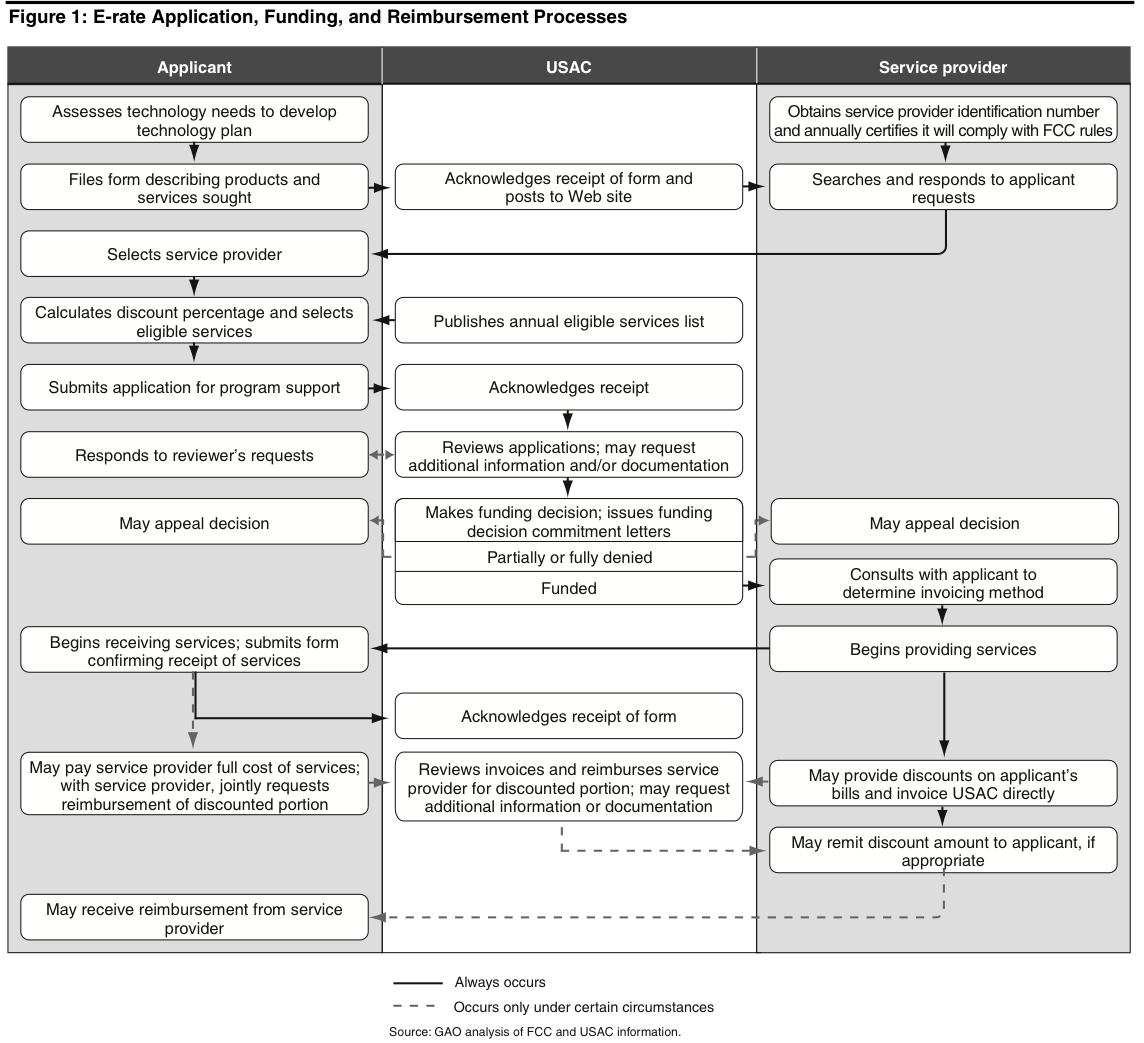
The steps applicants must carry out to obtain program support—including the application, review, invoicing, and reimbursement processes—are illustrated in figure 1. This figure is followed by a more detailed description of each of these steps.
Prior to submitting an application for E-rate support, an applicant must complete several steps, including the following:
Prepare a technology plan. The applicant conducts a technology assessment and develops a technology plan to ensure that any services it obtains will be used effectively and that it can provide for the nondiscounted portion of services as well as for the goods or services that are ineligible for E-rate funding. Open competitive bidding. The applicant identifies products and services needed to implement its technology plan and submits a form to USAC describing the desired products and services. USAC posts completed forms on its Web site so that service providers can view and consider bidding on these requests.19 To participate in the E-rate program, service providers must obtain identification numbers from USAC and certify compliance with program rules in each year that they provide services under the program. Select a service provider and enter into a service agreement. At least 28 days after the applicant’s description of requested services is posted to USAC’s Web site,21 an applicant may enter into an agreement with a provider of eligible services. After completing these steps, the applicant submits its application for program support to USAC. USAC accepts applications during a filing window, the exact dates for which change somewhat each year but are generally from November to Feburary.23 The information the applicant provides on this form, includes, but is not limited to, the following:
the discount percentage to which the applicant is entitled, calculated using a worksheet provided on the application; detailed information about each requested service or product and its cost—some services have both eligible and ineligible components, in which case the applicant must calculate the portion of the service eligible for an E-rate discount, a process referred to as cost allocation; and certifications that, among other things, the applicant has adequately budgeted for the undiscounted portion of services, as well as related ineligible services—such as computers, training, software, and electrical capacity—needed to make effective use of the services ordered. USAC reviews requests for funding to determine whether applicants have properly complied with program rules and requirements; this process is known as the program integrity assurance (PIA) review. Reviewers may ask applicants to submit additional information, such as verification of a contract award date or enrollment and income data for newly constructed schools. Some applications undergo “selective” reviews, which require more detailed documentation that the applicant has complied with the rules. Applicants are chosen for selective review based on defined criteria to test compliance with specific FCC rules. Additionally, applicants that fail selective review in a given year must go through selective review the following year.
Based on the outcome of the application review, USAC issues funding commitment decision letters stating how much funding the applicant may receive based on eligible services provided within the funding year deadlines. Funding commitments are conditional upon applicants meeting additional requirements as described later. Funding commitments may be for the full amount requested or less than the amount requested, or funding may be denied entirely for reasons such as competitive bidding violations or requests for ineligible services. Funding requests for Priority 2 services may also be denied if the applicant’s discount percentage falls below the annual discount percentage threshold for internal connections.
After eligible services have been delivered, service providers or applicants submit invoices to USAC to request reimbursement for the discounted portion of services. Before seeking reimbursement for the discounted portion of services from USAC, applicants must confirm
(1) that the services are planned to be or are being provided;
(2) approval of their technology plans by a state or other authorized body, if required; and
(3) compliance with the Children’s Internet Protection Act (CIPA) and the Neighborhood Children’s Internet Protection Act, if required.26Under these acts, if required, schools and libraries receiving support for Internet access, internal connections, or basic maintenance must certify that they have in place certain Internet safety policies and technology protection measures. Funding requests for telecommunications services do not require certification of CIPA compliance. Service providers may apply the discount rate to the applicant’s bill before sending it to the applicant, in which case the applicant pays only the nondiscounted portion and the service provider invoices USAC directly to obtain reimbursement. Alternatively, applicants may pay for services in full and submit a form to USAC to request reimbursement. Regardless of which invoicing method is used, USAC reviews the invoices and disburses payments for universal service support to service providers; under the latter method, service providers remit the discounted amount to the applicant. To ensure compliance with FCC rules, both USAC and FCC’s Office of Inspector General periodically select a sample of participants to audit and conduct site visits of beneficiaries.